

AI-generated illustration created to represent the article’s subject. It does not depict an actual EPW course, trainer, participant, client, event or venue.
Artificial intelligence (AI) and machine learning (ML) can help organisations make better decisions, increase operational capacity, improve forecasts, manage risk and develop new services. Those benefits are not automatic. They become measurable when a clearly defined problem is matched with relevant data, an accountable process owner, appropriate human oversight and a baseline against which results can be compared.
The business case is becoming harder to ignore. The Stanford AI Index 2025 reports that 78% of organisations surveyed used AI in 2024, up from 55% a year earlier. Adoption, however, is not the same as value. The more useful question is not simply whether an organisation uses AI, but where it improves an outcome that matters.
Key takeaways
- AI is the broader field; ML is one way of building systems that learn patterns from data.
- The strongest benefits begin with a specific operational or decision problem, not with a tool looking for a use.
- Every proposed benefit needs a mechanism, an owner, a baseline measure and a review process.
- Good governance supports value by reducing unreliable, unsafe or unfair results before they become costly.
- Workforce capability matters because people must frame problems, interpret outputs and redesign processes around the technology.
What AI and machine learning can do for an organisation
AI refers to systems designed to perform tasks associated with human intelligence, such as interpreting language, recognising images, recommending actions or generating content. ML is a branch of AI in which models learn patterns from examples and use those patterns to classify, predict or detect new cases.
The distinction affects use-case selection. A rules-based assistant may guide an employee through a procedure, while an ML model may estimate demand from historical sales and seasonal data. Generative AI may draft a service response; a predictive model may estimate its likelihood of escalation.
| Capability | Typical organisational question | Example output |
|---|---|---|
| Classification | Which category does this item belong to? | Prioritised service requests |
| Prediction | What is likely to happen next? | Demand or maintenance forecast |
| Anomaly detection | Which cases differ from the expected pattern? | Potential fraud or quality alert |
| Recommendation | Which action or option is most relevant? | Next-best action for an adviser |
| Generation | Can a useful first draft be produced from context? | Summary, response or structured content |
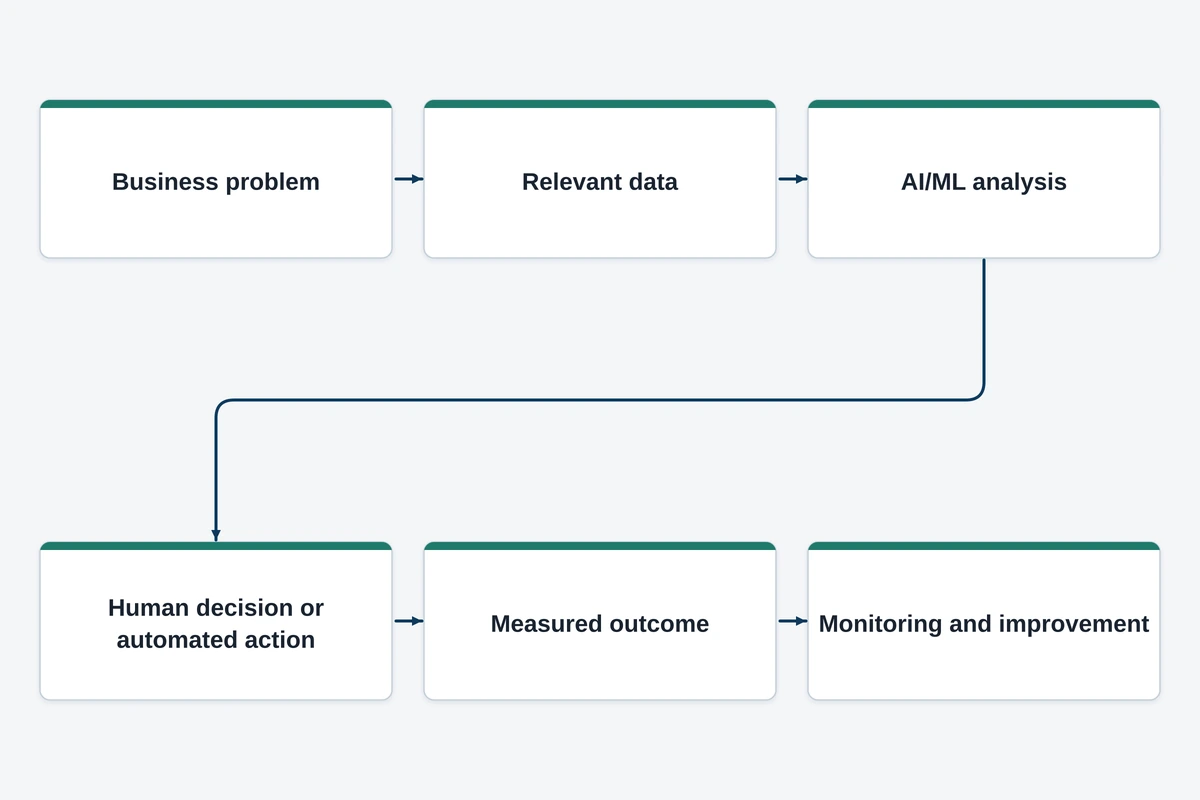
These capabilities can support many functions, but the same model will not produce the same result in every organisation. Data quality, process design, user behaviour, risk tolerance and the definition of success all influence the outcome.
Seven organisational benefits and how they work
1. Greater operational capacity
AI can reduce the time spent on repetitive cognitive work such as routing requests, extracting fields, finding relevant knowledge or producing a first draft. The mechanism is task support or partial automation: the system handles a defined part of the workflow while a person reviews exceptions or higher-risk decisions.
Capacity should be measured through the process, not assumed from time saved in a demonstration. Useful measures include cycle time, cases completed per hour, backlog, rework and the proportion of exceptions requiring human intervention.
A peer-reviewed field study of 5,172 customer-support agents in the Quarterly Journal of Economics found that a generative AI assistant increased issues resolved per hour by 15% on average. Gains were larger for less experienced and lower-skilled workers; the most skilled saw little benefit and a small decline in solution quality. This is one setting, not a universal productivity rate, so organisations should measure results by role and task.
2. Faster and more consistent decisions
Models can organise large volumes of information and apply the same analytical logic across similar cases. This can help decision-makers identify relevant signals, compare options and prioritise attention more consistently than manual triage alone.
This does not require removing people from the decision. The system can provide a score, explanation or recommendation while a qualified person remains accountable. Track decision time, consistency, overrides, errors and downstream outcomes—not merely model accuracy.
3. Better forecasting and resource planning
ML models can combine historical demand with variables such as seasonality, promotions, location or equipment behaviour. This may improve staffing, inventory, cash-flow planning or preventive maintenance when the future resembles learnable patterns in the available data.
Compare forecast value with the current method through measures such as error, stockouts, excess inventory, unplanned downtime or schedule adherence. Continue monitoring because changing markets, policies or customer behaviour can make old patterns less reliable.
4. More responsive customer and employee services
AI can help people find answers, summarise case history, translate content, draft communications or receive relevant recommendations. The mechanism is quicker access to context and a more appropriate next action, not personalisation for its own sake.
Service metrics should balance speed and quality. Pair resolution and self-service measures with satisfaction, complaints, escalations and sampled accuracy reviews. Sensitive decisions need stronger controls than low-risk information retrieval.
5. Earlier detection of risk, error and quality problems
Anomaly-detection and classification models can flag transactions, equipment readings, documents or production outputs that merit review. This concentrates scarce expert attention on unusual or higher-risk cases.
Value depends on the cost of missed cases and false alarms. A model can waste time if it creates too many weak alerts. Measures include precision, recall, loss avoided, review workload and time to intervention.
6. Stronger organisational learning
AI tools can make approved knowledge easier to retrieve and can provide prompts, examples or feedback inside a workflow. Used carefully, this can help newer employees become productive more quickly and reduce dependence on informal access to a small number of experts.
The organisation still needs authoritative sources, update ownership and a way to report inaccurate guidance. Measure time to competence, task completion, knowledge reuse and correction rates. The goal is supported learning, not faster unverified answers.
7. New products, services and operating models
AI can enable services that were previously too slow or expensive, including continuous monitoring, adaptive recommendations or rapid analysis of unstructured information. It can also change how an existing service is delivered by combining human judgement with scalable machine assistance.
Innovation claims need commercial and operational tests. Early indicators include adoption, completion or time to value; later measures may include retention, revenue, cost to serve or mission outcomes. A prototype proves possibility, not demand or sustainability.
EPW’s benefit-to-action matrix
Use this matrix to turn a general benefit into a testable first initiative. The final column is deliberately outcome-focused: deployment, prompts sent or model accuracy alone do not demonstrate organisational value.
| Potential benefit | Value mechanism | Suitable first use case | Measure before and after |
|---|---|---|---|
| Operational capacity | Reduce repetitive handling and search | Route and summarise low-risk service requests | Cycle time, backlog, rework |
| Decision quality | Surface relevant patterns consistently | Prioritise cases for expert review | Decision time, errors, override rate |
| Forecasting | Learn relationships in historical data | Forecast demand for one product or service | Forecast error, stockouts or staffing variance |
| Service responsiveness | Retrieve context and suggest a next action | Provide advisers with approved knowledge | Resolution time, satisfaction, escalations |
| Risk and quality control | Flag unusual or high-risk cases | Detect anomalies in a defined transaction set | True issues found, false alarms, loss avoided |
| Workforce learning | Deliver guidance within the task | Support a standard procedure for new staff | Time to competence, corrections, completion |
| Innovation | Make a previously impractical service viable | Test one user problem with a limited pilot | Adoption, completion, retention or mission impact |
The matrix also reveals weak proposals. If a team cannot name the affected process, the mechanism or a baseline measure, it is too early to promise a benefit.
Conditions that turn potential into value
A problem worth solving
Begin with a costly delay, recurring error, unmet user need or decision that could be improved. A narrow, frequent and measurable task is generally a stronger first candidate than a broad ambition to “use AI across the organisation”.
Relevant and usable data
ML requires data that represents the task and outcome. The team must understand where the data came from, who may use it, which groups or situations may be under-represented, and how it will be maintained. Generative AI also depends on reliable context, approved knowledge and controls over sensitive information.
Governance proportional to risk
Governance is part of benefit realisation because unreliable or harmful outputs create rework, complaints, legal exposure and loss of trust. The NIST AI Risk Management Framework organises work around governing, mapping, measuring and managing AI risk. The OECD AI Principles emphasise inclusive growth, human rights and fairness, transparency, robustness and accountability.
Controls should reflect impact. A tool that suggests internal search terms does not need the same review as a system that influences employment, credit, safety or access to an essential service.
Process ownership and workforce capability
An AI output creates value only when it leads to an effective action. The process owner must decide who reviews the output, what happens when confidence is low, how errors are corrected and when the system should be paused.
The Skills England AI skills tools package combines technical, responsible and non-technical skills with an employer readiness checklist and a nine-stage adoption pathway. That breadth is important: organisations need people who can connect technology with a business problem, explain limitations and operate it responsibly.
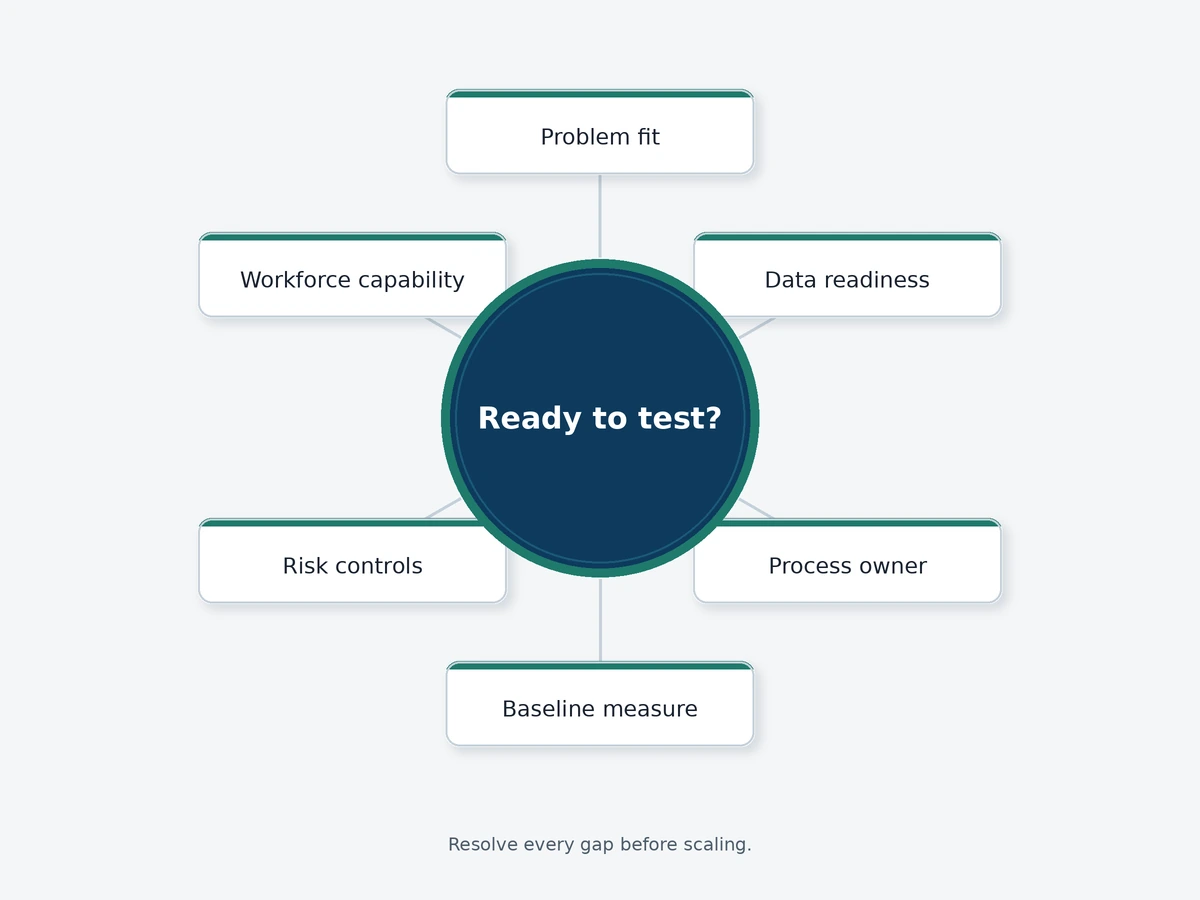
EPW’s six-question organisational readiness test
Before approving a pilot, require a clear answer to all six questions:
- Problem fit: What recurring decision, task or service outcome will improve?
- Data readiness: Is the required data or knowledge relevant, lawful, representative and maintainable?
- Process owner: Who is accountable for the workflow and the result?
- Baseline measure: What is current performance, and which balanced measures will show improvement or harm?
- Risk controls: What could go wrong, who reviews exceptions, and when will use stop?
- Workforce capability: Do users understand the task, the tool’s limits and their responsibility for the outcome?
If any answer is missing, resolve it before scaling. A technically impressive pilot with no owner or baseline is still an organisationally unready pilot.
For teams building this shared foundation, EPW’s Foundations of Artificial Intelligence and Machine Learning course covers core AI and ML concepts, data preparation, model selection and evaluation, neural networks, natural language processing, computer vision, practical frameworks and ethics.
When AI does not create value
AI is unlikely to help when the underlying process is unnecessary, the data cannot represent the outcome, errors cannot be detected, or nobody owns the operational change. Automating a poor process can make its weaknesses faster and more difficult to see.
Value can also disappear when teams measure activity instead of outcomes. The number of users, generated summaries or automated steps may describe adoption, but it does not prove improved quality, capacity or service. Measure the benefit and its trade-offs together—for example, speed with accuracy, detection with false alarms, or personalisation with complaints and opt-outs.
Finally, not every problem requires AI. A clearer policy, a standard workflow, better search, a simple rule or conventional analytics may be cheaper, more transparent and easier to maintain. Choosing the simplest effective approach is a sign of sound AI judgement.
Practical steps to realise the benefits
- Choose one outcome. Define the decision, task or service result in operational language.
- Record the baseline. Measure current time, cost, quality, risk or user experience before introducing the system.
- Map data and risk. Identify data sources, affected people, failure modes, permissions and required human review.
- Run a limited comparison. Test the AI-supported workflow against the current method with representative users and cases.
- Review balanced measures. Look for improvement in the target outcome without unacceptable deterioration elsewhere.
- Decide whether to stop, revise or scale. Document what was learned, assign ongoing ownership and monitor changing data and behaviour.
This keeps the business case evidence-led and gives leaders a defensible reason to stop a weak use case before sunk costs turn an experiment into an obligation.
Build the capability behind the technology
The most durable organisational benefit is not access to a particular model. It is the ability to identify suitable problems, evaluate data, interpret results, manage risk and redesign work around reliable evidence. Those capabilities allow an organisation to assess new tools without treating every development as either a miracle or a threat.
Explore EPW’s Artificial Intelligence and Machine Learning Courses and the Artificial Intelligence and Machine Learning Articles hub for further learning. For a structured starting point, review the Foundations of Artificial Intelligence and Machine Learning course and discuss how its learning outcomes relate to a real organisational use case.
Sources and references
- Stanford Institute for Human-Centered Artificial Intelligence, AI Index Report 2025.
- Erik Brynjolfsson, Danielle Li and Lindsey R. Raymond, “Generative AI at Work”, Quarterly Journal of Economics, 2025.
- National Institute of Standards and Technology, Artificial Intelligence Risk Management Framework (AI RMF 1.0), 2023.
- OECD.AI, OECD AI Principles, updated 2024.
- Skills England, AI skills for the UK workforce: AI skills tools package, 2025.



6 thoughts on “Benefits of AI and Machine Learning for Organisations”
Comments are closed.