
AI-generated illustration created to represent the article’s subject. It does not depict an actual EPW course, trainer, participant, client, event or venue.
Transmission lines form the heart of contemporary power systems by connecting power generating stations with substations to transport electricity to a variety of usages in homes and industries. That emphasizes the importance of Transmission lines design with respect to safety and power delivery efficiency, a small segment of the electrical engineering industry. Engineers and technicians need transmission line design training to develop in an area of power systems.
What is Transmission Line Design?
Transmission line design means the planning and designing of the arrangement, structure & components of high voltage overhead power lines to deliver electricity over long routes. This includes conductor (sag, tension, line loss), tower structures and insulators. It involves fine-tuning for optimum performance, but also in compliance with safety regulations, codal requirements and environmental needs.
A properly configured transmission line guarantees a minimum loss of energy, low cost of maintenance, and no interruptions in the supply. Several aspects like terrain, weather condition, load demand to name a few should be looked into deeply by the engineers to have an excellent transmission system in place.
Importance of Transmission Line Design Training
Engineers who want to work with complex power systems need thorough training in transmission line design, which provides both technical expertise and practical techniques for making informed design guidelines.
They are trained on different types of conductors, line parameters, towers details and electrical calculations to calculate the voltage drop which helps engineers design work properly. At the same time, there is an emphasis on safety because high-voltage systems can be dangerous at more than a few hundred volts; training ensures that standards defined by national and international authorities are followed to minimize hazards for both the workforce and general public.
With engineers also learning how to optimize material use and minimize losses on the line which saves costs, practical experiments around fault finding, simulations and troubleshooting develop these skills further in practice.
Key Components of Transmission Line Design
Understanding the primary components of a transmission line is fundamental for any training program. Here are the key elements:
Conductors
Conductors are the medium through which electricity flows. Selection depends on factors such as current capacity, voltage level, mechanical strength, and environmental conditions. Common conductor types include Aluminum Conductor Steel Reinforced (ACSR), All Aluminum Alloy Conductor (AAAC), and Copper Conductor.
Towers and Poles
Transmission towers support the conductors and insulators. Design considerations include height, material, shape, and load-bearing capacity. Common tower types are lattice towers, tubular steel poles, and monopoles. Training programs often include software-based tower design simulations.
Insulators
Insulators prevent current leakage from the conductor to the tower. They must withstand electrical, mechanical, and environmental stress. Training covers materials like porcelain, glass, and polymer, as well as selecting the appropriate type for different voltage levels.
Foundations and Grounding
Tower foundations provide stability against mechanical and environmental forces. Engineers learn to calculate foundation dimensions based on soil type, tower load, and environmental conditions. Grounding ensures safety by dissipating fault currents into the earth.
Transmission Line Parameters
Design training includes the calculation of electrical parameters such as resistance, inductance, capacitance, and reactance. Understanding these parameters helps reduce line losses, improve efficiency, and ensure system stability.
Steps in Transmission Line Design
A structured approach is essential for effective transmission line design. Training programs typically cover the following steps:
- Survey and Route Selection: Engineers perform field surveys to identify the most efficient and feasible route, considering topography, land use, and environmental impact.
- Load and Voltage Assessment: Determining the voltage level and load requirements helps in selecting conductors, towers, and insulators.
- Conductor Selection: Based on current-carrying capacity, sag, tension, and mechanical strength.
- Tower Design and Spacing: Calculating tower height, span, and type according to terrain, line voltage, and safety regulations.
- Insulator Design: Choosing insulators based on voltage, mechanical load, and environmental conditions.
- Electrical Calculations: Determining line impedance, line losses, voltage drop, and efficiency
- Safety and Compliance Checks: Ensuring the design meets standards set by organizations like IEEE, IEC, and local electrical codes.
Software Tools Used in Transmission Line Design
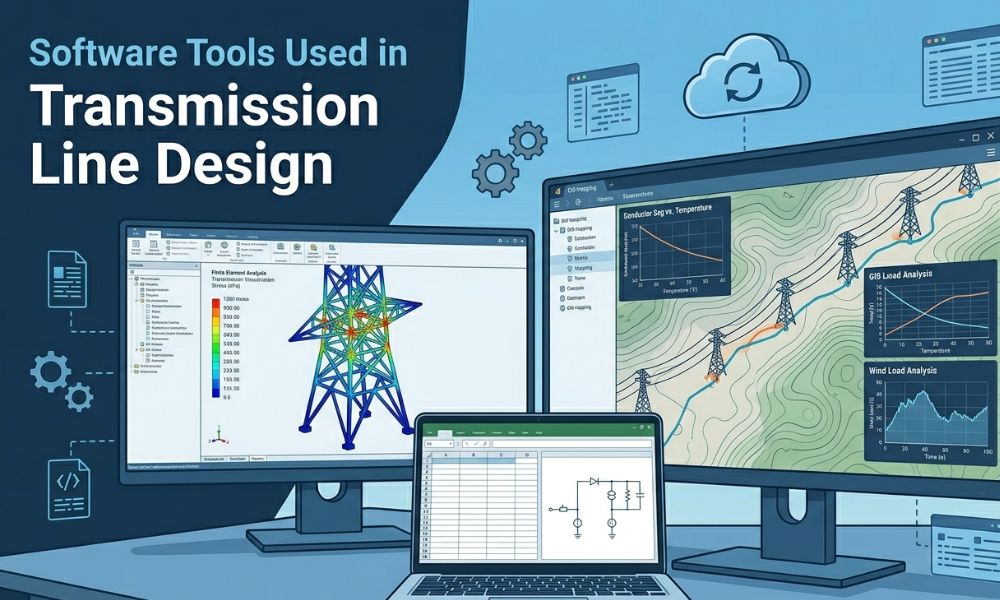
Modern transmission line design relies heavily on software for precision and efficiency. Some commonly used tools include:
- PSS®E (Power System Simulator for Engineering): For load flow and stability analysis.
- ETAP (Electrical Transient Analyzer Program): Used for fault analysis, load calculations, and system modeling.
- CYMCAP: For corona loss analysis and insulator selection.
- AutoCAD and Civil 3D: For creating detailed structural drawings and tower layouts.
Training programs provide hands-on experience with these tools, enabling engineers to create optimized designs quickly and accurately.
Benefits of Enrolling in Transmission Line Design Training
Investing in training brings multiple advantages for aspiring engineers:
- Enhanced Career Opportunities: Skilled professionals are in demand in power utilities, renewable energy companies, and infrastructure projects.
- Practical Knowledge: Training emphasizes real-world applications, preparing engineers for site visits, surveys, and operational challenges.
- Industry Recognition: Certification from recognized training providers adds credibility to your profile.
- Networking Opportunities: Training programs often connect participants with industry experts, fostering professional relationships.
Who Should Attend Transmission Line Design Training?
Transmission line design training is ideal for:
- Electrical engineers seeking specialization in power systems.
- Junior engineers looking to advance their careers in transmission and distribution.
- Technicians involved in installation, maintenance, and testing of transmission lines.
- Project managers in energy sector companies.
Whether you are a fresh graduate or a professional seeking to upgrade your skills, structured training provides the foundation to succeed in this specialized field.
Types of Training Programs
Training programs vary in format, duration, and level of expertise:
- Classroom-Based Training: Focuses on theory, calculations, and standards.
- Online Courses: Offers flexibility for working professionals, often including interactive simulations.
- Hands-On Workshops: Practical sessions involving field visits, conductor handling, tower assembly, and sag measurement.
- Certification Programs: Industry-recognized certifications validate your skills and enhance employability.
Key Skills Learned in Transmission Line Design Training
Participants gain expertise in:
- Electrical and mechanical design principles
- Load flow analysis and fault calculations
- Conductor selection and sag-tension calculations
- Tower structure design and foundation calculations
- Safety standards and regulatory compliance
- Use of industry-standard software for design and analysis
These skills ensure that engineers can confidently handle design projects from concept to commissioning.
Challenges in Transmission Line Design
Transmission line design involves several challenges that training helps to overcome:
- Terrain Complexity: Hilly, forested, or urban areas require specialized design approaches.
- Weather Conditions: Engineers must account for wind, ice, and temperature variations.
- Material Selection: Balancing cost, durability, and electrical performance.
- Safety Compliance: Meeting stringent national and international standards.
- Environmental Impact: Minimizing land disturbance and adhering to ecological regulations.
Training programs equip engineers to tackle these challenges with analytical and practical solutions.
Conclusion
Transmission line design is a vital discipline within electrical engineering, playing a key role in the reliable and efficient delivery of electricity. Transmission line design training empowers engineers with the knowledge, skills, and tools to plan, design, and implement high-voltage lines that meet modern energy demands. From conductor selection to tower design, software simulations, and compliance with safety standards, training provides a comprehensive learning experience.
Whether you are a recent graduate, a practicing engineer, or a professional seeking advancement, investing in transmission line design training can open doors to rewarding careers in power utilities, renewable energy projects, and infrastructure development. By acquiring these skills, you contribute to building a resilient, efficient, and sustainable electrical grid for the future.