

AI-generated illustration created to represent the article’s subject. It does not depict an actual EPW course, trainer, participant, client, event or venue.
With the emergence of business environment becoming highly competitiveBusiness organizations need to enhance constantly over their Process, Products and Services. Total Quality Management (TQM) is one of the most efficient methods in maintaining high-class quality across various business dimensions. Total Quality Management training course provides professionals with the tools, knowledge and strategies required for implementing TQM practices in their organizations. Organizations can benefit from implementing the concepts they learn in such a course to achieve overall excellence.
Total Quality Management (TQM): What is it?
Total Quality Management (TQM) is an overall organization approach to improve the quality of an organizations output either a product or service. It stresses the need for all employees to be part of the quality improvement process, and continuous improvement in processes to satisfy customers. You are data driven so when it comes to decision making you have constant support because of the collaboration at all levels which forms a part of TQM. TQM goes beyond using a few techniques; it is an attitude, a motivation to improve quality in everything we do.
Why TQM is Essential for Modern Businesses
The need for TQM in today’s business landscape cannot be overstated. As competition intensifies and consumer expectations rise, businesses must consistently deliver high-quality products and services to remain relevant. By implementing TQM, organizations can achieve:
- Enhanced customer satisfaction: Meeting or exceeding customer expectations is at the heart of TQM.
- Increased efficiency: Streamlining processes and eliminating waste leads to greater productivity.
- Lower costs: Reducing errors and inefficiencies minimizes operational costs.
- Improved employee morale: Engaging employees in the quality process fosters a sense of ownership and pride.
By incorporating TQM principles, companies create a robust framework that drives excellence across all operations, ensuring long-term success and growth.
The Core Principles of TQM
TQM is grounded in several fundamental principles that guide organizations towards achieving sustainable quality improvements. These principles include:
Customer Focus
Every decision should prioritize the satisfaction of the customer, ensuring that the business consistently meets their needs and expectations.
Employee Involvement
Quality is everyone’s responsibility. All employees, from management to the front line, should be involved in the process of quality improvement.
Process Approach
Focusing on optimizing processes ensures that the business operates efficiently, minimizing errors and waste while maximizing quality output.
Data-Driven Decision Making
Decisions should be based on accurate data and performance metrics, ensuring that quality improvements are both measurable and effective.
Continuous Improvement
TQM is an ongoing process. Organizations should continually seek ways to improve their operations, striving for incremental enhancements rather than one-time fixes.
Fact-Based Decision Making
All decisions should rely on facts and data, ensuring that actions taken are well-informed and effective in achieving the desired quality outcomes.
Overview of a Total Quality Management Training Course
A Total Quality Management training course equips professionals with the knowledge and tools needed to apply TQM principles effectively within their organization. These courses typically cover a wide range of topics, including:
- Quality management systems and frameworks
- Problem-solving and root cause analysis techniques
- Lean and Six Sigma methodologies
- Customer satisfaction measurement and improvement
- Process control and performance management
Participants are introduced to both theoretical concepts and practical strategies, often through case studies and hands-on exercises. Many courses also offer certification, which can be a valuable credential for career advancement.
Who Should Take a Total Quality Management Training Course?
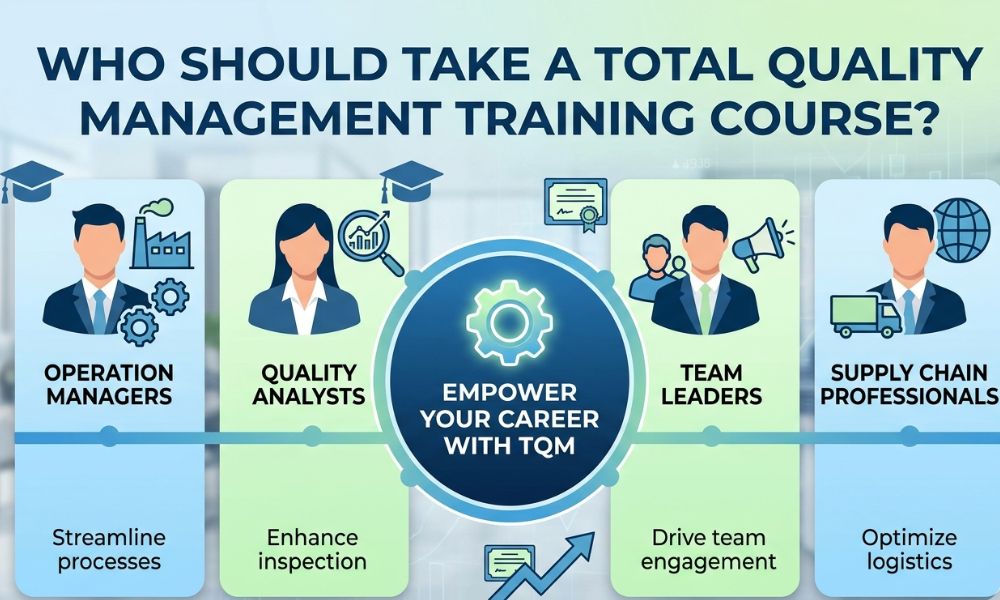
A Total Quality Management training course is beneficial for a variety of professionals, including:
- Managers: To lead quality initiatives and foster a culture of continuous improvement.
- Operations and quality managers: To refine processes and improve overall organizational performance.
- Employees: Who wish to enhance their problem-solving skills and contribute to process improvements.
- Business owners: Looking to improve customer satisfaction and streamline operations.
This course is perfect for anyone eager to learn how to enhance business performance and ensure sustained excellence across all organizational functions.
Key Components of a Total Quality Management Training Course
A comprehensive Total Quality Management training course provides in-depth instruction on various TQM tools and methodologies. Key components of such a course include:
Quality Management Frameworks
Participants learn about ISO standards, quality management systems (QMS), and how to implement these frameworks to create structured approaches to quality improvement.
Lean and Six Sigma
These powerful methodologies focus on reducing waste and improving processes through statistical analysis and problem-solving techniques.
Root Cause Analysis
Understanding how to identify and address the underlying causes of problems, rather than just addressing symptoms, is essential for sustainable quality improvement.
Customer Satisfaction Measurement
Courses teach how to measure and improve customer satisfaction through feedback, surveys, and direct engagement.
Statistical Process Control (SPC)
Participants gain practical knowledge in using statistical tools to monitor and control process variability, ensuring consistent quality output.
Benefits of Taking a Total Quality Management Training Course
Enrolling in a Total Quality Management training course provides numerous benefits to both individuals and organizations. Key advantages include:
- Improved skills: Participants develop a deeper understanding of quality management techniques, tools, and best practices.
- Career advancement: Gaining TQM certification enhances employability and demonstrates expertise to employers.
- Operational efficiency: Learning to streamline processes leads to cost savings and improved productivity.
- Enhanced team collaboration: TQM fosters a culture of teamwork and involvement, improving employee engagement and morale.
Moreover, businesses that invest in TQM training can expect to see significant improvements in both product and service quality, ultimately boosting customer loyalty and profitability.
Conclusion
A Total Quality Management training course is a powerful resource for professionals and businesses committed to improving quality standards. Through TQM training, individuals gain the skills and knowledge necessary to implement effective quality management practices, leading to greater customer satisfaction, reduced costs, and improved business performance. As the business landscape continues to evolve, adopting a TQM approach will help organizations maintain a competitive edge and drive long-term success. Investing in TQM training is an investment in the future of both individuals and businesses.