

Supervised learning algorithms are a fundamental of predictive problems in the field of data science. These algorithms allow computers to learn from historical data, and are useful for a variety of tasks, like predicting the future or classifying data. Supervised learning = businesses and industries making better, data-based decisions from labeled data -and becoming more efficient and innovative.
Here, in this article, one is introduced to the basics of supervised learning. Its algorithms and applications as well as challenges. Whether you are totally new to data science or just want to learn more about supervised learning, you’re going to receive everything that you need in order to gain an understanding of this topic.
What is Supervised Learning?
Supervised learning: A form of machine learning in which a model learns from labeled data. The data is labeled meaning for each input example in the training set. You know what its corresponding output should be. This permits the model to learn the correlation between inputs and outputs, which it can use to make predictions on out-of-sample data. The most general statement about the objective of supervised learning is that we want to predict or classify new data we have not seen based on patterns learned from past observations.
How Supervised Learning Works
At training time, the model sees input features (the variables) with appropriate outputs (labels). This information is then used to learn a function from inputs to outputs. As the model observes more examples, it tunes its parameters to lower these errors and increase its accuracy. After training, you can use the model to make predictions on new data.
Types of Supervised Learning Algorithms
Supervised learning is typically divided into two categories: regression and classification. Both types serve different purposes and are suited to specific tasks.
Regression Algorithms
Regression algorithms predict continuous outcomes. These are used when the output variable is numeric. For instance, predicting house prices, stock market trends, or the amount of rainfall are all examples of regression problems.
- Linear Regression: One of the simplest and most widely used algorithms for predicting continuous outcomes. It assumes a linear relationship between input variables and the output.
- Polynomial Regression: An extension of linear regression that can model non-linear relationships by fitting data to a polynomial curve.
Classification Algorithms
Classification algorithms are use to predict categorical outcomes. In other words, these algorithms assign data to specific classes or categories. Common classification problems include identifying whether an email is spam, or whether a customer will purchase a product.
- Decision Trees: A flowchart-like tree structure used for both classification and regression. It divides data into subsets based on feature values, making it easy to interpret.
- Support Vector Machines (SVM): A powerful classification algorithm that finds the hyperplane which best separates different classes in the data.
- Logistic Regression: Despite the name, logistic regression is a classification algorithm. It predicts the probability of a categorical dependent variable based on input features.
Key Applications of Supervised Learning Algorithms
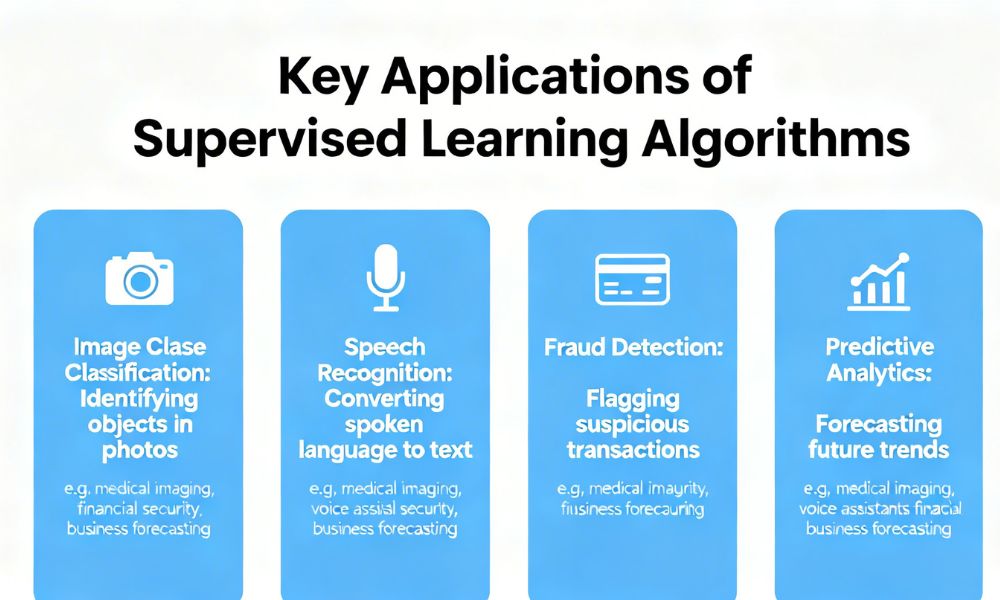
Supervised learning has far-reaching applications across various industries. By leveraging labeled data, these algorithms provide the foundation for critical decisions and innovations.
Healthcare
In healthcare, supervised learning helps predict disease outcomes, personalize treatment plans, and identify high-risk patients. Algorithms can analyze patient records to forecast the likelihood of a medical condition, enabling early interventions and improved care.
Finance
Supervised learning is widely use in finance for risk assessment, fraud detection, and stock market prediction. By training models on historical data, financial institutions can make more accurate decisions and improve security measures.
Retail
Retailers use supervised learning to understand consumer behavior, predict purchasing patterns, and optimize inventory management. By analyzing past customer data, businesses can personalize offers and improve customer engagement.
Autonomous Vehicles
Supervised learning is crucial for self-driving cars, where algorithms learn to identify objects, such as pedestrians and other vehicles, in real-time. This technology is improving the safety and efficiency of autonomous driving systems.
Challenges in Supervised Learning
While supervised learning offers significant advantages, it also comes with challenges that data scientists must address for optimal results.
Data Quality and Availability
Supervised learning models require large amounts of high-quality labeled data to train effectively. However, obtaining labeled data can be expensive, time-consuming, and difficult, particularly for complex tasks such as image recognition or medical diagnosis.
Overfitting
Overfitting occurs when a model becomes too complex and learns to memorize the training data, rather than generalizing from it. This can lead to poor performance when the model is tested on new data. To avoid overfitting, techniques like cross-validation and regularization are use to improve model generalization.
Bias in Data
If the training data is biased or unrepresentative of the real world, the model will likely produce biased predictions. Ensuring diverse and representative data is key to training fair and accurate models.
Conclusion
Supervised learning algorithms are essential in the field of data science, providing the framework for making predictions and classifications based on historical data. With their ability to transform industries such as healthcare, finance, and retail, supervised learning is shaping the future of data-driven decision-making.
Despite its challenges, such as data quality and overfitting, the power of supervised learning can be fully realized with the right data, tools, and techniques. As technology continues to evolve, these algorithms will remain a crucial component in building intelligent systems that drive innovation across various sectors. Understanding and mastering supervised learning is key to unlocking the full potential of data science.