
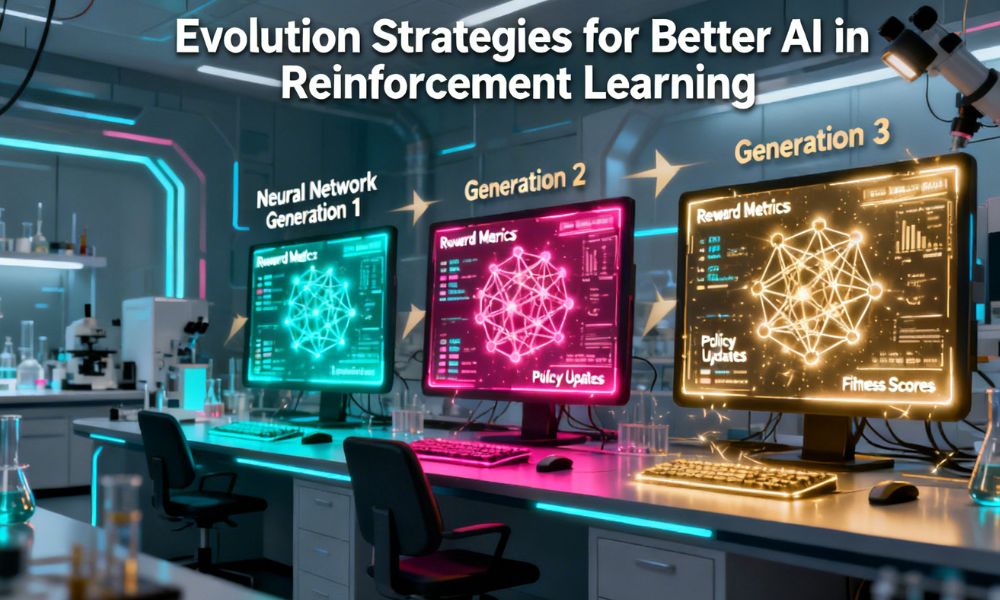
Artificial intelligence (AI) like other fields of study advances through time and new methods are developed to solve problems that were impossible to tackle before. A viable approach that is being recognized nowadays is Evolution Strategies (ES), a competitive optimization strategy based on natural selection. When combined with Reinforcement Learning (RL), Evolution Strategies provide a novel approach for training AI agents to obtain superior performance in complex and changing worlds. In this article we will be looking at the fundamentals of Evolution Strategies and how they fit with Reinforcement Learning, and why it’s quickly become a major advancement in AI.
What are Evolution Strategies?
Evolution Strategies are an optimization technique inspired by evolution in nature, involving selection, mutation and recombination to move from one generation of individuals to the next. In machine learning, the genetic algorithm creates a pool of potential solutions (individuals), evaluates their performance, and evolves them over successive generations. As nature selects the fittest organisms, ES does that to the most successful solutions with some introduction of mutation and variation.
The advantage of Evolution Strategies is that they can solve complex optimization problems without using gradients. This fact makes them specially valuable for non-differentiable problems or noisy data.
A Beginner’s Guide to Deep Reinforcement Learning
Trial and Error Learning. This is what Reinforcement learning is all about, the game of the agent who needs to take a decision. For example, in Reinforcement Learning (RL) [11], an agent interacts with its environment and obtains rewards or punishments. The objective is to find a best possible sequence of actions which maximize the cumulative rewards as time goes.
RL models have found its major success in robotics, gaming and finance. But coupling ES and RL accelerates the learning of agents and enables it to generalize better in non-linear, unpredictable environment.
How to Develop Evolution Strategies in Reinforcement Learning
Evolution Strategies provide a new setting for Reinforcement Learning based on population-based optimization. Rather than using the traditional gradient-based approaches, ES uses the idea of evolution— try out a bunch of things and keep around the good ones. This is further advantageous to enhance the convergence for optimal solutions in some situations where traditional RL methods cannot handle well.
The process starts with an initial population of potential solutions. These solutions are analyzed by their performance in the selected RL environment. The fittest individuals are chosen and random mutations are induced to generate new solutions. This cycle repeats and the population evolves to accumulate better information, making learning of the AI agent better and faster.
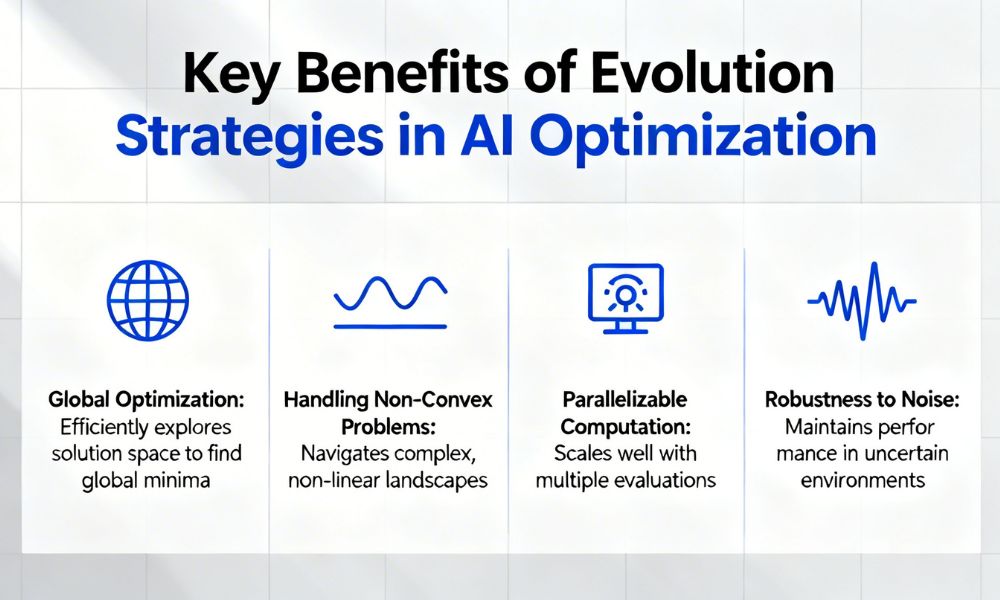
Key Benefits of Evolution Strategies in AI Optimization
Handling Non-Differentiable Functions
One of the standout features of Evolution Strategies is their ability to optimize non-differentiable functions. Unlike gradient-based methods, ES does not rely on continuous gradients to update the model. This makes ES ideal for solving problems with complex or unknown reward structures where traditional methods might struggle.
Adaptability to Noisy Environments
Evolution Strategies excel in noisy or uncertain environments. Since they rely on evaluating the performance of solutions rather than gradients, ES can navigate environments with fluctuating data and inconsistent feedback. This robustness makes them suitable for real-world applications, such as robotics and autonomous systems.
Parallelism and Efficiency
The population-based nature of Evolution Strategies allows for parallel processing, making it possible to evaluate multiple solutions simultaneously. This parallelism can significantly speed up the learning process, especially in high-dimensional or computationally expensive environments.
The Role of Selection, Mutation, and Recombination
Selection: Choosing the Fittest Solutions
In Evolution Strategies, selection is the process of identifying the best-performing individuals in the population. Solutions that demonstrate superior performance—such as higher rewards in an RL task—are selected for reproduction. The selection process ensures that only the most promising candidates pass on their characteristics to the next generation.
Mutation: Introducing Variability
Mutation introduces random changes to the solutions, allowing for exploration of new possibilities in the solution space. This variability prevents the algorithm from getting stuck in local optima and encourages exploration of novel strategies that might lead to better overall performance.
Recombination: Combining the Best Traits
Recombination, or crossover, involves combining the features of two or more high-performing solutions to create offspring. This allows the algorithm to leverage the strengths of multiple solutions. Further enhancing the evolutionary process and leading to better overall performance.
Applications of Evolution Strategies in Reinforcement Learning
Evolution Strategies are not just theoretical concepts they have real-world applications across various domains of AI. Some notable applications include:
- Robotics: ES can help robots learn complex movement patterns by optimizing their control policies through evolutionary processes.
- Game AI: Evolution Strategies are used to train game agents that adapt and improve their strategies based on feedback from the environment, leading to more challenging and intelligent gameplay.
- Autonomous Systems: ES enables self-driving cars and drones to improve their decision-making abilities, even in dynamic and unpredictable environments.
Why Evolution Strategies are More Effective than Traditional Methods
While traditional reinforcement learning methods, such as Q-learning and policy gradient techniques, rely on gradient-based optimization, Evolution Strategies introduce a population-based approach that offers distinct advantages. One of the primary benefits of ES over traditional methods is its ability to solve optimization problems that are non-differentiable and complex.
Additionally, ES are more scalable than gradient-based methods, allowing them to handle high-dimensional tasks with greater efficiency. The ability to handle noisy environments and their capacity for parallel computation further enhance their effectiveness. Making them a versatile tool in the AI toolkit.
Conclusion
Evolution Strategies are redefining the way AI agents learn and optimize their behavior. By mimicking natural evolution, ES provides an efficient, adaptable, and scalable method for tackling complex problems in Reinforcement Learning. As AI continues to evolve, the integration of Evolution Strategies promises to unlock new possibilities for AI applications, enabling machines to learn more effectively and adapt to a wide range of real-world challenges.
Evolution Strategies in Reinforcement Learning represent a transformative approach to optimization, offering significant advantages in solving challenging, non-differentiable, and dynamic problems. As the field progresses, we can expect ES to play an increasingly important role in shaping the future of AI and machine learning.