

AI-generated illustration created to represent the article’s subject. It does not depict an actual EPW course, trainer, participant, client, event or venue.
The main types of performance appraisal methods include objective-based appraisal, rating scales, behaviourally anchored rating scales, competency assessment, 360-degree feedback, self-appraisal, critical-incident review and narrative assessment. No single method is best for every organisation. The right choice depends on what the appraisal must achieve, how observable the work is, who holds reliable evidence and how consequential the decision will be.
This guide compares the methods, explains when each is useful and shows how HR teams can combine them without creating an unnecessarily complex review process.
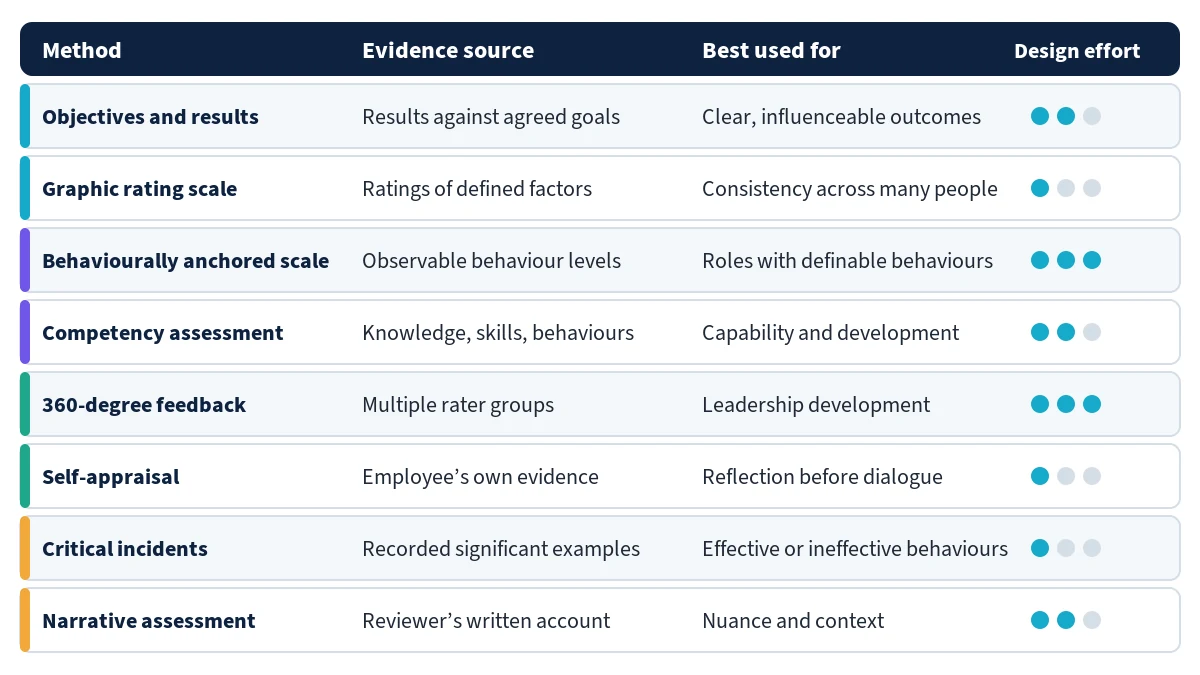
Performance appraisal methods at a glance
| Method | Best used for | Main limitation |
|---|---|---|
| Objectives and results | Roles with clear, influenceable outcomes | Can overlook quality, context and behaviour |
| Graphic rating scale | Consistent assessment across many employees | Labels may be interpreted differently |
| Behaviourally anchored rating scale | Roles where critical behaviours can be defined | Requires careful design and maintenance |
| Competency assessment | Capability and development discussions | Generic competencies can become vague |
| 360-degree feedback | Leadership and interpersonal development | Not automatically suitable for pay decisions |
| Self-appraisal | Reflection and preparation for dialogue | Self-ratings vary in confidence and calibration |
| Critical incidents | Reviewing significant effective or ineffective behaviours | Recency and selective recording can distort the picture |
| Narrative assessment | Nuanced evidence and contextual judgement | Harder to compare consistently at scale |
These are appraisal techniques, not a complete performance management system. Effective performance management also includes goal setting, ongoing feedback, support, development and recognition. The US Office of Personnel Management’s performance management cycle describes planning, monitoring, developing, rating and rewarding as connected activities rather than a once-a-year event.
1. Objective-based appraisal
Objective-based appraisal evaluates results against agreed goals, targets or deliverables. It works best when the employee can materially influence the outcome and when quality, timeliness and constraints are defined in advance.
Examples include completing a project milestone to an agreed standard, reducing a controllable processing delay or achieving a service improvement. A numerical target without context is not enough. HR should test whether the measure encourages the right behaviour, whether data are reliable and whether external factors have been considered.
This method suits accountable, results-oriented roles but should normally be paired with evidence about how the result was achieved.
2. Graphic rating scales
A graphic rating scale asks the reviewer to select a level for defined factors such as quality, collaboration, customer focus or dependability. It is efficient, familiar and easy to aggregate, which makes it attractive for organisations with many employees.
Its weakness is interpretation. “Exceeds expectations” may mean something different to each manager. Clear definitions, examples, manager training and calibration are therefore essential. Avoid asking managers to rate broad personality traits that are not demonstrably related to the job.
3. Behaviourally anchored rating scales
A behaviourally anchored rating scale, often shortened to BARS, describes observable behaviours at different performance levels. Instead of rating “communication” in the abstract, the scale might distinguish between failing to share essential information, providing timely updates and proactively adapting communication for different stakeholders.
BARS can improve clarity and coaching because the anchors show what performance looks like. However, developing credible anchors takes input from people who understand the work. The scale must also be reviewed when roles, technology or operating practices change.
4. Competency-based appraisal
Competency assessment considers the knowledge, skills and behaviours needed for effective performance. It is valuable for development, career planning and roles in which results alone do not capture professional judgement.
The method becomes weak when competencies are generic, overlapping or detached from real work. Define each competency in role-relevant terms, provide behavioural indicators and distinguish present performance from future potential. Potential is a separate judgement and should not be implied by a current-performance score.
5. 360-degree feedback
Multi-source or 360-degree feedback gathers perspectives from groups such as the employee, manager, peers, direct reports and relevant stakeholders. It is especially useful when leadership impact and collaborative behaviour are important and no single observer sees the full picture.
Its value depends on confidentiality, well-designed questions, suitable raters and skilled interpretation. Different scores may reflect genuinely different experiences rather than an error. Because respondents may feel pressure when feedback affects pay or promotion, many organisations use 360-degree feedback primarily for development and keep the purpose explicit.
6. Self-appraisal
Self-appraisal asks employees to review their achievements, evidence, challenges and development needs. It can improve preparation and make the discussion more balanced. It should not be treated as a test of whether the employee awards themselves the “correct” score.
Provide structured prompts: Which outcomes were achieved? What evidence supports them? What changed during the period? Where is support needed? The manager remains responsible for a fair, evidence-based judgement where a formal rating is required.
7. Critical-incident review
This method records significant examples of particularly effective or ineffective job behaviour over the review period. Specific examples make feedback easier to understand and reduce reliance on a vague overall impression.
The danger is selective memory. Managers may record problems more often than routine success, or overvalue recent events. Use proportionate, contemporaneous notes, apply the same approach across comparable employees and review patterns rather than treating one incident as the entire appraisal.
8. Narrative or essay appraisal
A narrative assessment allows the reviewer to explain performance, context, strengths and development needs in prose. It is useful for complex roles and can capture nuance that a number cannot.
Quality varies with the reviewer’s writing and judgement. A structured template helps: ask for evidence of outcomes, observed behaviour, constraints, development priorities and agreed next steps. Narratives should support, not obscure, clear conclusions.
How to choose the right appraisal method
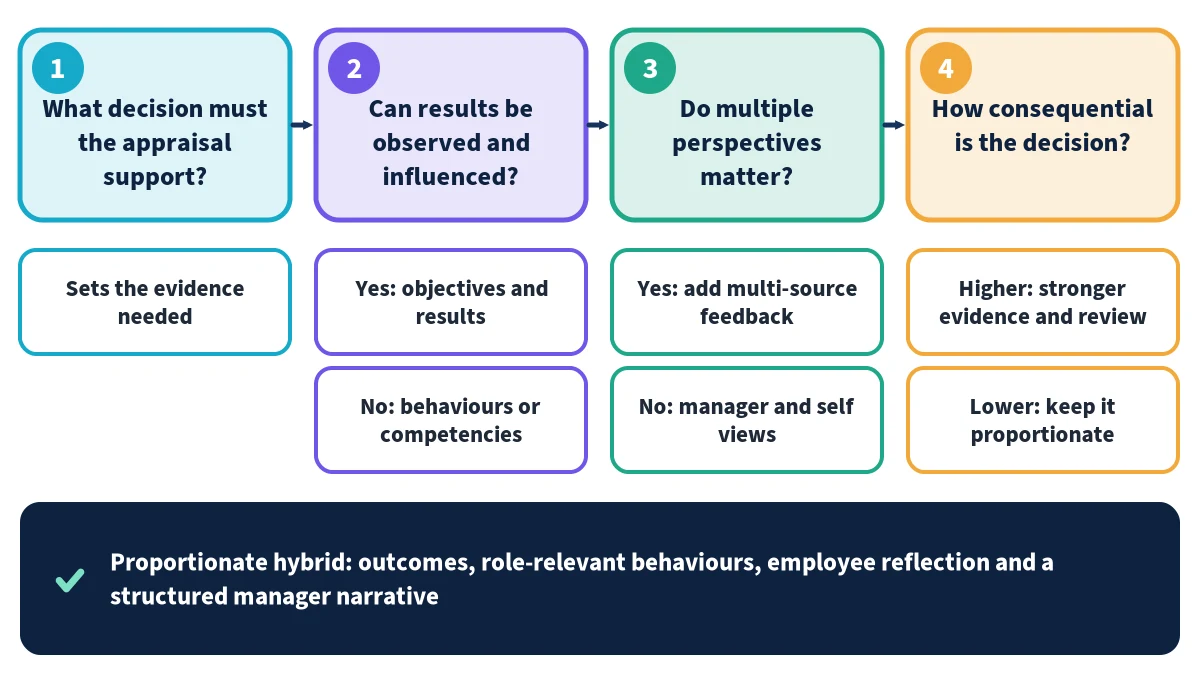
Start with the decision the appraisal needs to support. A developmental conversation, a probation review, a pay decision and succession planning do not require identical evidence. Then assess the role and operating environment.
- Define the purpose. Be explicit about development, accountability, reward, capability or another decision.
- Identify credible evidence. Decide which results, behaviours, work products and stakeholder observations are relevant.
- Test job relevance. Criteria should reflect work the employee is expected and able to influence.
- Assess consistency needs. Large or distributed workforces may need more structure, while specialist roles may require more narrative judgement.
- Consider consequences. Higher-stakes decisions require stronger evidence, governance, documentation and review.
- Design the conversation. The process should produce clear feedback, employee input and agreed action.
Acas advises that reviews may consider objectives, behaviours and development plans, and that formal reviews should sit alongside regular feedback, coaching and check-ins. Its performance review guidance also recommends keeping a written record and sharing it with the employee.
HR teams strengthening the wider system may find EPW’s discussion of strategic HRM useful for connecting individual performance choices to organisational priorities. The published guide to HR business partner operating models also helps clarify who should advise leaders, support calibration and challenge inconsistent decisions.
Why a hybrid approach is usually stronger
Most organisations need more than one evidence lens. A practical hybrid might combine agreed outcomes, two or three role-relevant behaviours, a short employee reflection and a structured manager narrative. Leadership roles may add multi-source feedback for development. This is often more informative than forcing all performance into one number.
Keep the design proportionate. Every field should support a decision or a useful conversation. If managers cannot explain how a score was reached, or employees cannot see the relationship between criteria and work, extra complexity has not improved the process.
Fairness and quality safeguards
Whatever method is selected, apply a consistent quality standard:
- publish the criteria and process before the assessment period;
- base judgements on job-relevant evidence across the full period;
- train reviewers to recognise common judgement errors;
- use calibration to test consistency, not to predetermine a distribution;
- give employees a meaningful opportunity to respond and add context;
- separate performance, conduct and potential where different processes are needed;
- document reasons for consequential decisions; and
- review the method for adverse patterns and apply relevant local law and policy.
The US Office of Personnel Management’s guidance on communication skills in performance management recommends drawing feedback from managerial observation and varied performance data. That principle is broadly useful: stronger decisions combine sources while remaining clear about their relevance and limitations.
For HR practitioners who need to design, compare and implement these approaches, EPW’s Performance Management Systems and Appraisal Methods Course provides a structured course option covering appraisal techniques, feedback, coaching and strategic alignment.
Frequently asked questions
Which performance appraisal method is most effective?
The most effective method is the one matched to a clear purpose, relevant evidence and the nature of the role. A hybrid of results, behaviours and structured narrative is often more balanced than one method alone.
Is 360-degree feedback suitable for performance ratings?
It can provide valuable evidence about leadership and collaboration, but its purpose and governance must be explicit. Where raters believe their comments determine pay or promotion, candour and fairness may be affected. Many organisations therefore use it primarily for development.
Should every employee use the same appraisal form?
A common framework can support consistency, but criteria should remain relevant to the role. Organisations can standardise the process, rating logic and evidence expectations while adapting objectives and behavioural examples for different job families.
How often should performance appraisals happen?
Formal review timing depends on organisational need and applicable policy. Acas says employers should conduct regular reviews for employees and considers at least once a year a good idea, while also recommending regular informal conversations. A yearly meeting should not replace ongoing feedback.
Design an appraisal method that fits the work
Choose appraisal methods by purpose, evidence and consequence — not by habit. A well-designed approach gives employees clarity, helps managers exercise better judgement and produces information HR can use responsibly.
Ready to strengthen your organisation’s approach? Explore EPW’s Performance Management Systems and Appraisal Methods Course and review how its outline aligns with your current design challenges. You can also browse EPW’s Human Resources Training Courses and Human Resources Articles for related learning and guidance.
Sources and References
- EPW Training. Performance Management Systems and Appraisal Methods Course. Accessed 22 September 2026. Course page.
- Acas. Reviews and appraisals. Updated 23 June 2026. Guidance.
- US Office of Personnel Management. Performance Management Cycle. Accessed 22 September 2026. Guidance.
- US Office of Personnel Management. Communication Skills. Accessed 22 September 2026. Reference material.