

AI-generated illustration created to represent the article’s subject. It does not depict an actual EPW course, trainer, participant, client, event or venue.
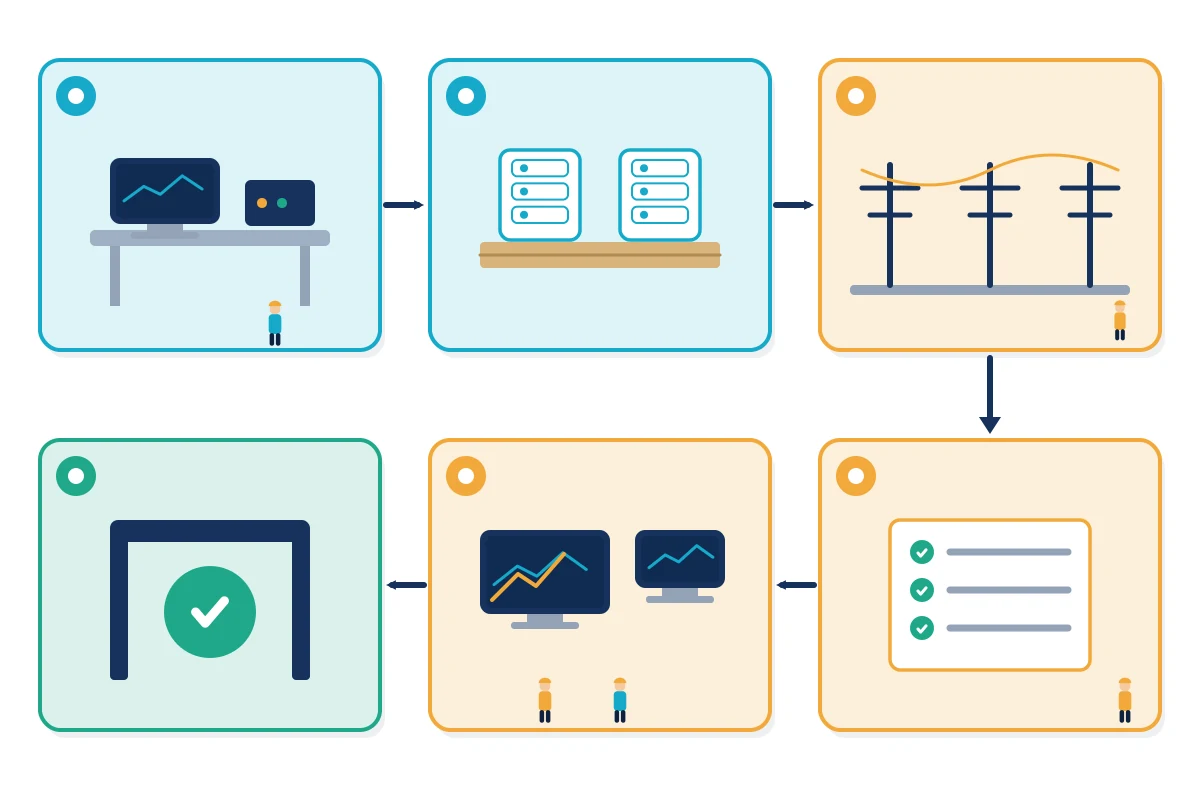
A SCADA implementation process should move through nine controlled stages: operational requirements, asset and interface definition, architecture, detailed design, configuration, factory testing, site installation, site acceptance testing and operational handover. For utilities and industrial power networks, each stage needs an accountable owner, approved evidence and a decision gate so that incomplete data, unsafe controls or cybersecurity weaknesses do not pass into service.
This process is intended for asset owners, utility engineers, control-centre teams, system integrators, operational technology specialists and project managers. It focuses on implementation governance rather than a particular supplier platform.
SCADA implementation overview
Supervisory control and data acquisition (SCADA) connects field devices, communications, servers, operator interfaces, historians and control functions. The technical system must preserve safe power-system operation while also meeting availability, maintainability, audit and cybersecurity needs.
| Stage | Primary owner | Required output | Decision gate |
|---|---|---|---|
| 1. Requirements | Asset owner and operations | Approved operational requirements specification | Scope and acceptance measures agreed |
| 2. Assets and interfaces | Protection, field and SCADA engineers | Signal, interface and data-quality registers | Source systems and responsibilities confirmed |
| 3. Architecture | SCADA and OT security leads | Approved logical, physical and security architecture | Availability and risk treatment accepted |
| 4. Detailed design | System integrator with owner review | Design package and test specifications | Design frozen for configuration |
| 5. Configuration | Integrator | Controlled software build and integration record | Build ready for factory testing |
| 6. Factory test | Owner and integrator | Factory acceptance test report | Shipment or site release authorised |
| 7. Installation | Site delivery team | Installation and pre-commissioning dossier | Safe energisation readiness confirmed |
| 8. Site test | Commissioning authority | Site acceptance test report and defect list | Operational use authorised |
| 9. Handover | Owner and operations | As-built system, training and support package | Formal acceptance and warranty start |
The process is iterative, but its approvals should not be informal. A design issue discovered during site testing may require a controlled return to detailed design, configuration and selected factory tests.
1. Define operational requirements
Begin with the operating decisions the system must support. Identify control-centre roles, normal and contingency operating states, remote-control functions, alarm response, reporting, event analysis, availability targets, recovery objectives and regulatory obligations.
Write measurable requirements. Replace “fast alarm display” with an agreed end-to-end performance criterion and test method. Replace “high availability” with the required service, permitted outage, redundancy behaviour and recovery sequence. Classify every control by consequence and define when local control must override or block a remote command.
Include operational technology (OT) security from the start. NIST Special Publication 800-82 Revision 3 describes OT topologies, threats, vulnerabilities and countermeasures while recognising performance, reliability and safety constraints. The requirements team should therefore involve operations, safety, protection, telecommunications and cybersecurity—not only information technology.
2. Confirm assets, signals and interfaces
Create an authoritative asset and interface register. It should identify substations, remote terminal units (RTUs), intelligent electronic devices, meters, programmable logic controllers, gateways, time sources, communications paths, servers, operator workstations and external systems.
For each signal, record source, destination, protocol address, engineering unit, scaling, normal state, quality flag, alarm class, time stamp, scan or reporting rule and control authority. Define ownership for energy-management, outage-management, geographic-information, historian, maintenance and market interfaces.
Reconcile the signal list with single-line diagrams, protection schemes and field drawings. Duplicate names, inconsistent phase labels and ambiguous open/closed conventions are common sources of commissioning defects. Freeze a baseline, then manage changes through a traceable request.
3. Approve architecture and cybersecurity controls
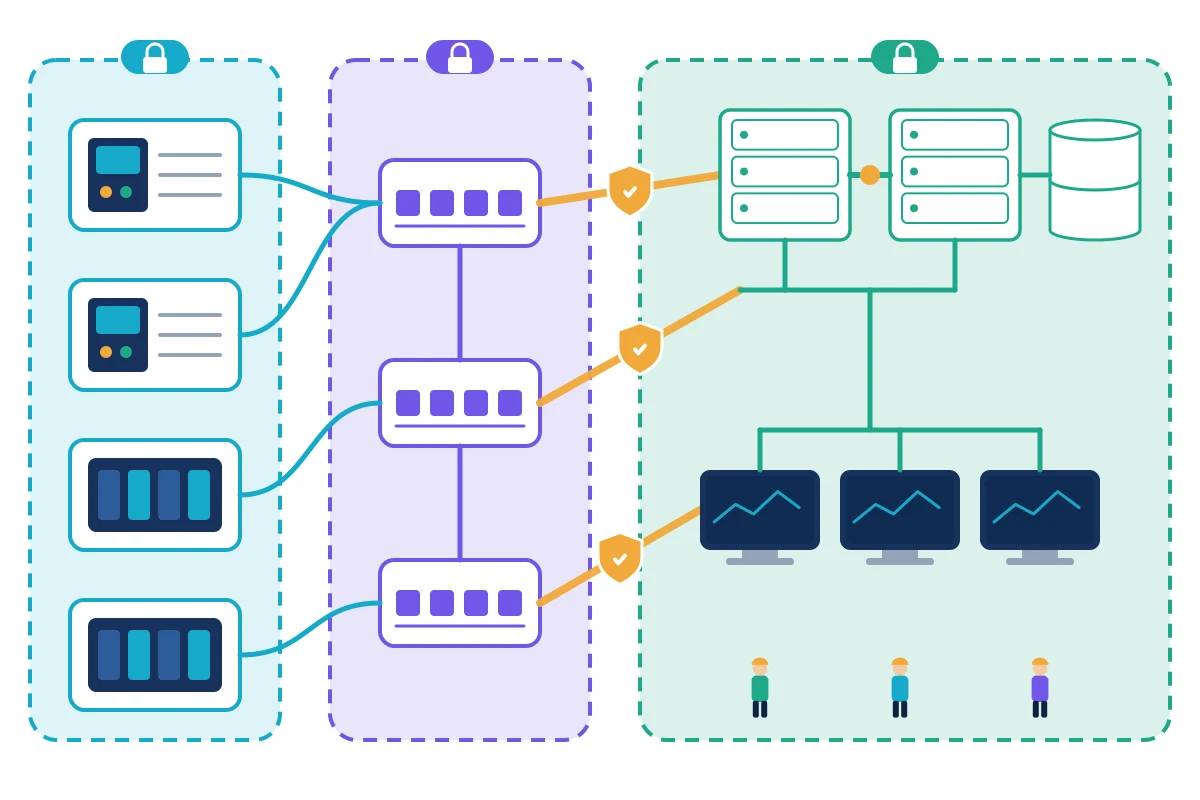
Develop logical and physical architecture together. Select redundancy for servers, communications, control centres, power supplies and time synchronisation according to the operational requirement. Define failure behaviour, failover time, data buffering and restoration after a communications outage.
Segment the environment into security zones and controlled conduits. The ISA/IEC 62443 series addresses industrial automation and control-system security across the lifecycle, including the roles of asset owners, service providers and product suppliers. Apply least privilege, managed remote access, secure configuration, account governance, logging, backup, recovery and supplier-access controls.
For power-system communications, map applicable protocol-security requirements. The IEC 62351 series addresses data and communications security for power-system management and associated information exchange. Do not treat protocol conformance as proof that the complete SCADA system is secure; architecture, identity, monitoring, physical protection and operating procedures still matter.
4. Complete and approve detailed design
Turn the architecture into a buildable package. Include network diagrams, equipment schedules, cabinet layouts, input/output allocation, database design, naming rules, alarm philosophy, control interlocks, mimic standards, reports, historian points, user roles, backup design, patch approach and time synchronisation.
Create a requirements traceability matrix linking each requirement to a design element and planned test. Write the factory acceptance test (FAT) and site acceptance test (SAT) procedures before configuration is complete. This exposes requirements that cannot be measured and interfaces without a clear test method.
Hold multidisciplinary reviews for human factors, protection coordination, telecommunications, maintenance, safety and cyber risk. The design gate should close every major comment or formally accept the residual risk. Approved exceptions need an owner and expiry or review condition.
5. Configure, build and integrate the system
Configure the SCADA database, operator displays, alarms, controls, historian, reports, user roles and interfaces under version control. Separate development, test and production environments. Record software, firmware, licence and configuration versions.
Use standard templates for recurring bays, feeders and devices, but validate every instance against the approved signal list. Automated import reduces manual entry, yet it can also reproduce one mapping error across hundreds of points. Apply peer review, configuration checks and controlled build releases.
Integrate external systems with simulators or agreed test stubs before the FAT. Test normal messages, quality flags, time stamps, communication loss, invalid values and recovery—not only successful data transfer.
6. Conduct factory acceptance testing
The FAT demonstrates that the integrated build meets approved requirements before site deployment. Use the released hardware and software configuration where practicable, simulate field devices and retain evidence for every test.
A strong FAT covers:
- point-to-point database mapping and engineering units;
- alarm priority, acknowledgement, shelving and sequence-of-events behaviour;
- remote-control selection, interlocks, feedback, timeout and failure handling;
- server, network and communications failover;
- operator displays, trends, historian, reports and user roles;
- backup restoration and recovery procedures;
- external interfaces and degraded data-quality states; and
- security configuration and relevant negative tests.
Classify defects by consequence and agree retest rules. Shipment should not be authorised merely because all test steps were attempted. Open defects must be closed, accepted with compensating controls or assigned to an approved site action.
7. Install and pre-commission safely
Verify cabinets, earthing, power supplies, environmental conditions, network paths, fibre and copper terminations, labelling and time sources. Confirm that field and control-centre versions match the released build. Back up the pre-change system before modifying an operating site.
Use a commissioning plan that defines outage windows, isolation, permits, temporary links, rollback, communications with operators and command authority. Point-to-point checks should confirm the physical source, SCADA indication and control path. A screen change alone does not prove that the correct field device will operate.
Complete readiness reviews before energisation or enabling controls. Outstanding work, temporary configurations and bypasses must be visible to operations.
8. Conduct site acceptance testing
The SAT proves the installed system in its real environment. Repeat critical FAT functions and test the elements that could not be demonstrated off site: live communications, field scaling, end-to-end timing, control circuits, redundancy across installed paths, control-centre interfaces and operational procedures.
Use approved test states or outages. Never create an unsafe plant condition solely to complete a test. Where a full operational scenario cannot be performed, document the alternative evidence and residual limitation.
Cybersecurity acceptance should include asset inventory reconciliation, account and privilege review, network segmentation checks, secure remote-access tests, logging, backup restoration and vulnerability or configuration findings under an approved method. IEC cybersecurity conformance specifications themselves warn that protocol test success does not guarantee the security of the entire implementation; additional system assurance remains necessary.
9. Hand over, train and close the project
Formal handover requires more than a signed SAT sheet. Deliver as-built drawings, database exports, configuration backups, source files, licence records, administrator procedures, recovery media, cybersecurity baseline, approved deviations, spare parts, support contacts and the final defect register.
Train operators, maintainers, SCADA administrators and cyber-response personnel for their actual roles. Include failover, degraded communications, alarm floods, backup restoration, account management and vendor-support access. Record competency evidence where the organisation requires it.
Agree warranty start, response targets, patch and vulnerability responsibilities, change-control route and periodic recovery tests. Define acceptance as a signed decision by the authorised owner after required evidence is complete—not as the date the supplier leaves site.
Illustrative end-to-end implementation
Consider an illustrative project adding three distribution substations to an existing control centre. The owner first defines telemetry, alarms, remote switching, availability and recovery needs. Engineers reconcile the proposed signal lists with protection and metering drawings, then approve redundant communications and a segmented security architecture.
The integrator configures standard feeder templates, maps each point and builds test simulations. During FAT, a control feedback timeout and inconsistent phase naming are found and corrected. Site teams then verify cabling, time synchronisation and point-to-point operation. SAT demonstrates live telemetry, authorised controls, communications failover, historian transfer and backup restoration.
The owner accepts the system only after the as-built database, security baseline, training records and remaining low-impact defects have approved owners and dates. This example is a process illustration, not a claim about a real project.
Common SCADA implementation failures
- Starting configuration before requirements and naming rules are approved.
- Treating the signal list as a clerical file rather than a controlled engineering record.
- Designing redundancy without testing failure and restoration behaviour.
- Adding cybersecurity after architecture and procurement decisions are fixed.
- Writing FAT and SAT procedures after the system is built.
- Testing positive communications only and ignoring invalid, stale or lost data.
- Allowing uncontrolled manual changes during commissioning.
- Accepting the system without recoverable backups and as-built records.
- Leaving supplier access, patching and vulnerability ownership undefined.
SCADA implementation completion checklist
- Operational requirements and acceptance measures are approved.
- Assets, signals, interfaces and control authority are traceable.
- Availability, failure behaviour and cybersecurity architecture are accepted.
- Every requirement maps to design and test evidence.
- The software build and configuration versions are controlled.
- FAT defects are closed or formally dispositioned before site release.
- Installation, point-to-point checks and rollback readiness are complete.
- SAT proves end-to-end operation in the installed environment.
- As-built records, backups, training and support responsibilities are handed over.
- The authorised asset owner signs final acceptance.
Conclusion
A disciplined SCADA implementation process prevents technical gaps from moving silently into operations. The nine stages make each decision visible: what the system must do, how it is designed, what has been tested and who accepts the residual risk. The result is not merely a functioning screen; it is an operable, maintainable and defensible power-system control capability.
Develop power-system SCADA implementation skills
EPW’s SCADA and Automation for Power Systems course helps engineers and operators connect field interfaces, communications, control-centre functions, testing and operational governance. Explore related programmes in the Electrical Power and Energy Engineering category.
Sources and References
- National Institute of Standards and Technology. Guide to Operational Technology (OT) Security, SP 800-82 Rev. 3. September 2023.
- International Society of Automation. ISA/IEC 62443 Series of Standards.
- International Electrotechnical Commission. IEC 62351:2026 Series—Power Systems Management and Associated Information Exchange: Data and Communications Security. 30 July 2026.
- International Electrotechnical Commission. IEC TS 62351-100-4:2023—Cybersecurity Conformance Testing. 27 November 2023.
- International Electrotechnical Commission. IEC TS 62351-100-6:2022—Cybersecurity Conformance Testing for IEC 61850 Communications. 17 August 2022.