
A training needs assessment process turns evidence about required performance, current capability and business risk into a ranked set of development priorities. It should not begin with a catalogue of courses. It begins with the results the organisation needs, tests why performance gaps exist, identifies the knowledge or skills that learning can realistically improve, and defines how success will be measured.
The output is a decision record: which gaps matter, who is affected, what evidence supports the diagnosis, whether training is the right response, and what should happen first. The US Office of Personnel Management (OPM) states that a training needs assessment identifies performance requirements and the knowledge, skills and abilities needed to achieve them, helping direct resources towards areas of greatest demand. OPM’s training needs assessment guidance also connects the work to mission delivery, productivity and service quality.
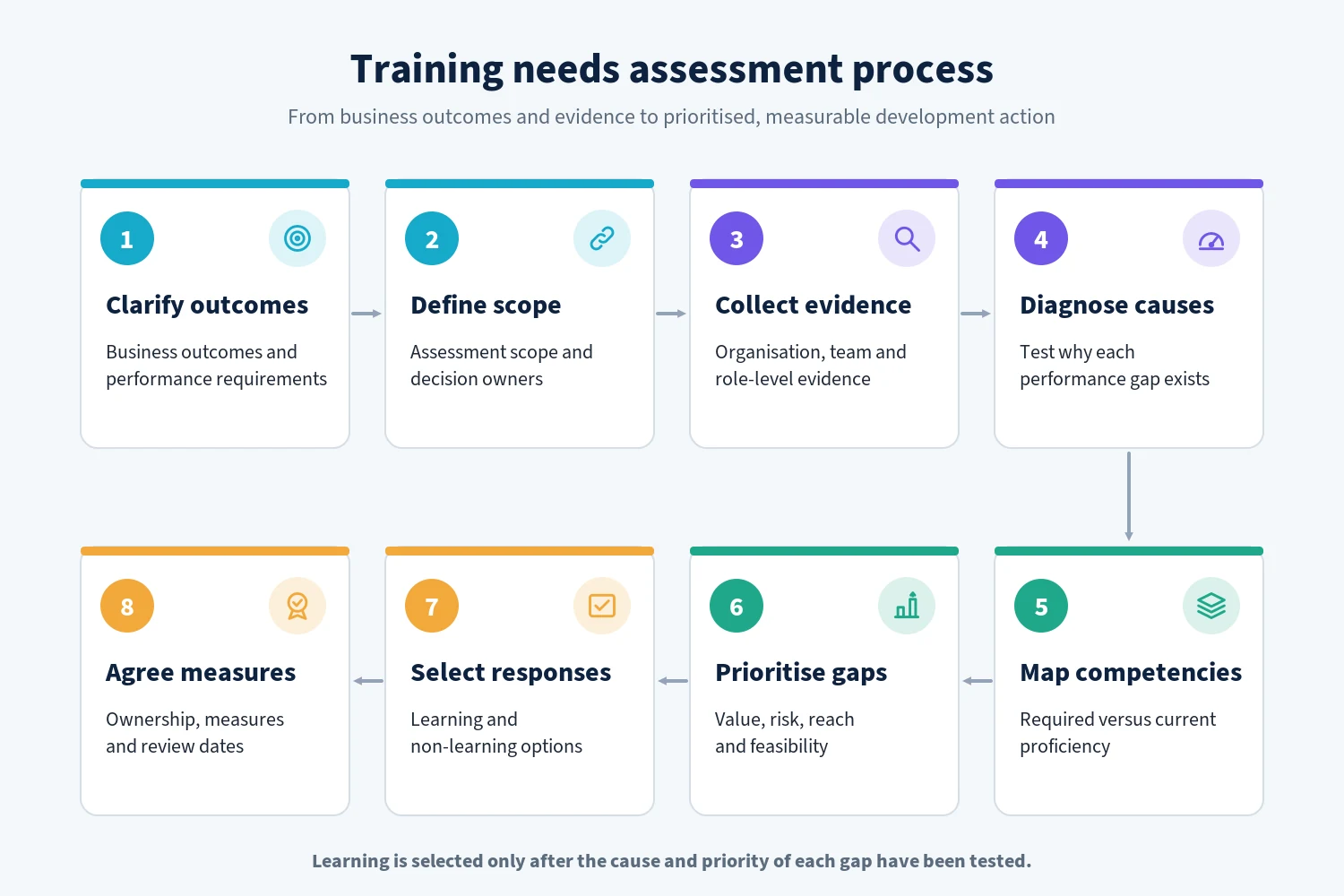
The training needs assessment process at a glance
- Clarify business outcomes and performance requirements.
- Define the assessment scope and decision owners.
- Collect evidence at organisational, team and role levels.
- Diagnose the causes of each performance gap.
- Map required competencies and current proficiency.
- Prioritise gaps by value, risk, reach and feasibility.
- Select learning and non-learning responses.
- Agree measures, ownership and review dates.
This sequence prevents a common error: treating every performance problem as a training problem. A gap caused by unclear accountability, a broken process, missing tools or conflicting incentives will not disappear merely because employees attend a course.
Step 1: Start with required business and service outcomes
Write down the outcome that must improve before asking what people need to learn. Examples include reducing avoidable rework, improving first-time resolution, meeting a new control requirement, shortening equipment downtime or raising the quality of management decisions. The requirement should be specific enough to guide evidence collection.
Translate each outcome into observable performance. “Improve customer service” is too broad. “Resolve a higher proportion of eligible enquiries at first contact while maintaining quality and compliance” identifies behaviour, quality constraints and a measurable result. This makes it possible to distinguish capability gaps from capacity, system or policy problems.
Step 2: Define scope, stakeholders and decision rights
State which business units, roles, locations and time period are included. Name the sponsor, assessment lead, subject-matter experts, data owners, line managers and employee representatives. Decide who validates competency requirements, approves priorities and owns follow-through.
A narrowly defined assessment usually produces more useful decisions than a survey sent to the entire organisation without a clear question. For a multi-role process, map the workflow first so that the assessment captures hand-offs and shared dependencies rather than analysing each job in isolation.
Step 3: Gather evidence from several levels
Use multiple sources because no single dataset explains a capability problem. The CIPD’s learning needs analysis factsheet treats learning needs as organisational, team and individual concerns and emphasises connecting analysis to performance rather than relying only on requested courses.
| Level | Useful evidence | Question answered |
|---|---|---|
| Organisation | Strategy, operating plan, risk register, audit findings, technology roadmap and workforce plan | Which future capabilities and material risks matter? |
| Team or process | Quality, productivity, service, safety, cycle-time and customer data | Where does actual performance differ from the requirement? |
| Role | Job outputs, competency profiles, observed tasks, work samples and manager evidence | What must a competent performer know and do? |
| Individual | Assessment results, performance conversations, self-reflection and development plans | Who needs which support, and at what level? |
Interviews and surveys are useful, but they record perceptions. Triangulate them with work evidence. Protect confidentiality, minimise unnecessary personal data and explain how results will be used. Where scores affect employment decisions, apply appropriate validation, fairness and review controls.
Step 4: Diagnose the cause before prescribing training
For every gap, ask whether capable performance is possible under current conditions. Test role clarity, process design, tools, workload, information access, supervision, incentives and consequences. Then test knowledge, skill and confidence. A simple diagnostic is:
- Can people explain the required standard? If not, knowledge or communication may be involved.
- Can they demonstrate the task in realistic conditions? If not, skill practice or coaching may help.
- Do proficient people succeed consistently? If not, the system may be the constraint.
- Is the expected behaviour reinforced? If not, management and incentives require attention.
OPM’s training programme management guidance defines a needs assessment as identifying the difference between required and current performance, then exploring the reasons for the gap and methods for closing it. That second part is what protects the organisation from spending on irrelevant learning.
Step 5: Map competencies and proficiency
Describe each required competency as observable behaviour in context. Avoid vague labels such as “communication” without specifying the work. For example: “Explains a control exception to a non-specialist stakeholder, checks understanding and records the agreed corrective action.”
Use a small, consistent proficiency scale. A four-level scale might distinguish awareness, working application, independent practice and advanced guidance. Define evidence for each level. Compare the required level with current evidence by role or population, then record the gap and confidence in the data.
Professionals who want to practise this work can explore EPW’s Training Needs Assessment and Competency Mapping course, which covers needs analysis, competency mapping, programme design and evaluation.
Step 6: Convert gaps into defensible priorities
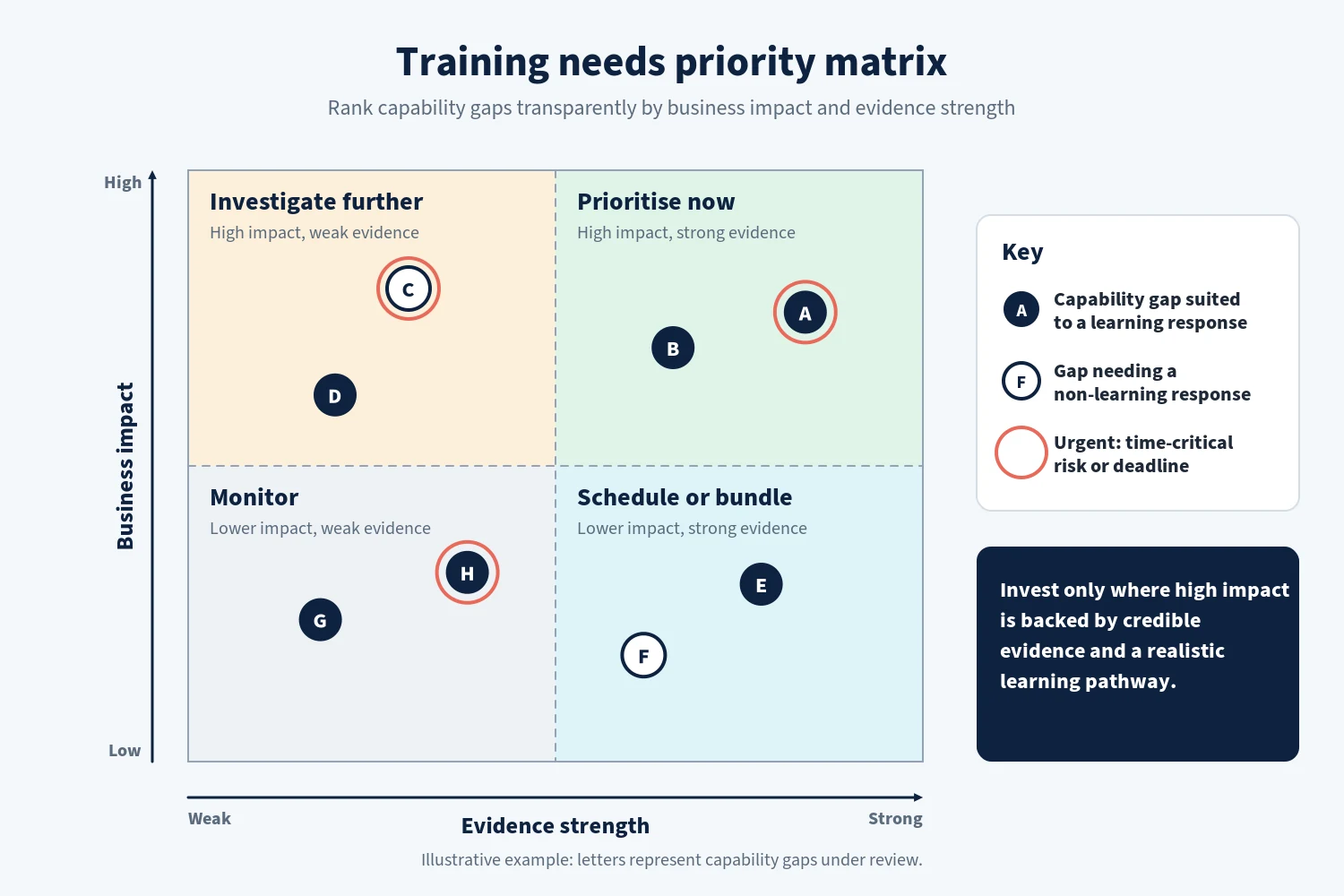
Do not rank gaps by the number of survey requests alone. Score each need against transparent criteria and keep the supporting evidence. A practical priority score can consider:
- Strategic value: contribution to a stated objective or service outcome.
- Risk exposure: safety, regulatory, financial, operational or reputational consequence.
- Performance gap: size and reliability of the difference between required and current capability.
- Reach: number of roles, employees, customers or processes affected.
- Urgency: when the capability must be available.
- Trainability: whether learning is likely to change the outcome.
- Feasibility: time, access, cost and availability of practice opportunities.
Weighting should reflect the organisation’s context. A compliance-critical gap may outrank a larger but low-risk productivity need. Record the rationale so leaders can challenge assumptions and revisit the ranking when priorities change.
Step 7: Choose the smallest effective response
A priority need does not automatically require a classroom programme. Match the response to the cause, complexity and work environment. Options include guided practice, job aids, coaching, peer observation, scenario exercises, workflow changes, clearer standards, manager reinforcement or a structured course. The CIPD’s learning and development guide links needs analysis with intervention design, delivery and impact assessment.
Specify the target group, starting level, learning objectives, practice conditions and transfer support. If a new process is involved, ensure that the tools, procedures and manager expectations are ready before training begins. EPW’s Developing High Impact Training Programs course is relevant when the next task is turning a validated need into a programme that supports workplace application.
Step 8: Define measures before delivery
Set a baseline and identify leading and outcome measures. Completion and satisfaction can indicate participation and experience, but they do not prove capability or business impact. Use practical assessment, observed behaviour, quality results and relevant operational outcomes. Agree when data will be reviewed and who can act on the result.
The CIPD’s learning evaluation guidance notes that evaluation should be linked to identified performance gaps. This means the assessment question, learning objective and evaluation measure should form one traceable chain.
A worked example: reducing avoidable invoice errors
Assume a finance operation reports a rise in invoice corrections. This example is illustrative. The team first defines the required outcome: accurate processing at first submission without weakening control checks. Data show that errors are concentrated in two transaction types and began after a workflow change.
Observation finds that experienced staff also struggle because a reference table is difficult to access. Newer staff additionally misclassify exceptions. The response therefore combines a process fix and a job aid for everyone with scenario-based practice for the affected employees. Success is measured through classification accuracy, rework rate and use of the revised workflow. A generic finance course would have addressed neither cause precisely.
Common mistakes to avoid
- Beginning with preferred courses instead of performance requirements.
- Using self-reported interest as the only evidence of need.
- Confusing a broad competency label with observable work behaviour.
- Ignoring process, tool, capacity or incentive causes.
- Ranking needs without transparent criteria or data confidence.
- Designing learning before defining transfer conditions and measures.
- Collecting sensitive employee data without clear purpose and governance.
From assessment to a coherent people strategy
Training priorities are strongest when they connect to workforce and business decisions. EPW’s article on why strategic HRM matters for organisational performance explains the broader alignment between people practices and organisational outcomes. Related development routes include Learning and Development Strategies for HR Leaders and the wider Human Resources Training Courses portfolio.
Ready to build an evidence-led assessment? Review the Training Needs Assessment and Competency Mapping course and discuss the most appropriate delivery option for your team.
Sources and References
- US Office of Personnel Management. Training Needs Assessment – Planning and Evaluating. Accessed 16 September 2026.
- US Office of Personnel Management. Training Program Management. Accessed 16 September 2026.
- Chartered Institute of Personnel and Development. Learning Needs Analysis. Factsheet, accessed 16 September 2026.
- Chartered Institute of Personnel and Development. Learning and Development for People Professionals. Guide, accessed 16 September 2026.
- Chartered Institute of Personnel and Development. Learning Evaluation, Impact and Transfer. Factsheet dated 18 August 2025.
- OECD. A Skills-First Labour Market. 2026.