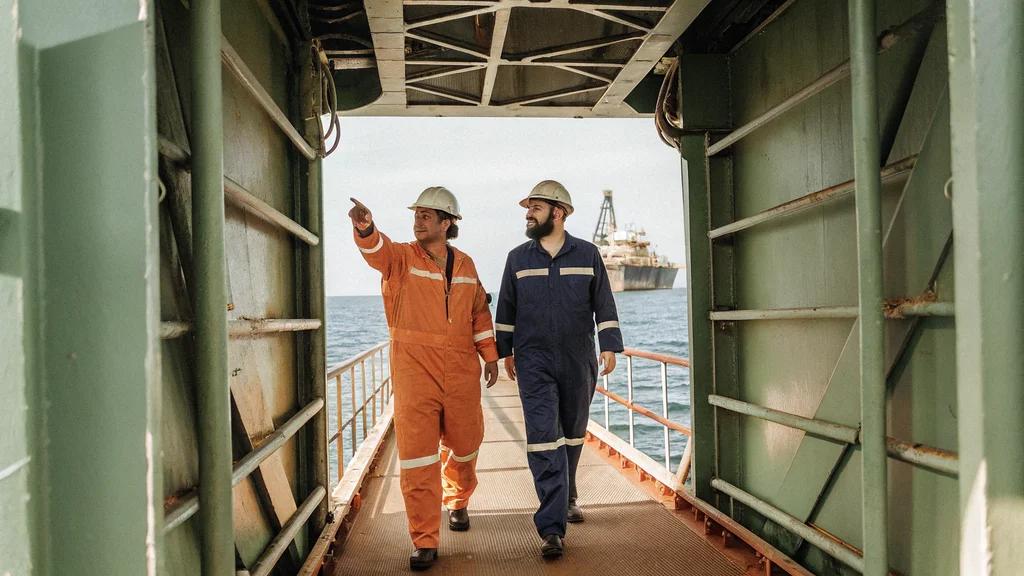
AI-generated illustration created to represent the article’s subject. It does not depict an actual EPW course, trainer, participant, client, event or venue.
A fixed platform is structurally connected to the seabed, while a floating production system remains buoyant and is held on station by moorings, tendons or dynamic positioning. Fixed platforms commonly support dry trees and direct access to wells; floating systems accommodate deeper water and may offer storage, relocation or phased-development advantages, but add motion, riser and station-keeping challenges.
The right concept depends on the reservoir, water depth, seabed, metocean conditions, well architecture, processing duty, export route, installation capability, regulations and economics. This comparison explains the principal differences without imposing a universal water-depth or cost threshold.
Fixed platform vs floating production system at a glance
| Dimension | Fixed platform | Floating production system |
|---|---|---|
| Support | Foundation, piles or gravity base transfers load to seabed | Buoyancy supports weight; station keeping restrains position |
| Motion | Limited structural movement | Responds to waves, wind and current |
| Water depth | Often favoured in shallow to moderate water, concept dependent | Commonly enables deeper-water development |
| Wells | Can support platform wells and dry trees | Often connected to subsea wells by flexible or steel risers |
| Export | Usually pipeline, although configuration varies | Pipeline or storage and tanker offloading, depending on unit |
| Installation | Foundation and topsides installed at field | Hull may be integrated at yard and towed to field |
| Reuse | Location-specific and difficult to relocate | Some concepts can be redeployed after modification |
What is a fixed offshore platform?
A fixed platform has a substructure that extends to the seabed. Common concepts include steel jackets, gravity-based structures and compliant towers. The deck may contain wellheads, drilling equipment, separation, compression, utilities, accommodation and export systems.
The Bureau of Ocean Energy Management’s platform-structure categories distinguish fixed-leg platforms from compliant towers, floating production systems, tension-leg platforms, spars and FPSOs [1]. The exact definition used by a regulator or project should govern classification.
Fixed jackets transfer environmental and operating loads through legs, bracing and piles. Their low motion can simplify topsides equipment, well access and rigid riser arrangements. As water becomes deeper, structural weight, fabrication, transport and installation can become less attractive relative to floating solutions.
What is a floating production system?
A floating production system supports processing equipment on a buoyant hull. Main families include ship-shaped FPSOs, semi-submersibles, spars and tension-leg platforms. They differ significantly in motion response, storage, wells, risers, mooring and installation.
BSEE describes floating production systems as anchored or dynamically positioned units receiving production through risers; it also distinguishes spars, tension-leg platforms and FPSOs [2]. An FPSO can process and store liquids for shuttle-tanker offloading, while a production semi-submersible normally exports through pipelines unless separate storage is provided.
EPW’s Floating Production Storage and Offloading Operations course examines the operational features of the ship-shaped FPSO concept.
Difference 1: water depth and foundation
Fixed platforms require a foundation capable of supporting gravity, environmental, equipment and accidental loads. Soil conditions, pile drivability, fatigue and scour are important. Greater depth normally increases jacket height, weight and installation complexity, although compliant structures extend the usable range.
Floating systems separate topside support from a full-height seabed structure. Moorings, tendons or thrusters provide station keeping, and foundations anchor those systems. Deep water still creates demanding riser, umbilical, mooring and intervention requirements; floating does not remove seabed engineering.
Difference 2: wells and risers
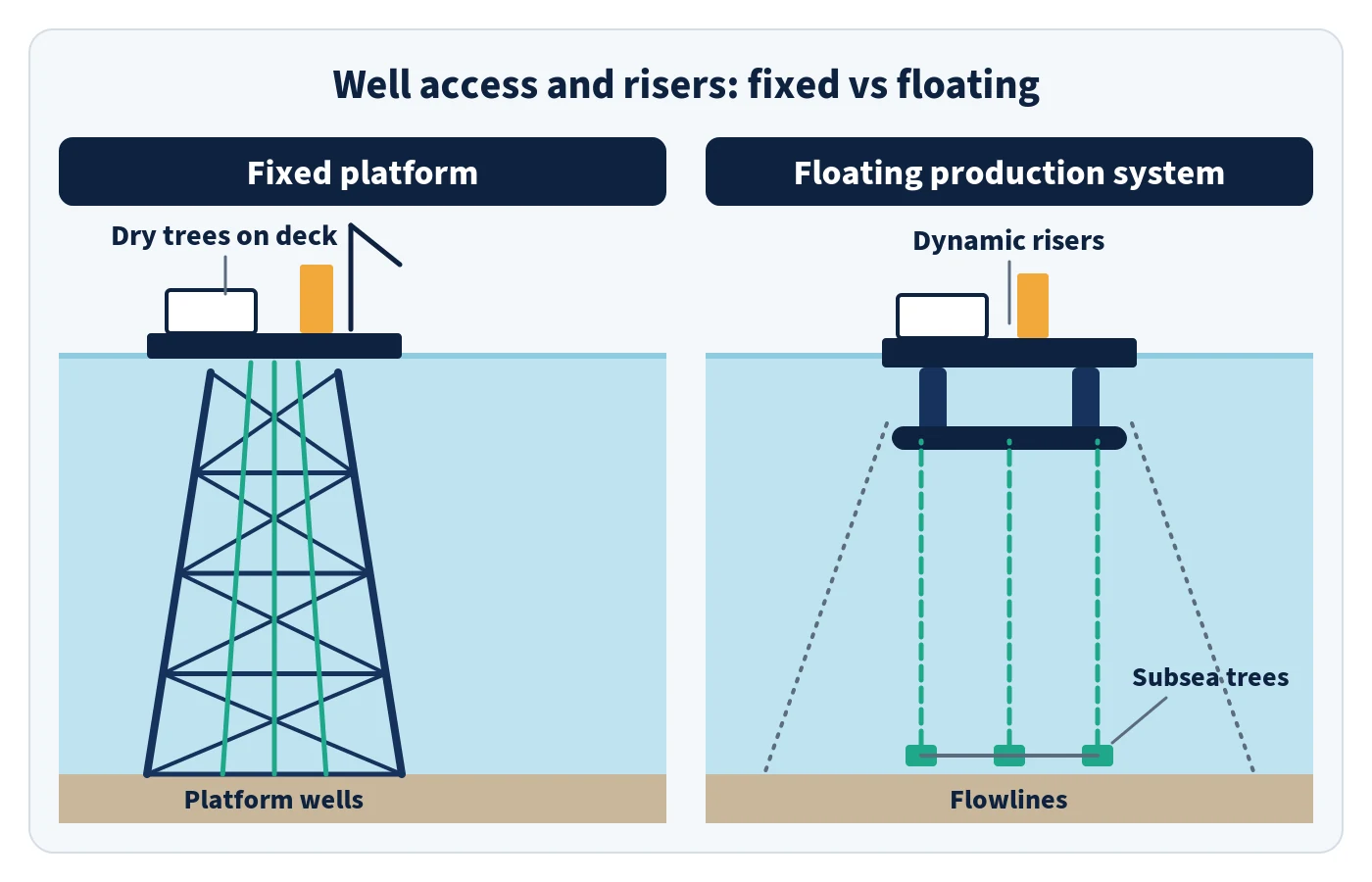
A fixed platform may locate wellheads and dry trees on the deck, giving direct access for drilling, workover and maintenance. Deviated wells can reach a limited area around the platform, while satellite subsea wells can also be tied back.
Many floating developments use subsea trees connected by flowlines and risers. Riser design must accommodate pressure, temperature, fluid behaviour, fatigue and platform motion. Tension-leg platforms and spars may support dry-tree arrangements in suitable configurations, so “floating” does not automatically mean “subsea wells”.
Difference 3: motion and topsides design
A fixed platform has limited motion, so equipment support, piping and human factors are designed for structural vibration and environmental loads without continuous hull motions. Floating units experience surge, sway, heave, roll, pitch and yaw. Motion affects separators, rotating equipment, cranes, flare systems, accommodation, walkways and maintenance.
The hull, mooring, risers and topsides form a coupled system. Weight growth and centre-of-gravity changes can affect stability and motion response. This makes disciplined weight control and interface management essential throughout design and modification.
Difference 4: storage and export
Fixed facilities commonly export oil and gas by pipeline. Where pipelines already exist, this can be efficient, but new remote routes may dominate cost and schedule. Buffer storage is usually limited.
An FPSO adds substantial liquid storage and offloads to shuttle tankers, reducing dependence on a new oil-export pipeline. Gas still needs a destination: pipeline export, reinjection, use as fuel or another approved solution. Semi-submersibles, spars and TLPs generally rely on pipeline export unless paired with storage infrastructure.
Difference 5: fabrication, installation and schedule
Fixed-platform work may be split between jacket fabrication, pile manufacture, topsides modules, offshore lifting, hook-up and commissioning. Installation windows depend on weather, heavy-lift vessels, seabed preparation and pile driving.
A floating unit can allow more integration and commissioning at a yard before tow-out. Offshore work still includes moorings, risers, subsea connections and start-up. Conversion of an existing hull may appear faster, but residual life, layout, weight, safety and class requirements must be fully assessed.
Difference 6: operations and maintenance
| Operating issue | Fixed platform emphasis | Floating system emphasis |
|---|---|---|
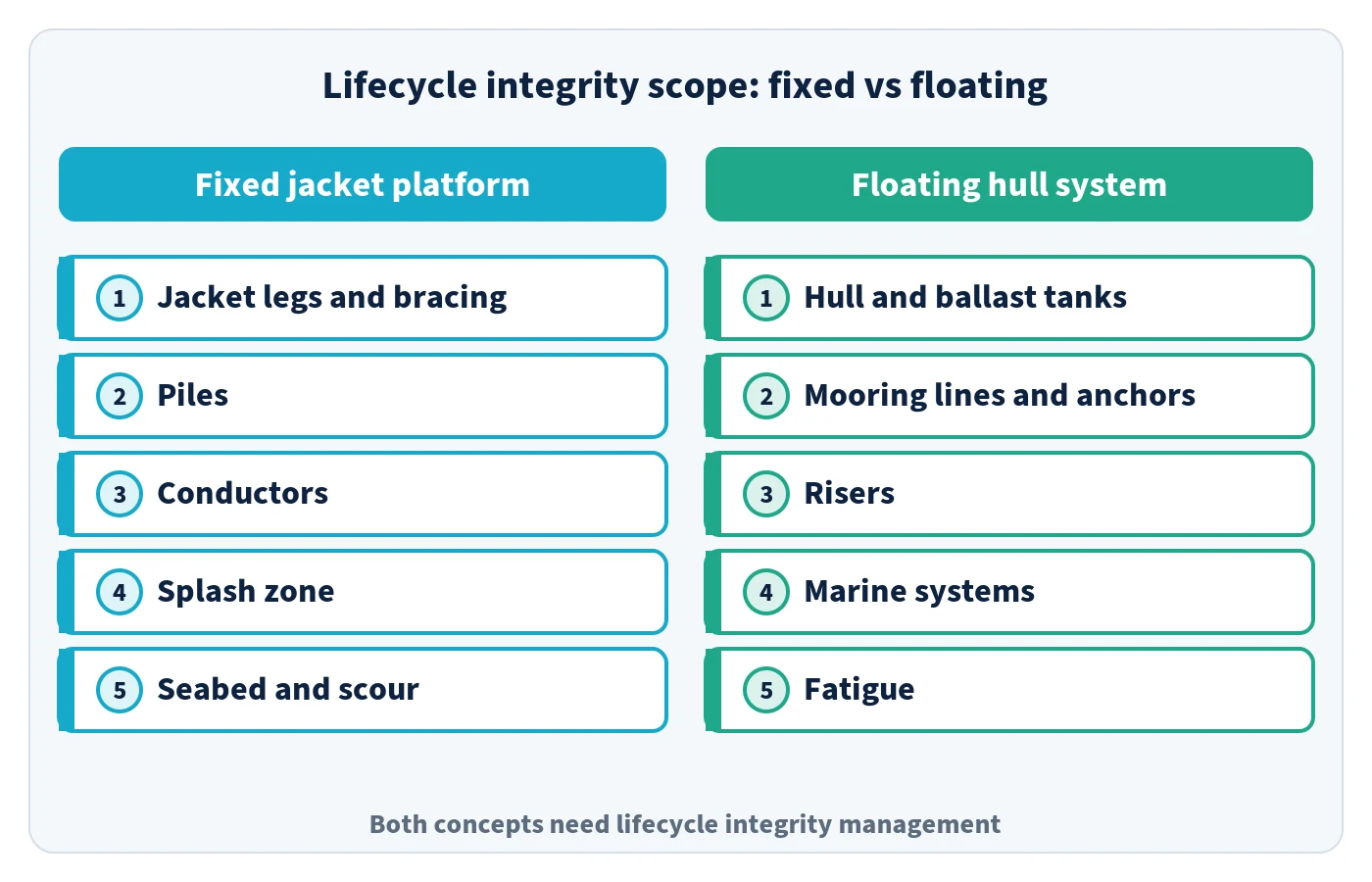
| Structural integrity | Jacket, piles, conductors, splash zone and seabed | Hull, ballast, moorings, tendons, anchors and fatigue |
| Flow assurance | Platform wells and export pipelines | Subsea flowlines, risers and long tie-backs |
| Marine systems | Boat landing, cranes and evacuation craft | Marine systems plus station keeping and offloading where fitted |
| Inspection access | Underwater fixed structure and topsides | Hull tanks, marine systems, risers and moorings |
| Shutdown risk | Export and platform-well dependencies | Subsea, riser, mooring and marine dependencies |
DNV provides separate lifecycle verification scopes for fixed structures and classification frameworks for floating production units, reflecting their different structural and marine assurance needs [3] [4].
Difference 7: decommissioning and reuse
A fixed platform is removed in sections or through approved abandonment and disposal methods, with wells, conductors, pipelines and seabed addressed under the relevant regime. Removal engineering can be substantial.
A floating unit may be disconnected and taken to a yard, sold, recycled or redeployed. Reuse is not automatic: a new field may require different processing, water depth, metocean capacity, fatigue life, mooring and regulatory compliance. Subsea infrastructure and wells still require decommissioning.
How to select the right production concept
Concept selection should compare complete development systems using consistent reservoir and commercial assumptions. Evaluate:
- production profile, fluid composition and processing duty;
- water depth, seabed and metocean design basis;
- well count, drilling approach and intervention philosophy;
- oil, gas and water export or disposal routes;
- local fabrication, installation and marine capability;
- operability, maintenance, staffing and evacuation;
- schedule, capital, operating cost and abandonment liability;
- expandability, tie-backs and reuse potential;
- safety, environmental and regulatory requirements.
Run sensitivity cases for reserves, plateau rate, weather downtime, pipeline availability, schedule and commodity price. A concept with the lowest initial capital may not maximise lifecycle value or resilience.
For reservoir-to-facility integration, EPW’s Advanced Oil and Gas Exploration and Production Fundamentals course provides useful context. Integrity competencies are covered in the Asset Integrity and Corrosion Management for Oil and Gas Facilities course.
Safety and regulatory considerations
Both concepts require hazard analysis, process containment, emergency shutdown, fire and gas detection, relief, evacuation and environmental protection. Floating systems add class and marine requirements, stability, ballast, collision, station keeping and offloading risks. Fixed installations require foundation and structural verification, boat-landing and underwater inspection controls.
BSEE’s incorporated standards include API RP 14C for analysing, designing, installing and testing safety systems on offshore production facilities [5]. Applicable requirements vary by jurisdiction and facility, so the project must establish its own regulatory and assurance basis.
Frequently asked questions
Is an FPSO the same as every floating production system?
No. An FPSO is a ship-shaped unit with processing, storage and offloading. Other floating systems include semi-submersibles, spars and tension-leg platforms.
Are fixed platforms only used in shallow water?
No. Fixed and compliant structures can serve a range of depths, but increasing depth generally makes a full-height seabed-supported structure more demanding.
Can floating platforms have dry trees?
Yes. Certain TLP and spar configurations can support surface wellheads. Many other floating developments use subsea trees and dynamic risers.
Which system is cheaper?
Neither is always cheaper. Compare the complete field-development lifecycle, including wells, export, installation, operations, downtime and decommissioning.
Build offshore facility expertise
Fixed and floating systems solve different combinations of reservoir, water-depth, export and operating constraints. EPW’s Offshore Oil and Gas Facility Design and Operations course connects concept selection, topsides systems, safety and lifecycle performance. Review the course outline or browse the wider Oil, Gas and Energy training portfolio.
Sources and references
- Bureau of Ocean Energy Management, platform structure classifications.
- Bureau of Safety and Environmental Enforcement, deepwater production systems.
- DNV, verification of fixed offshore structures.
- DNV, floating production classification.
- BSEE, standards development and incorporated offshore standards.