
AI-generated illustration created to represent the article’s subject. It does not depict an actual EPW course, trainer, participant, client, event or venue.
Construction schedules translate project scope into a time-based plan showing what must happen, in what sequence, by whom and by when. The right type depends on the decision being made: executives need a master programme, delivery teams need detailed phase and look-ahead schedules, buyers need procurement schedules, and managers facing delay need a recovery programme. These schedules should align rather than compete.
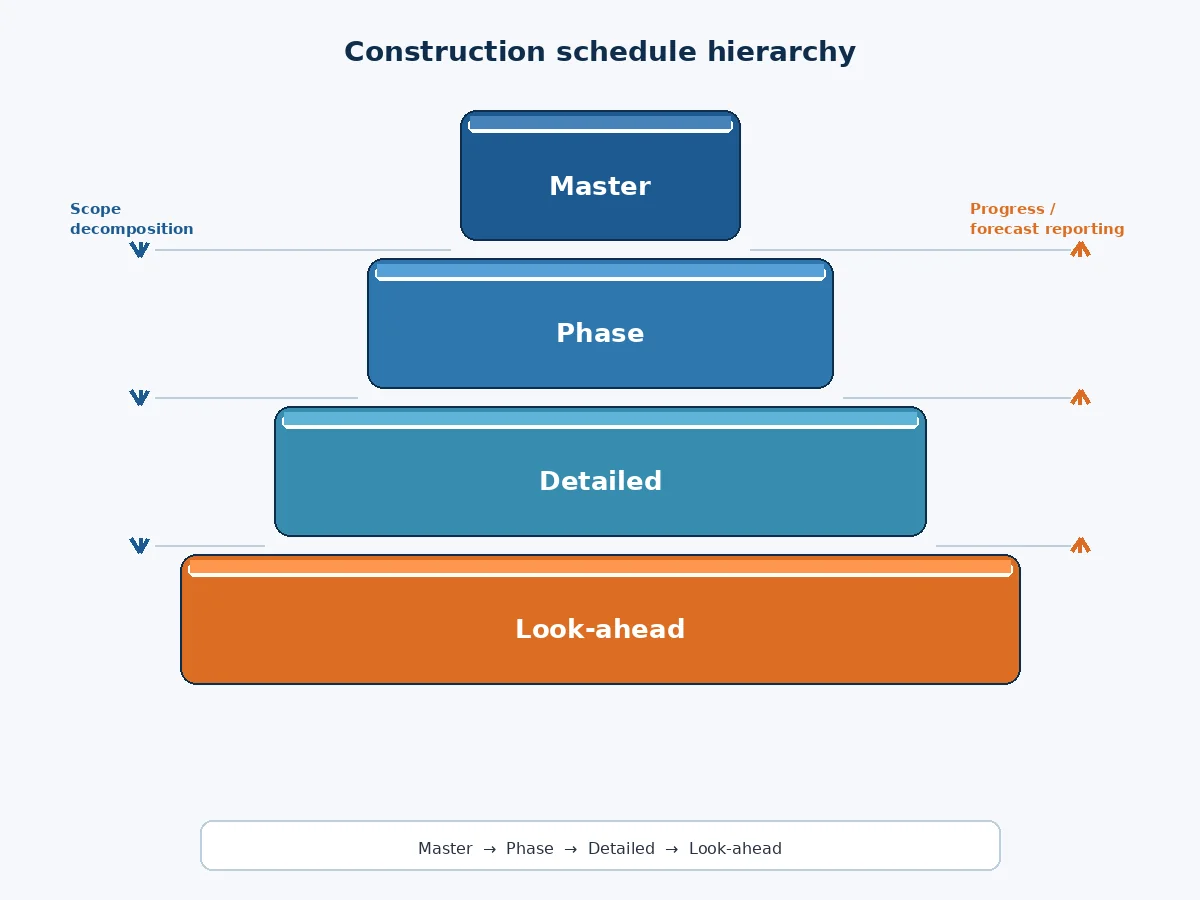
Construction professionals often use the word “schedule” as if it described one document. In practice, a controlled project uses a hierarchy of schedules at different levels of detail. The challenge is to select the minimum set that gives each audience reliable information without creating parallel versions of the truth.
Key takeaways
- A master schedule supports governance; detailed and short-term schedules support execution.
- Schedule type should follow the decision, audience, time horizon and available definition.
- Critical-path, critical-chain and location-based planning are scheduling methods, not substitutes for a schedule hierarchy.
- All schedule levels should use consistent milestones, calendars, coding and status dates.
- A schedule becomes a control tool only when it is baselined, updated with evidence and linked to corrective action.
Contents
- What a construction schedule must contain
- Main types of construction schedules
- How to select the right schedule
- Scheduling methods and formats
- How the schedule hierarchy works
- Worked civil-project example
- Quality checklist
What a construction schedule must contain
A schedule is more than a dated activity list. It should define activities or work packages, logical dependencies, durations, calendars, constraints, milestones and responsibility. At control level it also needs a status date, approved baseline, actual progress, remaining duration and a forecast finish.
The Association for Project Management places scheduling within project planning and highlights critical path and critical chain as principal approaches. The US Government Accountability Office Schedule Assessment Guide sets out ten practices for a reliable schedule, including capturing all activities, sequencing them logically, assigning resources, establishing realistic durations, confirming a valid critical path and maintaining a baseline.
These principles apply at every level, but the amount of detail must be proportionate. A board cannot govern a project from thousands of site activities, while a foreman cannot coordinate tomorrow’s excavation from six executive milestones.
Main types of construction schedules
| Schedule type | Primary use | Typical horizon/detail | Best used when |
|---|---|---|---|
| Master programme | Governance, funding and contractual milestones | Whole project; summary workstreams | Sponsors need a single strategic completion picture |
| Phase or stage schedule | Coordinate design, approvals, procurement and construction within a phase | Several months; intermediate detail | A defined stage needs integrated management |
| Detailed construction schedule | Plan and control trade or work-package execution | Weeks to months; activity-level logic | Production sequence, interfaces and critical path must be managed |
| Look-ahead schedule | Make work ready and coordinate crews | Usually two to six weeks | Near-term constraints and commitments need active removal |
| Procurement schedule | Control enquiries, approvals, manufacture and delivery | Long-lead packages and required-on-site dates | Late information or materials could delay site work |
| Design and approvals schedule | Manage information release, reviews and permits | Deliverables, review cycles and decision gates | Construction depends on coordinated design inputs |
| Resource-loaded schedule | Test labour, plant and productivity capacity | Activities with resource quantities or costs | Resource peaks or competing work fronts affect feasibility |
| Recovery schedule | Restore an agreed completion target after variance | Focused, more detailed than the current baseline | Delay requires approved resequencing, acceleration or added resources |
Master programme
The master programme communicates the project’s authorised time envelope. It normally includes major design releases, statutory approvals, procurement gates, access dates, construction phases, testing, handover and contractual completion. It should be stable enough for governance but still traceable to lower-level plans. Overloading it with minor tasks hides the decisions executives need to make.
Phase and detailed construction schedules
A phase schedule expands a section of the master programme—for example, substructure, bridge deck or station fit-out. The detailed construction schedule then shows executable activities, logic and interfaces. Detail should increase as scope becomes mature. Prematurely adding hundreds of speculative activities creates false precision; insufficient detail conceals hand-offs and critical work.
Look-ahead schedule
The look-ahead is a production-management view, not a replacement baseline. It should identify upcoming work, prerequisite information, labour, plant, permits, temporary works, access and materials. Teams can then assign owners and dates to remove constraints before a task becomes urgent. Commitments in the look-ahead must reconcile with the approved detailed schedule.
How to select the right construction schedule
Use four questions before choosing a schedule:
- What decision will it support? Funding approval, interface coordination, daily production and delay recovery require different evidence.
- Who will own and use it? Assign an accountable owner and define who supplies progress data and approves changes.
- What is the planning horizon? Longer horizons generally need less detail; near-term work can be decomposed as definition improves.
- What information is mature? Match activity detail to confirmed design, quantities, methods and procurement strategy.
| Decision need | Recommended schedule | Key control question |
|---|---|---|
| Approve investment or contractual dates | Master programme | Are major milestones feasible and governed? |
| Coordinate a design or construction phase | Phase schedule | Are interfaces and approvals logically connected? |
| Direct work packages | Detailed schedule | Is the sequence executable with available resources? |
| Prepare the next few weeks | Look-ahead | Which constraints must be cleared now? |
| Protect a required-on-site date | Procurement schedule | Are submittal, manufacture and logistics allowances adequate? |
| Respond to material delay | Recovery schedule | Is the proposed recovery safe, resourced and achievable? |
Practical learning prompt: If you manage civil works and want to practise building work breakdown structures, logic-driven networks, baselines and recovery plans, explore EPW’s Construction Project Management and Scheduling Course.
Scheduling methods and presentation formats
A schedule type describes purpose and level. A scheduling method describes how the plan is calculated or organised. Critical path method calculates the longest logic path and float through a network. Critical chain incorporates resource constraints and protective buffers. Location-based scheduling, line of balance and takt planning can make repetitive work—such as roads, pipelines, floors or housing units—easier to coordinate by location and production rate.
Gantt charts are a presentation format. They are useful for communicating timing, but a visually attractive bar chart is not necessarily a reliable network schedule. The underlying model still needs sound logic, calendars and status evidence. Milestone charts suit executives, while time-location diagrams can expose trade clashes that are difficult to see in a conventional bar chart.
How the schedule hierarchy works
Good governance establishes one integrated planning system. The master milestone is decomposed into phase and detailed activities; the near-term look-ahead selects work from those activities. Progress is captured at the lowest controlled level and rolled upward. Every level should share the same coding structure, approved calendars, milestone definitions and status date.
Baseline control is equally important. Preserve the approved baseline for variance measurement. Update the current schedule with actual starts, finishes, remaining durations and approved scope changes. Do not quietly overwrite the baseline to make performance appear better. If recovery is required, document the assumptions, additional resources, risks, safety checks and approval route.
Worked example: urban bridge replacement
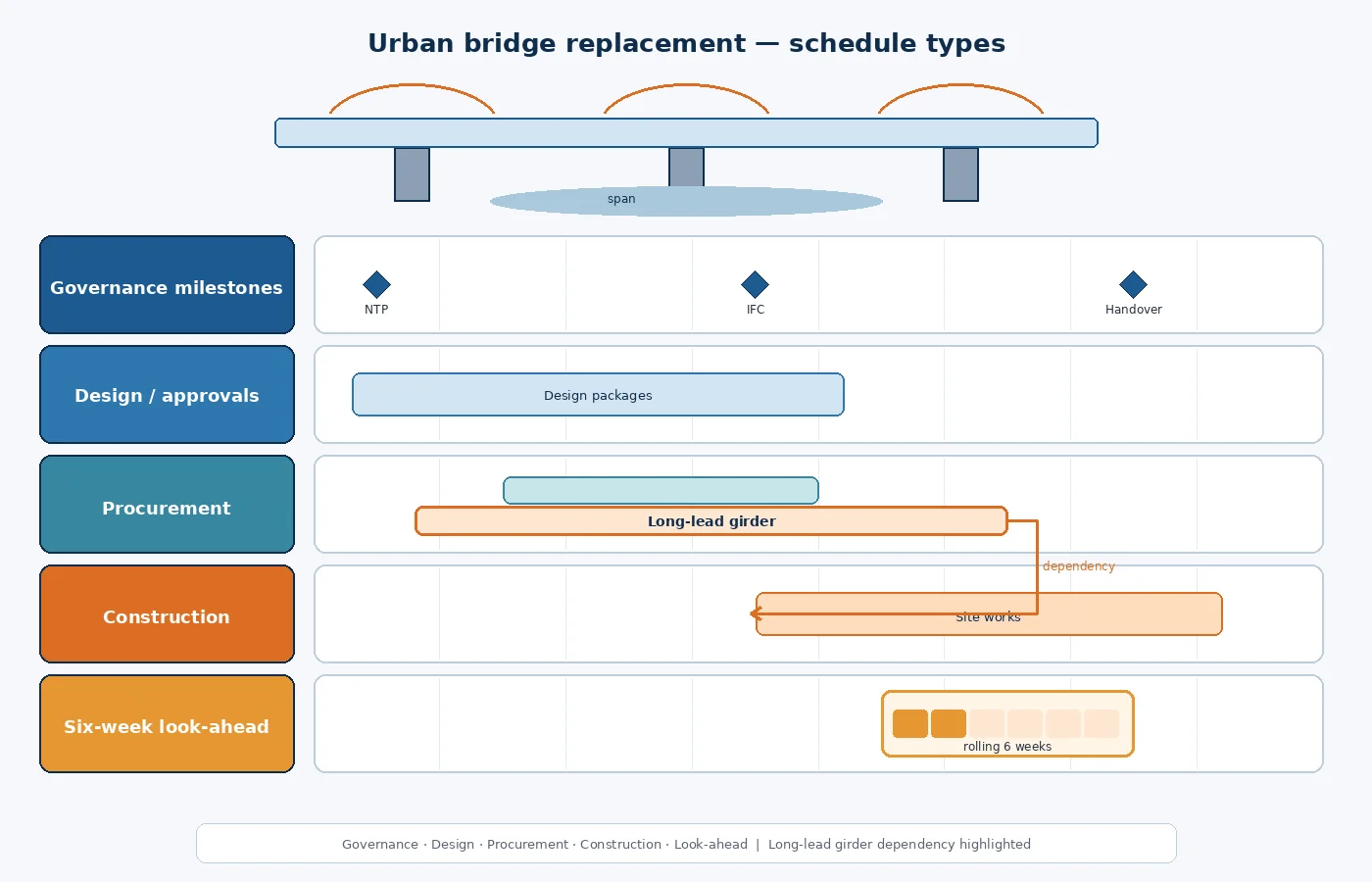
Consider a bridge replacement delivered under traffic constraints. The master programme may show design acceptance, utility diversion, possession windows, demolition, deck completion and reopening. A phase schedule expands substructure works and connects piling, pile caps, abutments and curing to temporary traffic stages.
The detailed schedule adds crew-level activities, inspection points and plant movements. A six-week look-ahead checks permits, rebar delivery, crane access, temporary works approval and weather-sensitive pours. A procurement schedule works backwards from girder installation through shop drawings, fabrication, coating, inspection and transport. If late utility diversion consumes float, a recovery schedule tests safe resequencing before management accepts acceleration.
The schedules serve different decisions, but their dates cannot conflict. If a delivery moves in the procurement schedule, the detailed plan, look-ahead and master forecast should reflect the same consequence.
Construction schedule quality checklist
- Scope is complete and traceable to a work breakdown structure.
- Activities have clear ownership, measurable completion rules and realistic durations.
- Logic reflects the delivery method; dangling activities and unnecessary constraints are resolved.
- Calendars, access limitations and review periods are explicit.
- Resources are tested where they could change the critical path or productivity.
- The baseline, current schedule and recovery scenarios are kept distinct.
- Progress is supported by contemporaneous evidence and entered to one status date.
- Critical and near-critical paths are reviewed, not merely reported by software.
- Upper and lower schedule levels reconcile at milestones.
- Changes and forecast movements have an auditable approval trail.
Develop stronger construction planning capability
The best schedule is the one that answers a defined management question with proportionate detail and dependable evidence. Use the master programme to govern outcomes, phase and detailed schedules to coordinate execution, look-ahead plans to make work ready, and specialist schedules to manage procurement, resources or recovery.
To build practical competence in WBS development, critical-path scheduling, resource planning, baseline control and delay recovery, review the EPW Construction Project Management and Scheduling Course. You can also browse the full Civil Engineering Training Courses portfolio, read how construction project management training supports career growth, or see essential training for beginner construction project managers.
Sources and references
- Association for Project Management — What is scheduling in project management?
- Association for Project Management — Planning, Scheduling, Monitoring and Control
- US Government Accountability Office — Schedule Assessment Guide: Best Practices for Project Schedules
Technical review note: Before publication, a qualified construction planner should confirm terminology and adapt any governance or contractual recommendations to the project’s procurement route and applicable contract.