

AI-generated illustration created to represent the article’s subject. It does not depict an actual EPW course, trainer, participant, client, event or venue.
Flexible pavements distribute traffic loads through several asphalt-bound and granular layers, while rigid pavements use the flexural stiffness of a concrete slab to spread loads over the foundation. Neither system is universally better. The appropriate choice depends on design traffic, subgrade and drainage, climate, materials, construction constraints, maintenance strategy, user disruption, risk and life-cycle economics.
This comparison is for highway and pavement professionals making an early type-selection decision. It explains the mechanisms, performance differences and evidence that should govern selection. Project-specific standards and the responsible road authority remain controlling.
Key takeaways
- Structural action differs: flexible systems rely on layered load distribution; rigid systems rely heavily on slab action.
- Failure modes differ: flexible pavements are commonly assessed for rutting, fatigue and thermal cracking, while rigid pavements require control of slab cracking, joints, faulting and load transfer.
- The foundation matters to both: uniform support, moisture control and drainage influence performance regardless of surface type.
- First cost is not the decision: compare construction, maintenance, rehabilitation, user impacts and residual value over a common analysis period.
- Local capability affects risk: materials supply, plant, workmanship, quality assurance and future maintenance capacity can change the preferred option.
Contents
- Comparison at a glance
- How flexible pavements work
- How rigid pavements work
- Key design and performance differences
- Pavement type selection framework
- Worked selection example
Flexible vs rigid pavements at a glance
| Criterion | Flexible pavement | Rigid pavement |
|---|---|---|
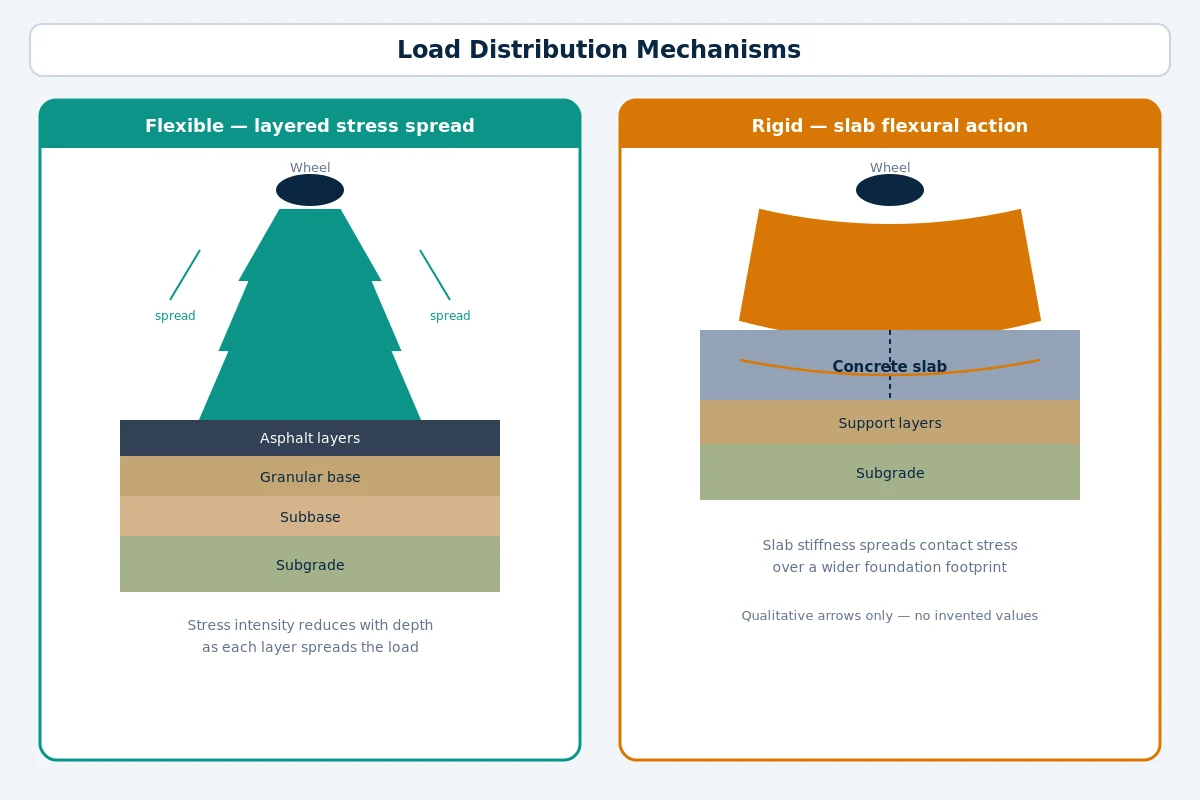
| Primary structural mechanism | Layered system progressively distributes wheel stresses | Concrete slab flexure spreads load over a wider foundation area |
| Typical surface | Asphalt mixture | Cement concrete |
| Foundation sensitivity | Layer stiffness and subgrade response strongly influence strain and rutting | Uniform, erosion-resistant support is important for slab support and joint performance |
| Typical structural checks | Asphalt fatigue, permanent deformation, thermal response and foundation performance | Slab cracking, load transfer, joint behaviour, faulting, erosion and foundation response |
| Temperature response | Asphalt stiffness changes with temperature and loading rate | Concrete slabs expand, contract and curl, requiring joint and restraint consideration |
| Construction sequence | Multiple compacted lifts, often with relatively quick staged opening | Slab placement, finishing, joint construction and strength development before opening |
| Maintenance profile | Surface treatments and overlays can be staged, but recurring interventions may be required | Joint, crack or slab repairs may be less frequent but can be disruptive and specialised |
| Economic comparison | Often attractive on initial flexibility and staged rehabilitation | May be attractive where long structural intervals and traffic disruption costs dominate |
| Selection principle | Compare technically viable alternatives using project risk and life-cycle cost—not material preference alone | |
How flexible pavements work
A conventional flexible pavement usually combines an asphalt surface with one or more bound or unbound layers over the prepared subgrade. The layers work together: higher-quality materials are generally placed nearer the surface, where traffic stresses and environmental exposure are greatest.
Wheel loads create vertical stresses, horizontal strains and recoverable and permanent deformation within the layered system. Engineers therefore consider traffic loading, asphalt properties, granular stiffness, subgrade resilience, temperature, moisture and drainage. The US Federal Highway Administration (FHWA) notes that realistic traffic loading forecasts and a uniform, stiff, moisture- and frost-resistant foundation are central to pavement structural design (FHWA pavement design and analysis guidance).
Typical flexible pavement distress
- Rutting: permanent deformation within asphalt, unbound layers, subgrade or a combination.
- Fatigue cracking: progressive cracking associated with repeated structural response.
- Thermal cracking: cracking caused or influenced by temperature contraction and material behaviour.
- Moisture-related damage: weakening, stripping or loss of support where water is not controlled.
- Surface deterioration: ravelling, oxidation, polishing or local defects affecting serviceability.
The distress label alone does not identify the cause. For example, an overlay may restore surface condition but will not correct a drainage defect or weak foundation. Investigation must locate the failing mechanism before treatment is selected.
How rigid pavements work
Rigid pavements use a concrete slab as the principal structural layer. Because the slab has high flexural stiffness relative to underlying layers, it distributes wheel loads over a wider area. The foundation still matters: changes in support, pumping, erosion, water and frost action can influence slab stress and joint performance.
Common systems include jointed plain concrete pavement, jointed reinforced concrete pavement and continuously reinforced concrete pavement. The appropriate form depends on the governing design method, local practice, expected movement, reinforcement strategy, construction capability and maintenance plan.
Joints and load transfer
Concrete expands and contracts with temperature and moisture changes, while temperature and moisture gradients can cause curling or warping. Joints provide controlled locations for movement and cracking. Their spacing, sealing, load-transfer arrangement and construction quality are design issues, not finishing details.
Rigid pavement assessment may consider transverse and longitudinal cracking, joint faulting, pumping, spalling, loss of load transfer and surface characteristics. A durable slab with weak or erodible support can still perform poorly at joints and edges.
What flexible and rigid pavements have in common
Both systems must provide safe, smooth and durable service under forecast traffic and environmental conditions. Both need reliable geotechnical information, drainage, suitable materials, construction quality assurance and a maintainable design. The FHWA’s Geotechnical Aspects of Pavements reference manual covers flexible, rigid and composite pavement systems while emphasising subgrade, drainage, construction and performance interactions.
Both also require performance criteria. A technically meaningful comparison should use the same traffic forecast, analysis period, reliability approach, climate assumptions and serviceability expectations. Changing assumptions between alternatives produces a price comparison, not an engineering comparison.
Key design and performance differences
1. Structural response and material behaviour
Flexible design is strongly influenced by the stiffness and thickness of each layer, the temperature- and rate-dependent behaviour of asphalt, and permanent deformation within the system. Rigid design concentrates on slab thickness and properties, load position, load transfer, joint or reinforcement details, foundation support and environmental slab movement.
2. Construction and opening strategy
Asphalt can often be laid in stages and opened after compaction and cooling, subject to the specification. Concrete requires controlled batching, placement, finishing, texturing, curing, joint construction and adequate strength before opening. Programme advantage depends on plant access, weather, traffic staging and the actual specification—not on pavement type alone.
3. Maintenance and rehabilitation
Flexible pavements support a range of surface treatments, milling and overlays. This can make intervention flexible, but frequent work may create cumulative cost and road-user disruption. Rigid pavement interventions may involve joint maintenance, partial-depth repair, full-depth slab replacement, grinding or overlays. Each alternative needs a credible future treatment sequence.
4. Traffic disruption and constructability
High traffic volumes, restricted possession windows, access constraints and detour limitations can make work-zone duration economically important. Conversely, an option that appears faster may fail if required materials, equipment or quality-control capability are unavailable. Constructability must be tested against the complete construction and renewal strategy.
5. Cost and economic risk
Initial construction cost does not measure economic value. FHWA describes life-cycle cost analysis (LCCA) as an engineering economic method for comparing differential costs of alternative investment options for a project (FHWA Life-Cycle Cost Analysis). A pavement comparison may include agency construction, maintenance and rehabilitation costs, work-zone user impacts, analysis timing, discounting and residual value, using the road authority’s approved procedure.
6. Sustainability and resource use
Environmental performance depends on material quantities, transport, energy, construction, service life, maintenance and end-of-life scenarios. Recycled content or a long nominal life is not enough to declare one system superior. Compare equivalent performance over an agreed boundary and document uncertainty.
If you need to connect structural behaviour, materials, drainage, quality control and whole-life decisions, EPW’s Highway Design and Pavement Technologies Course provides a structured professional route from design inputs to pavement management.
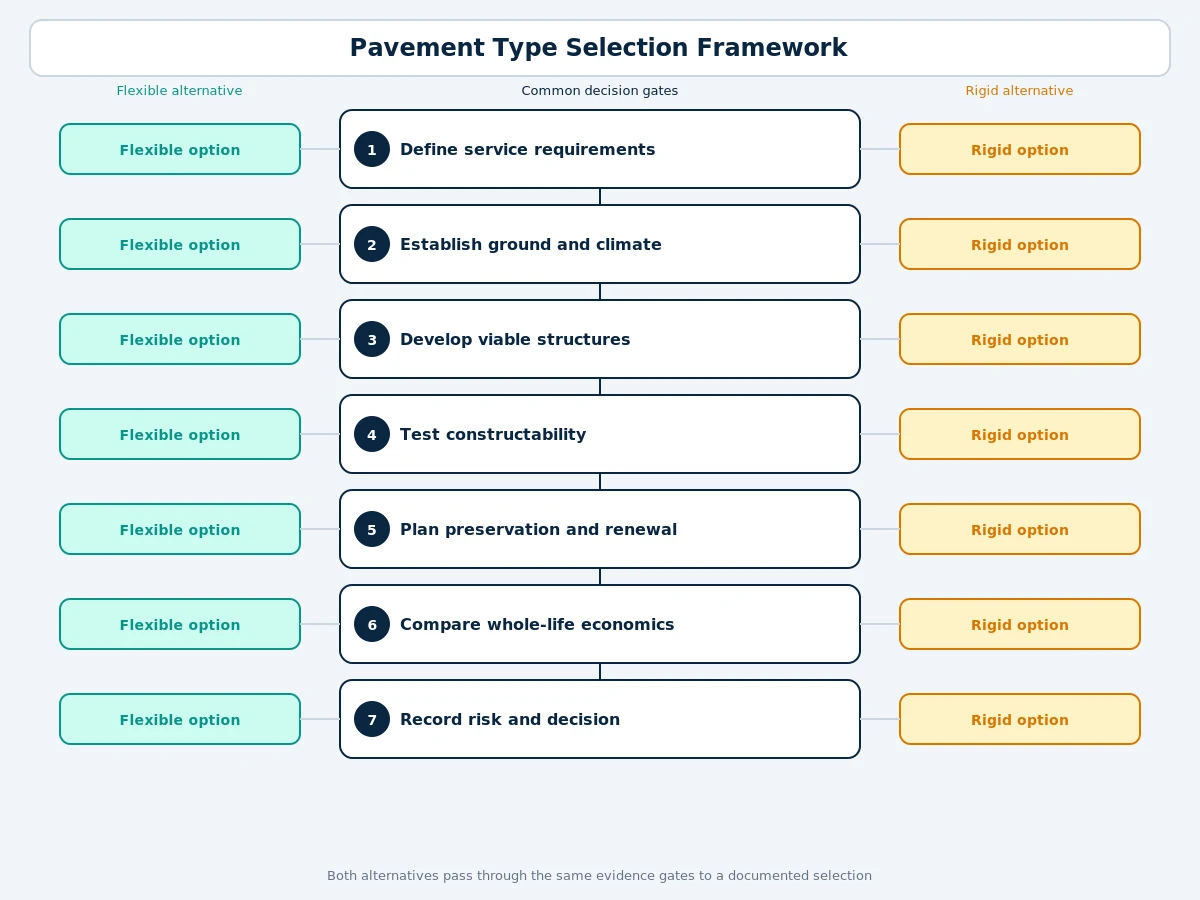
EPW pavement type selection framework
| Decision gate | Evidence required | Key question |
|---|---|---|
| 1. Define service requirements | Design life, traffic, reliability, ride, safety, access and allowable disruption | What performance must every option achieve? |
| 2. Establish ground and climate conditions | Subgrade variability, moisture, drainage, frost or heat exposure and geotechnical risk | Can a uniform, durable foundation be delivered? |
| 3. Develop viable structures | Authority-approved design method, materials and predicted distress | Which alternatives satisfy the same criteria? |
| 4. Test constructability | Plant, labour, supply chain, staging, curing, possessions and quality controls | Can each design be built consistently within site constraints? |
| 5. Plan preservation and renewal | Inspection, treatment triggers, maintenance methods and future closures | How will performance be sustained? |
| 6. Compare whole-life economics | Common analysis period, cost timing, user impacts, discounting and sensitivity | Which option offers value under plausible scenarios? |
| 7. Record risk and decision | Assumptions, uncertainties, owners and approval | Is the recommendation transparent and reviewable? |
Worked example: heavily trafficked urban corridor
Consider an urban reconstruction project with high heavy-vehicle demand, limited diversion routes and utilities beneath the carriageway. The subgrade is variable and water control is a known risk. A flexible alternative offers staged construction and future access through milling and reinstatement. A rigid alternative offers a stiff structural slab but requires carefully planned curing, joints and future utility interventions.
The team first develops compliant designs for both alternatives using the same traffic, climate, foundation and performance criteria. It then models construction stages and future interventions, including the duration and traffic impact of each closure. Foundation improvement is priced consistently rather than assigned to only one option.
Life-cycle analysis tests material cost, treatment timing and work-zone effects. A sensitivity case examines faster asphalt deterioration; another examines earlier concrete joint repair. The preferred system is the one that remains technically compliant and economically defensible across plausible scenarios. The example deliberately has no universal winner: local evidence produces the answer.
Common comparison mistakes
- Choosing by first cost. Include credible maintenance, rehabilitation and user-impact scenarios.
- Assuming one foundation suits both designs. Develop and cost the support required by each viable structure.
- Using generic service-life claims. Base treatment timing on local performance evidence and the approved design method.
- Ignoring drainage. Surface type cannot compensate for uncontrolled water and loss of support.
- Comparing unequal performance levels. Apply common traffic, reliability and service criteria.
- Treating maintenance as an afterthought. Plan access, materials, skills and closures from the outset.
- Using a single economic forecast. Test the assumptions that could change the decision.
Developing highway and pavement design capability
Sound pavement selection integrates materials, structural response, geotechnics, drainage, traffic, construction quality and asset economics. Explore EPW’s Highway Design and Pavement Technologies Course, the related Transportation Engineering and Traffic Management Course, or EPW’s wider Civil Engineering Training Courses.
Ready to make better-supported pavement type decisions? Review the highway course content and available locations, or request tailored in-house training for your engineering team.
Conclusion
Flexible and rigid pavements differ most clearly in structural action, material behaviour, distress mechanisms, construction and intervention strategy. Those differences matter, but they do not create a universal ranking.
A defensible selection begins with common service requirements, develops technically viable alternatives, tests foundation and construction risk, plans future treatments and compares whole-life economics under uncertainty. That process turns a material preference into an auditable engineering decision.
Sources and References
- Federal Highway Administration. Geotechnical Aspects of Pavements, Chapter 1: Pavement Systems and Types.
- Federal Highway Administration. Geotechnical Aspects of Pavements Reference Manual.
- Federal Highway Administration. Pavement Design and Analysis Guidance.
- Federal Highway Administration. Life-Cycle Cost Analysis.
- Federal Highway Administration. Appendix C: Flexible and Rigid Pavement Structural Design Procedures.