

AI-generated illustration created to represent the article’s subject. It does not depict an actual EPW course, trainer, participant, client, event or venue.
HR business partner operating models define how HR business partners connect business leaders with specialist expertise, shared services, workforce data and employee-facing support. There is no universally superior structure. The right model depends on organisational scale, business diversity, decision speed, manager capability and the work that HR business partners are expected to own.
This article explains six practical types of HR business partner (HRBP) operating model, their strengths and limitations, and the conditions in which each works best. It is written for HR directors, heads of people, organisation-design professionals and senior HRBPs reviewing how their people function delivers value.
Key takeaways
- Separate the HRBP role from the HR operating model: the role describes contribution, while the model defines accountabilities, interfaces and service delivery.
- Most large organisations use a hybrid of embedded HRBPs, centres of expertise and shared or digital services.
- Structural labels matter less than decision rights, service boundaries, capability and the quality of relationships with line leaders.
- Choose a model against explicit criteria and test it with real business scenarios before reorganising the people function.
Contents
- What is an HRBP operating model?
- Six types of HR business partner operating model
- HRBP operating-model comparison
- How to select the right model
- How to make the model work
What is an HR business partner operating model?
An HRBP operating model is the blueprint for how business-facing HR professionals are organised, what decisions they make, which services they provide, and how they work with other parts of HR. The Chartered Institute of Personnel and Development (CIPD) describes an HR operating model as covering the function’s structure, hierarchy, reporting lines, relationships, processes, systems, people and technology. Its analysis emphasises that the model should help the people function deliver value to the organisation and its internal customers. CIPD’s analysis of future HR operating models provides this broader definition.
Business partnering is therefore more than a job title. The CIPD describes it as a practice through which the people function works alongside the organisation to develop people solutions that support business objectives and enable employees to flourish. Its business partnering factsheet also stresses the importance of organisational context.
A useful model answers five operational questions:
- Which leaders or business segments receive dedicated HRBP support?
- Which employee and manager needs are handled by HRBPs, managers, shared services or self-service?
- How do HRBPs access specialist expertise in reward, talent, learning, employee relations and organisation development?
- Who owns workforce insight, prioritisation and implementation?
- How will the organisation know that the model is creating value?
Six types of HR business partner operating model
The following classification is an EPW decision framework rather than a claim that every organisation uses one standard taxonomy. Real people functions frequently combine elements from several models.
1. Embedded generalist HRBP model
In an embedded model, an HRBP or small HR team sits close to a business unit, geography or function and handles a broad portfolio. The partner may advise leaders, support employee relations, coordinate talent activity, interpret policy and deliver change.
Best suited to: smaller organisations, distinct business units, geographically separated operations, or contexts where leaders value one accountable HR contact.
Advantages: strong local knowledge, clear relationship ownership and faster contextual decisions. Limitations: duplication across units, variable practice, limited specialist depth and a risk that urgent casework crowds out strategic work.
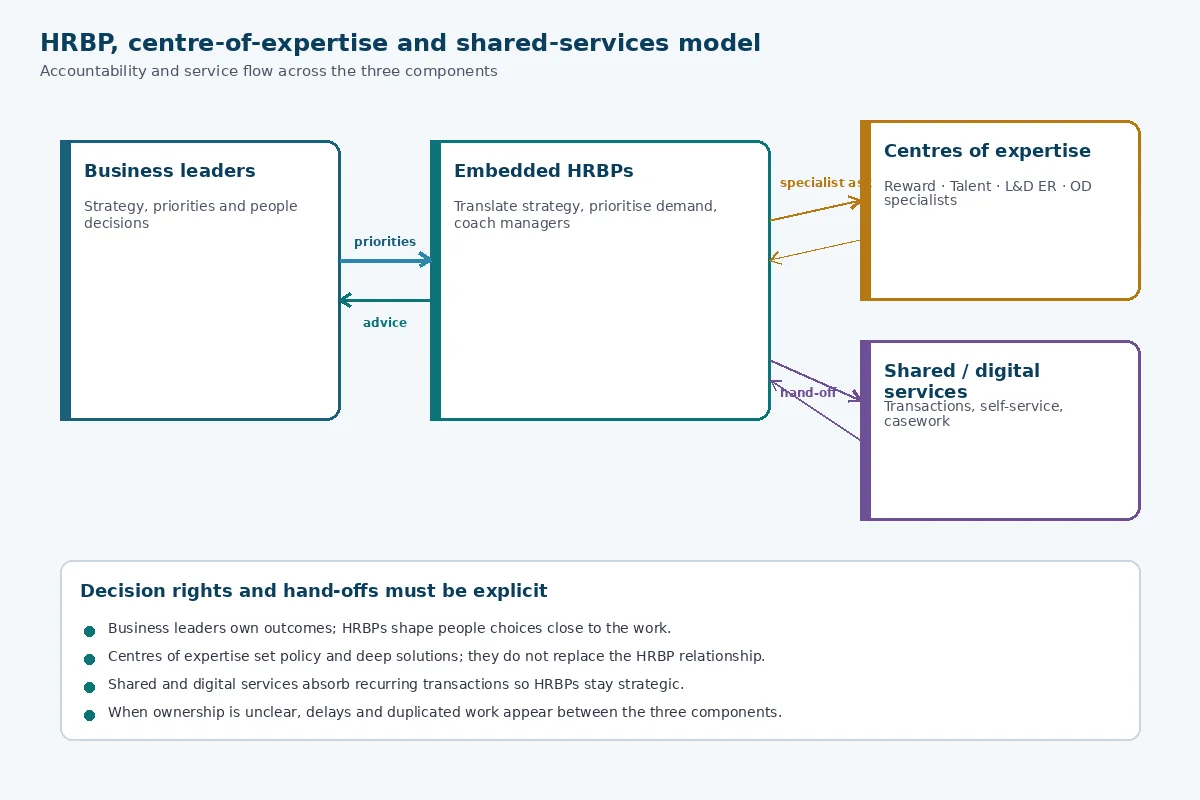
2. HRBP, centre-of-expertise and shared-services model
This widely recognised model separates business-facing partnership from specialist design and repeatable service delivery. HRBPs work with leaders; centres of expertise develop policies and specialist solutions; shared or digital services manage standard transactions, information and case routing.
Best suited to: medium and large organisations with sufficient scale to specialise work and standardise common services.
Advantages: deeper expertise, consistent services and more HRBP capacity for strategic priorities. Limitations: hand-off delays, unclear ownership and frustration when the three components optimise their own work rather than the end-to-end business outcome.
3. Segment-aligned strategic partner model
Here, senior HRBPs are assigned to a product line, customer segment, corporate function or business portfolio. They concentrate on strategic workforce choices rather than routine service delivery. Operational enquiries move through manager self-service, employee services or specialist teams.
Best suited to: diversified groups whose business segments have materially different strategies, skills, labour markets or change agendas.
Advantages: close alignment with commercial priorities and clearer accountability for workforce plans. Limitations: inconsistent enterprise practice, competition for specialist resources and possible duplication when segment independence is not balanced by group governance.
4. Hub-and-spoke or regional HRBP model
A central hub sets enterprise priorities, standards and capability, while regional or country HRBPs adapt delivery to local operating and legal contexts. Some specialist expertise may be central; other capability remains in regional spokes.
Best suited to: multinational, multi-site or federated organisations that need both enterprise consistency and legitimate local adaptation.
Advantages: economies of scale, coordinated governance and better local responsiveness than a fully centralised model. Limitations: matrix tension, slow escalation and ambiguity about whether global, regional or local leadership makes the final decision.
5. Employee-journey or product-based people model
This model organises teams around end-to-end experiences or products such as joining, developing, moving, rewarding or leaving. Cross-functional teams combine HR, technology, analytics and service-design expertise. HRBPs represent business needs and help prioritise the work rather than individually owning every solution.
Best suited to: digitally mature organisations seeking to simplify employee experience, reduce functional silos and manage HR services as products.
Advantages: clearer end-to-end ownership, faster iteration and better integration of process and technology. Limitations: substantial change to funding and governance, possible tension with functional specialists, and a need for strong product and data capability.
6. Networked or agile HRBP model
In a networked model, HRBPs and specialists form temporary multidisciplinary teams around a defined business problem—for example, a merger, capability shift, workforce redesign or market entry. A smaller permanent partnering core maintains leadership relationships and assembles expertise as priorities change.
Best suited to: project-led, fast-changing or highly matrixed organisations with mature collaboration and portfolio-management practices.
Advantages: flexible use of scarce expertise and better focus on strategic outcomes. Limitations: competing priorities, unstable team membership and weaker accountability if sponsorship, resourcing and decision rights are not explicit.
HRBP operating-model comparison
| Model | Primary organising logic | Main strength | Main risk | Useful success measure |
|---|---|---|---|---|
| Embedded generalist | Business unit or location | Context and accessibility | Transactional overload | Leader confidence and strategic capacity |
| HRBP–expertise–services | Type of HR work | Scale and specialist depth | Fragmented hand-offs | End-to-end resolution and business impact |
| Segment-aligned | Business portfolio | Strategic alignment | Enterprise inconsistency | Delivery of segment workforce priorities |
| Hub-and-spoke | Enterprise and region | Global consistency with local fit | Matrix ambiguity | Decision speed and permitted local variation |
| Journey or product-based | Employee experience | End-to-end ownership | Governance disruption | Journey outcomes and service adoption |
| Networked or agile | Strategic problem | Flexible expertise | Diffuse accountability | Outcome delivery and portfolio throughput |
The CIPD’s case studies show why labels alone are insufficient. Its Firstsource operating-model case study describes a redesigned structure intended to clarify roles, address capability gaps and support more strategic work. Its NatWest Group case study describes a model built around goals, employee journeys and shared capabilities. These are contextual examples, not templates to copy without diagnosis.
How to select the right HRBP operating model
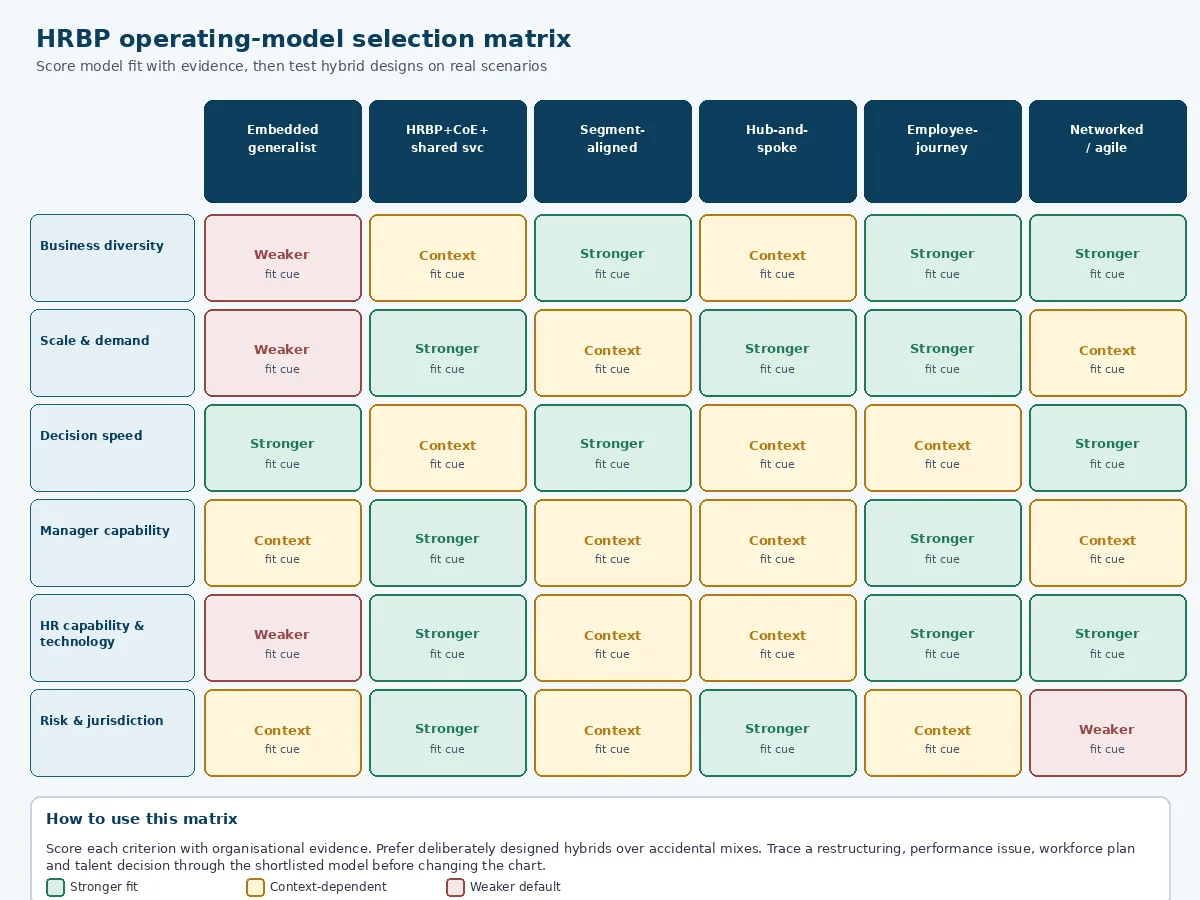
Use the following six criteria to compare options. Score each model against evidence rather than management preference.
- Business diversity: How different are the strategies, customers, skills and labour markets across business units?
- Scale and demand: Is there enough recurring work to support specialist teams and shared services?
- Required decision speed: Which people decisions must be made close to operations, and which benefit from enterprise control?
- Manager capability: Can line managers handle routine people management with reliable policy, tools and advice?
- HR capability and technology: Does HR have the consulting, analytics, service, product and specialist capability the chosen model assumes?
- Risk and jurisdiction: Which matters require local legal expertise, consistent governance or specialist review?
A simple decision rule is to centralise work where scale, consistency or scarce expertise adds value; embed work where context, trust or response time is decisive; and create cross-functional teams where the outcome spans several HR disciplines. Avoid pushing casework away from HRBPs until managers and service channels can absorb it reliably.
How to make the chosen model work
Restructuring boxes on an organisation chart does not create effective business partnering. The CIPD identifies the HRBP as the link between business strategy and human resource management, and notes the challenge of balancing operational support with strategic influence. Its analysis of the HRBP role in operating models highlights the need to refine both role and surrounding system.
Before launch, complete five implementation controls:
- Publish a service catalogue: define what HRBPs, managers, specialist teams and services own.
- Set decision rights: specify who recommends, approves, delivers and reviews recurring people decisions.
- Test real scenarios: trace a restructuring, performance issue, workforce plan and talent decision through the proposed model.
- Build capability: assess business acumen, consulting, data, organisation design, change and stakeholder skills.
- Measure outcomes: combine service measures with evidence that priority workforce and organisational outcomes improve.
For a fuller explanation of the profession and its contribution, see EPW’s article on the role of HR business partnering in workforce success. Professionals developing their strategic partnering capability can also review HR business partnering training and core skills.
If your organisation is reviewing role boundaries, stakeholder influence and strategic alignment, EPW’s HR Business Partnering and Strategic Alignment course provides a structured development route. The wider Human Resources Training Courses category connects this topic with analytics, performance, change and workforce planning.
Conclusion
The strongest HR business partner operating model is the one that makes value delivery clear: leaders know where to obtain strategic advice, managers know which responsibilities they own, employees receive reliable services, and specialist expertise reaches the right decisions without avoidable delay. Most organisations will need a hybrid, but that hybrid should be deliberately designed rather than allowed to emerge through unclear exceptions.
Ready to strengthen strategic HR partnering in your organisation? Explore the HR Business Partnering and Strategic Alignment course to review learning outcomes, dates and locations, or discuss tailored in-house development.
Sources and References
- Chartered Institute of Personnel and Development. Business partnering. 25 September 2025. CIPD.
- Chartered Institute of Personnel and Development. Do current HR operating models serve future needs? 5 June 2024. CIPD.
- Chartered Institute of Personnel and Development. Critical role of HR business partnering in HR operating models. 3 September 2024. CIPD.
- Chartered Institute of Personnel and Development. Transforming the HR operating model: Firstsource. 5 June 2024. CIPD.
- Chartered Institute of Personnel and Development. Transforming the HR operating model: NatWest Group. 9 July 2024. CIPD.