

AI-generated illustration created to represent the article’s subject. It does not depict an actual EPW course, trainer, participant, client, event or venue.
Regulatory compliance risks are the ways an organisation can fail to meet laws, regulatory rules, licence conditions or enforceable standards. The main types normally include regulatory-change, authorisation, conduct, financial-crime, data-protection, health-and-safety, reporting and third-party risks. A useful classification does more than name them: it connects each exposure to an owner, proportionate controls, monitoring and evidence.
This article is for compliance officers, risk managers, internal auditors and operational leaders who need a practical taxonomy for a regulated organisation. It explains eight risk types, the controls that commonly address them and a decision method for avoiding both control gaps and unnecessary bureaucracy.
Key takeaways
- Classify compliance risk by the obligation and failure scenario, not merely by department.
- Use preventive, detective and corrective controls together for material risks.
- Specify what evidence proves each control operated, who reviews it and how often.
- Reassess controls when regulations, products, systems, countries or third parties change.
- Treat a control as effective only after design and operating performance have been tested.
How to classify regulatory compliance risk
Start with an obligation inventory: the laws, rules, permits, contractual regulatory commitments and supervisory expectations that apply to the organisation. Then describe the event that would constitute failure, the affected process, the possible consequence and the evidence a regulator or auditor would expect to see.
The classification should remain useful across functions. For example, a failure to screen a new distributor may be recorded by procurement, but the underlying exposure can include anti-bribery, sanctions, fraud, data-protection and licence risks. The US Department of Justice’s 2024 compliance-program guidance asks whether a company’s risk assessment is subject to periodic review, whether resources follow the risk profile and whether lessons from misconduct are incorporated. This supports a dynamic, risk-based register rather than a static list.
Regulated organisations should also separate inherent risk from residual risk. Inherent risk is the exposure before controls; residual risk is what remains after considering control design and performance. This distinction prevents a strong policy document from being mistaken for proof that the underlying risk is low.
Eight types of regulatory compliance risks and controls
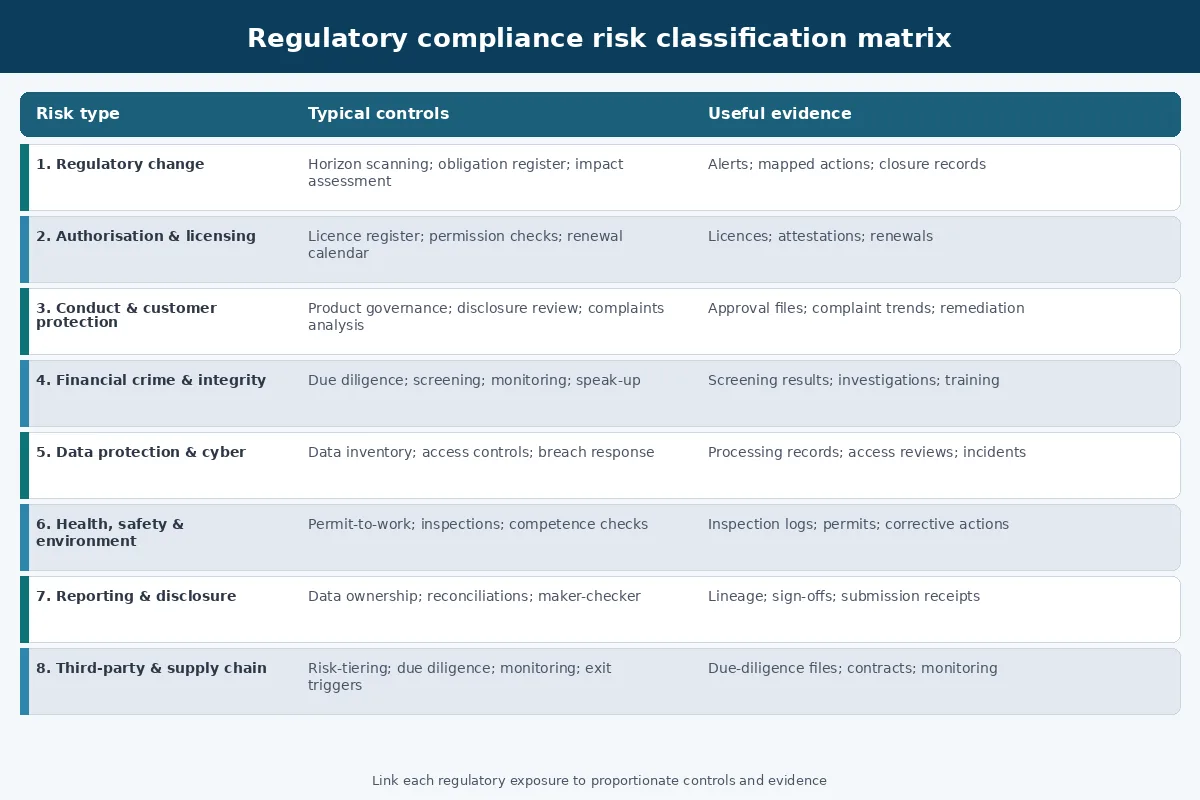
| Risk type | Typical failure | Example controls | Useful evidence |
|---|---|---|---|
| 1. Regulatory change | A new or amended requirement is missed or implemented late | Horizon scanning, obligation register, change-impact assessment | Regulatory alerts, mapped actions, approvals and closure records |
| 2. Authorisation and licensing | The organisation operates outside permissions or breaches licence conditions | Licence register, permission checks, renewal calendar, product approval | Current licences, attestations, committee minutes and renewal submissions |
| 3. Conduct and customer protection | Products, communications or decisions create unfair customer outcomes | Product governance, disclosure review, complaints analysis, conduct monitoring | Approval files, customer testing, complaint trends and remediation logs |
| 4. Financial crime and integrity | Bribery, fraud, money laundering, sanctions or conflicts are not prevented or detected | Due diligence, screening, approval limits, transaction monitoring, speak-up channels | Screening results, investigation files, training records and disciplinary outcomes |
| 5. Data protection and cyber compliance | Personal or regulated data is collected, used, retained or secured unlawfully | Data inventory, access controls, impact assessments, retention and breach response | Processing records, access reviews, test results and incident decisions |
| 6. Health, safety and environmental compliance | Operations breach safety, environmental or permit requirements | Permit-to-work, inspections, competence checks, monitoring and incident escalation | Inspection logs, permits, calibration records and corrective actions |
| 7. Reporting, records and disclosure | Regulatory returns, financial records or mandatory disclosures are inaccurate or late | Data ownership, reconciliations, maker-checker review, submission calendar | Source-to-report lineage, sign-offs, exception reports and submission receipts |
| 8. Third-party and supply-chain compliance | An agent, supplier or outsourced provider causes or conceals non-compliance | Risk-tiering, due diligence, clauses, monitoring, audit rights and exit triggers | Due-diligence files, contracts, monitoring results and remediation decisions |
1. Regulatory-change risk
Requirements can change through legislation, regulator rules, guidance, licence variations, enforcement outcomes or new supervisory priorities. The risk is not only failing to notice a change; it also includes poor interpretation, unclear ownership and incomplete operational implementation.
A strong control chain records the source, effective date, affected entities and processes, accountable owner, required actions and implementation evidence. High-impact changes should receive legal or specialist interpretation and independent challenge before closure.
2. Authorisation and licensing risk
This risk arises when an organisation, employee, branch, product or service operates without the correct permission or outside imposed conditions. It can also arise from missed renewals, unreported changes or activities performed in the wrong legal entity.
Controls should combine a central licence register with transaction-level or product-level checks. Renewal reminders alone are insufficient if staff can still launch an activity that exceeds the organisation’s permissions.
3. Conduct and customer-protection risk
Conduct risk concerns how decisions affect customers, markets and other stakeholders. Common failures include unsuitable products, misleading communications, biased decisions, poor treatment of vulnerable customers, unmanaged conflicts and ineffective complaints handling.
Controls should begin during product or service design and continue through distribution, customer communication, outcome monitoring and remediation. Management information must show outcomes, not only activity volumes.
4. Financial-crime and integrity risk
This category includes bribery, corruption, fraud, money laundering, terrorist financing, sanctions breaches, market abuse and conflicts of interest. The risk profile depends on geography, customers, payment methods, government touchpoints, intermediaries and transaction patterns.
The OECD Anti-Bribery Recommendation and its Good Practice Guidance emphasise risk-based internal controls, ethics and compliance measures. Relevant controls include third-party due diligence, segregation of duties, approval thresholds, screening, monitoring, confidential reporting and proportionate discipline.
5. Data-protection and cyber-compliance risk
Data risk spans lawful collection, purpose limitation, transparency, security, retention, individual rights, international transfer and breach response. Ownership must therefore extend beyond information technology to product, operations, legal, procurement and records-management teams.
The UK Information Commissioner’s Office states that accountability requires appropriate technical and organisational measures and evidence that compliance steps were taken. Its data-protection audit framework offers practical control measures for assessing this evidence. Security controls can also be mapped against the official NIST SP 800-53 control catalogue, tailored to the organisation’s legal and operational context.
6. Health, safety and environmental compliance risk
These risks arise where people, assets, communities or the environment may be harmed and where permits or statutory duties apply. Controls must be embedded in operational work: competence, maintenance, permits, inspections, exposure monitoring, emergency response and stop-work escalation.
Evidence quality is important. A signed checklist is weak if the inspection was superficial, the measuring instrument was not calibrated or overdue corrective actions were tolerated.
7. Reporting, records and disclosure risk
Regulators often depend on accurate and timely returns, notifications and records. Failures may result from ambiguous data definitions, manual manipulation, broken interfaces, weak reconciliations or unclear sign-off responsibility.
Effective controls trace data from source system to submitted figure, apply validation and reconciliation, document adjustments and require accountable review. Retention rules should preserve both the final submission and the evidence used to support it.
8. Third-party and supply-chain compliance risk
Outsourcing a process does not necessarily transfer the organisation’s regulatory accountability. Agents, distributors, suppliers, contractors and cloud providers may introduce bribery, sanctions, privacy, safety, labour, resilience and reporting risks.
Risk-tier third parties before onboarding, apply due diligence proportionate to exposure, include enforceable control and notification clauses, monitor performance, and define escalation and exit triggers. EPW’s overview of why third-party risk management matters provides broader context for this lifecycle.
Preventive, detective and corrective controls
A mature programme does not rely on a single control type. It creates layers:
- Preventive controls reduce the chance of failure. Examples include restricted system access, approval thresholds, mandatory due diligence and automated validation.
- Detective controls identify failure or weakening performance. Examples include reconciliations, exception reports, surveillance, quality reviews and compliance testing.
- Corrective controls contain harm and prevent recurrence. Examples include customer remediation, control redesign, disciplinary action, regulatory notification and root-cause action plans.
The official US Sentencing Commission guideline §8B2.1 identifies standards and procedures, oversight, training, monitoring and auditing, reporting mechanisms, incentives and discipline, response and periodic risk assessment as elements of an effective compliance and ethics programme. This illustrates why policy alone cannot provide a complete control environment.
How to select proportionate compliance controls
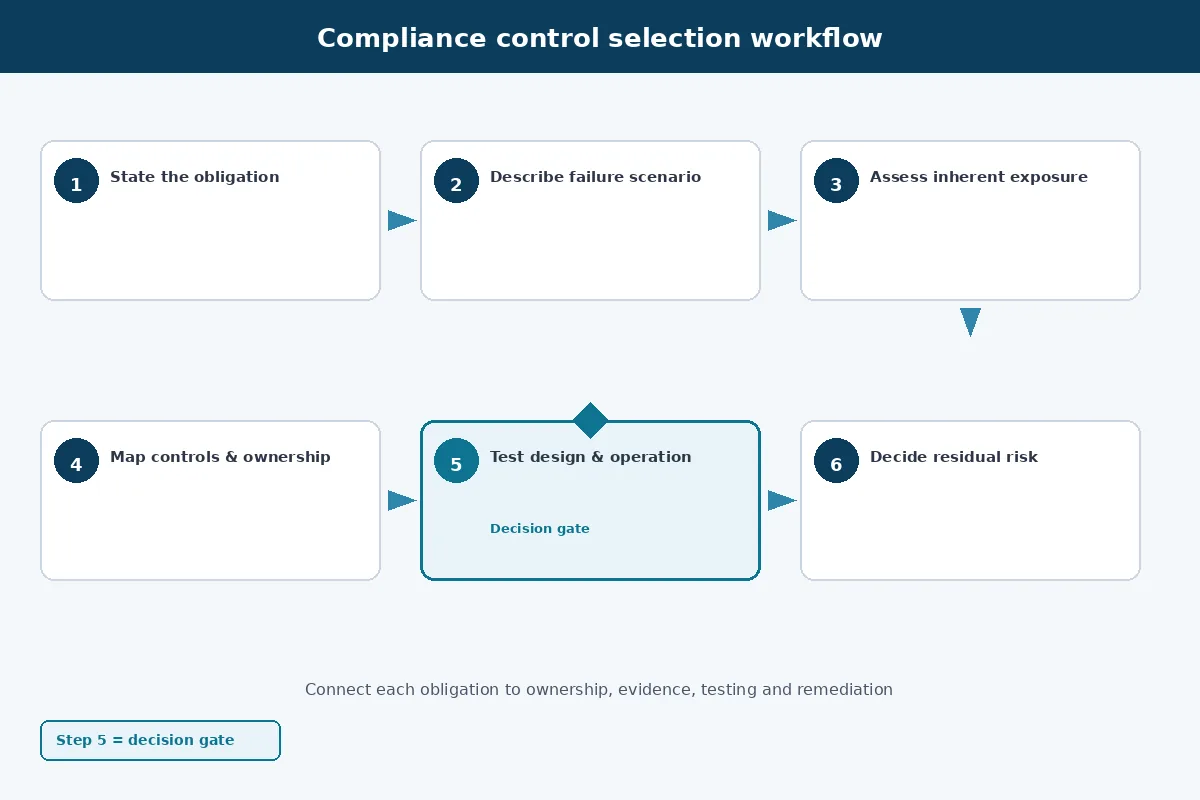
- State the obligation precisely. Record jurisdiction, legal entity, product, process, effective date and source.
- Describe the failure scenario. Explain who could do what, through which process, and what consequence could follow.
- Assess inherent exposure. Consider likelihood, impact, speed of harm, detectability and regulatory significance.
- Map existing controls. Identify control owner, frequency, system or manual operation, dependencies and required evidence.
- Test design. Ask whether the control would prevent, detect or correct the stated failure under realistic conditions.
- Test operation. Sample evidence, inspect exceptions, evaluate timeliness and confirm reviewers challenged rather than merely signed.
- Decide residual risk. Accept, improve, transfer or stop the activity within approved risk appetite and legal limits.
- Monitor change. Reassess after regulatory, product, system, geographic, workforce or third-party changes.
For UK-regulated financial firms, the Financial Conduct Authority’s SYSC 6 rules require adequate policies and procedures and regular assessment of their adequacy and effectiveness. The principle is broadly useful elsewhere: controls must be maintained and evaluated, not simply documented.
Worked example: onboarding a high-risk distributor
Assume a regulated manufacturer plans to appoint a distributor in a jurisdiction with high bribery and sanctions exposure. The inherent risks include improper payments, prohibited counterparties, inaccurate records, misleading promotion and mishandling of customer data.
| Stage | Control decision | Evidence |
|---|---|---|
| Before approval | Ownership verification, sanctions and adverse-media screening, conflict declarations and risk-tiered due diligence | Search results, verified documents, risk rating and approval record |
| Contracting | Defined territory and services, compliance warranties, audit rights, training, notification and termination clauses | Approved contract and exceptions log |
| Operation | Payment controls, marketing approval, transaction monitoring and periodic certification | Invoices, approvals, monitoring reports and attestations |
| Review | Risk-based refresh, exception investigation and remediation or exit decision | Review file, findings, action owners and closure evidence |
The worked example shows why one risk may require several controls owned by different functions. Compliance owns the framework, but procurement, finance, sales, legal, information security and business management operate much of the control chain.
Common classification mistakes
- Using departmental names instead of failure scenarios.
- Listing every law as a separate risk without grouping connected obligations.
- Recording a policy as the control without defining the operational action.
- Ignoring control dependencies such as data quality, access rights or staff competence.
- Assessing design but never testing actual operation.
- Closing findings on promised action rather than verified evidence.
- Treating all third parties as equal instead of applying risk tiers.
Developing practical compliance capability
Professionals who need to translate obligations into registers, controls, monitoring plans and governance reporting can review EPW’s Compliance Management in Regulated Environments course. The course focuses on obligation mapping, compliance-risk assessment, control ownership, programme implementation, testing, investigations and regulatory change.
You can also explore the wider Auditing, Governance, and Risk Compliance training portfolio. For a broader explanation of how the disciplines connect, see what governance, risk and compliance means and EPW’s introduction to compliance and risk management.
Conclusion
The most useful classification of regulatory compliance risk is one that improves decisions. Define the obligation, describe the failure, assign ownership, combine control layers and retain credible evidence. When the register is linked to real processes and reassessed after change, it becomes an operating tool for management and assurance rather than a catalogue of regulations.
Ready to strengthen your compliance-control system? Review the Compliance Management in Regulated Environments course outline and available training locations.
Sources and References
- US Department of Justice, Criminal Division. Evaluation of Corporate Compliance Programs. Updated September 2024.
- United States Sentencing Commission. §8B2.1 Effective Compliance and Ethics Program. Current Guidelines Manual.
- Organisation for Economic Co-operation and Development. Recommendation for Further Combating Bribery of Foreign Public Officials in International Business Transactions, including Annex II Good Practice Guidance. Amended 2021.
- Information Commissioner’s Office. Data Protection Audit Framework. Accessed 1 September 2026.
- Financial Conduct Authority. SYSC 6: Compliance, Internal Audit and Financial Crime. Accessed 1 September 2026.
- National Institute of Standards and Technology. SP 800-53 Rev. 5: Security and Privacy Controls for Information Systems and Organizations. September 2020, including subsequent updates.