
The modern era has seen the AI as a profound transformational force and has transformed industry verticals and the way technology now functions. With the world looking to data and automation more than ever the demand for AI professionals has never been greater. For those who have wondered what is an AI course and how it can help in future career prospects this article will offer you a detailed introduction on What is Artificial Intelligence course?
What Exactly Is Artificial Intelligence?
Artificial Intelligence at its essence involves machines mainly computers, simulating human intelligence processes. These processes are learning (improving performance over time), reasoning (solving problems using logic), and self-correction (modifying actions based on feedback). AI powers everything from voice assistants such as Siri and Alexa to complex algorithms that make stock market predictions.
AI is not just one technology, it’s a field that comprises many subdisciplines, like machine learning, natural language processing, robotics and neural networks. With this technology that is still in the making, our experience with equipments, systems and services will be revolutionized. Learning the AI basics with an AI course will provide a gateway for entering this rapidly expanding area.
Why Learn Artificial Intelligence?
Studying Artificial intelligence offers a wide range of career prospects, not just within the realms of tech but across industries like healthcare, finance, auto and entertainment. AI isn’t just a niche area that only tech specialists need to be aware of; instead, it’s something that should be central to your business – no matter what you do – as we’ll see in some of our examples below. That means by the very nature of AI, there will always be a demand for individuals well-versed in AI who can ensure neither them nor their business is left behind when new technology arrives on the scene.
An AI course gives you the basic knowledge needed to stand out in this realm. As industries are more and more relying on data-driven decision-making, professionals who can understand AI are in high demand. And, knowing AI can also increase your problem-solving abilities and allow you to approach problems in innovative ways.
Key Concepts in Artificial Intelligence
Understanding key AI concepts is crucial for anyone beginning an AI course. Some of the fundamental topics include:
Machine Learning (ML)
This branch of AI allows computers to learn from data without explicit programming. Through algorithms and statistical models, machines can identify patterns and make decisions independently.
Natural Language Processing (NLP)
NLP is the AI field focused on the interaction between computers and human language. From chatbots to real-time translation services, NLP helps machines understand and process human language.
Neural Networks
Modeled after the human brain, neural networks are a subset of machine learning that simulate how humans process information. They are particularly useful for tasks like image recognition and data classification.
By diving into these areas during an AI course, students gain a comprehensive understanding of how AI systems function and how they can be applied in the real world.
What Will You Learn in an Artificial Intelligence Course?
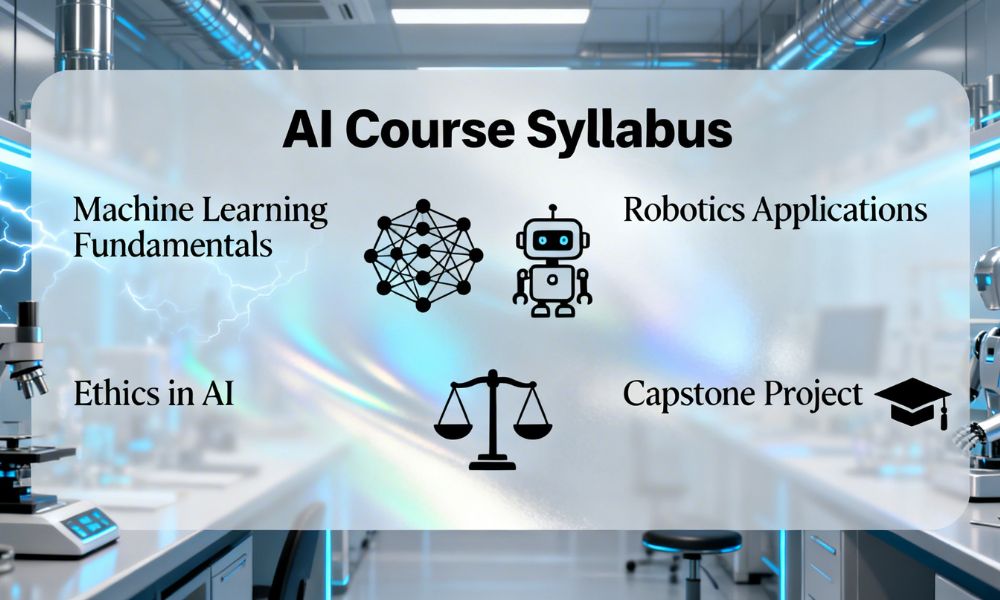
An AI course for beginners is designed to introduce essential AI concepts while also offering hands-on practice. Expect to learn the following:
- Foundational AI Terminology: You will start by familiarizing yourself with the language of AI. Key terms like “supervised learning,” “unsupervised learning,” and “reinforcement learning” are essential for navigating AI discussions.
- Basic Programming Skills: Many AI courses introduce programming languages such as Python, a key tool for developing AI models. You will be taught to write code, debug programs, and develop algorithms.
- Introduction to Data: AI relies heavily on data. You will learn how to gather, clean, and interpret data—skills that are necessary to build efficient AI models.
- Building Your First AI Project: The practical aspect of an AI course allows you to build simple projects, like a recommendation engine or a chatbot. This hands-on experience is essential for applying theoretical concepts to real-world problems.
Types of Artificial Intelligence Courses
AI courses come in various formats, each catering to different learning preferences. Some of the most common types include:
- Online AI Courses: These offer flexibility and are available on platforms like Coursera, Udemy, and edX. Many of these courses are self-paced, allowing you to learn at your convenience.
- University Programs: Traditional universities offer in-depth AI degrees, which often provide a more structured learning environment and a broader academic context.
- AI Certifications: For those already familiar with certain technical aspects, certification programs offer specialized learning in areas like machine learning, deep learning, and natural language processing.
Choosing the right course depends on your current skill level and the type of learning environment you prefer. Whether you opt for a self-paced online course or a full university degree, the goal remains the same: to acquire the skills needed to thrive in an AI-driven world.
What to Expect From an AI Course for Beginners
If you’re just starting out, don’t worry—AI courses for beginners are designed with you in mind. You’ll be gently introduced to the core concepts and given the tools necessary to build foundational knowledge. Here’s what you can expect:
- Step-by-Step Guidance: Courses are typically structured to gradually increase in complexity, so you won’t feel overwhelmed by too much technical jargon right off the bat.
- Hands-On Projects: Many beginner AI courses focus on real-world applications. For example, you might build your first AI-based application like a simple predictive model, which helps reinforce your learning.
- Mathematics and Algorithms: While AI involves some advanced mathematics, beginner courses often explain complex algorithms in a way that’s digestible for newcomers.
Tools and Technologies Used in Artificial Intelligence
In an AI course, you’ll be introduced to various tools and technologies that are pivotal in building AI systems. These include:
- Programming Languages: Python and R are commonly used in AI development. Both languages offer extensive libraries and frameworks tailored to machine learning and AI development.
- AI Frameworks: Libraries such as TensorFlow, Keras, and PyTorch are essential for developing machine learning and deep learning models. These frameworks simplify the process of building AI models.
- Data Handling Tools: Tools like Pandas and NumPy allow you to manage and analyze data efficiently, a critical skill for any AI professional.
By mastering these technologies, you’ll gain the skills needed to develop your own AI applications and solutions.
Overcoming Challenges in an AI Course
AI courses can be immensely rewarding, but they also come with challenges. One of the most common obstacles is the steep learning curve, as AI involves complex concepts like advanced mathematics, coding, and statistics that can initially seem intimidating.
To overcome this, it’s essential to take the time to master the basics, practice consistently, and seek help from instructors or peers. Another challenge is dealing with the mathematical foundation of AI, such as linear algebra and calculus.
While not all AI applications require advanced math, understanding these concepts can deepen your grasp of AI algorithms. Fortunately, numerous resources, including online tutorials, forums, and AI communities, are available to support your learning, helping you clarify doubts and expand your knowledge base.
AI Courses for Beginners: What to Look For
Choosing an AI course can be overwhelming, especially with so many options available. Here’s what to look for when selecting an AI course for beginners:
- Beginner-Friendly Content: Make sure the course starts with foundational concepts and gradually builds up to more complex topics. This ensures that you’re not thrown into deep-end challenges too soon.
- Hands-On Learning: Courses that provide interactive coding exercises and projects will help solidify your understanding.
- Instructor Support: If possible, look for courses that offer support from instructors or mentors. This guidance can be invaluable when you’re struggling with a tough concept.
Are Artificial Intelligence Courses Worth the Investment?
An AI course is undoubtedly an investment in your future. As AI continues to grow, the demand for skilled professionals increases, making it a lucrative career path. The skills you gain through an AI course can open doors to various job opportunities in industries like healthcare, finance, and marketing.
How AI Courses Can Boost Your Career
With businesses worldwide adopting AI, professionals with AI skills are highly sought after. By mastering AI, you’ll be better positioned to take on roles like data scientist, AI engineer, or machine learning specialist, roles that are highly valued and well-compensated.
Final Thoughts
Artificial Intelligence is one of the most exciting and promising fields today, and an AI course offers a solid foundation for understanding this transformative technology. Whether you’re looking to improve your career prospects, gain technical skills, or explore the future of automation, an AI course is the perfect starting point. The knowledge you acquire will empower you to tackle real-world problems, drive innovation, and contribute to the AI-driven future.