

AI-generated illustration created to represent the article’s subject. It does not depict an actual EPW course, trainer, participant, client, event or venue.
Nearly every aspect of life today runs on electricity. They provide energy to light homes, run hospitals and support businesses and transportation systems. But few consider the infrastructure that distributes this power over great distances. And behind that infrastructure is a specialist called a transmission line design engineer.
These specialists design the high-voltage wires that carry electricity from power stations to urban, rural and industrial centers. Their job is to make sure that power flows safely, efficiently and consistently through the power grid.
As communities grow and urban areas expand, the role of a transmission line design engineer becomes even more vital. As demand for electricity grows, well-engineered transmission systems allow utilities to keep energy flowing without interruption.
What does a Transmission Line Design Engineer do?
Transmission line design engineer: This type of engineer plans and designs high-voltage transmission systems that transport electricity over long distances. Their mission blends electrical engineering with structural design and environmental planning.
The work starts long before any tower is erected or any cable is laid. Engineers have to consider so much: terrain; climate; power demand; safety regulations. This is only after analysing can a transmission line be designed reliably.
Put simply, these engineers create the paths electricity will take through the land.
Why Transmission Line Design Is Important
Power generation alone is not enough to supply electricity to communities. Energy must travel through transmission networks before it reaches local distribution systems.
A well-designed transmission system ensures that electricity flows smoothly with minimal losses. Poor design, on the other hand, can lead to power outages, inefficiencies, or safety hazards.
The work of a transmission line design engineer contributes to:
- Reliable electricity supply
- Reduced power loss during transmission
- Improved safety for communities and workers
- Long-term stability of the power grid
In many developing areas, transmission infrastructure plays a key role in expanding energy access.
How Transmission Lines Are Planned
Designing a transmission line involves several technical steps. Each stage requires detailed engineering analysis.
Route Selection
One of the first tasks for a transmission line design engineer is choosing the best route for the power line. Engineers consider factors such as terrain, population density, environmental impact, and accessibility.
Geographic Information Systems (GIS) are often used to analyze maps and identify suitable transmission corridors.
Structural Design
Transmission towers must withstand harsh environmental conditions. Strong winds, heavy rainfall, temperature changes, and even ice accumulation can place stress on these structures.
A transmission line design engineer calculates these loads and designs towers capable of maintaining stability for decades.
Electrical Analysis
Engineers must ensure that electricity travels efficiently along the transmission line. This requires analyzing:
- Voltage levels
- Current capacity
- Conductor performance
- Energy losses along the lin
Proper electrical design prevents overheating and ensures stable operation of the power system.
Safety and Regulations
Transmission infrastructure must follow strict engineering standards and safety regulations. Engineers must ensure appropriate clearances between power lines and surrounding structures, roads, and buildings.
Compliance with these regulations protects both workers and communities.
Key Components of a Transmission Line
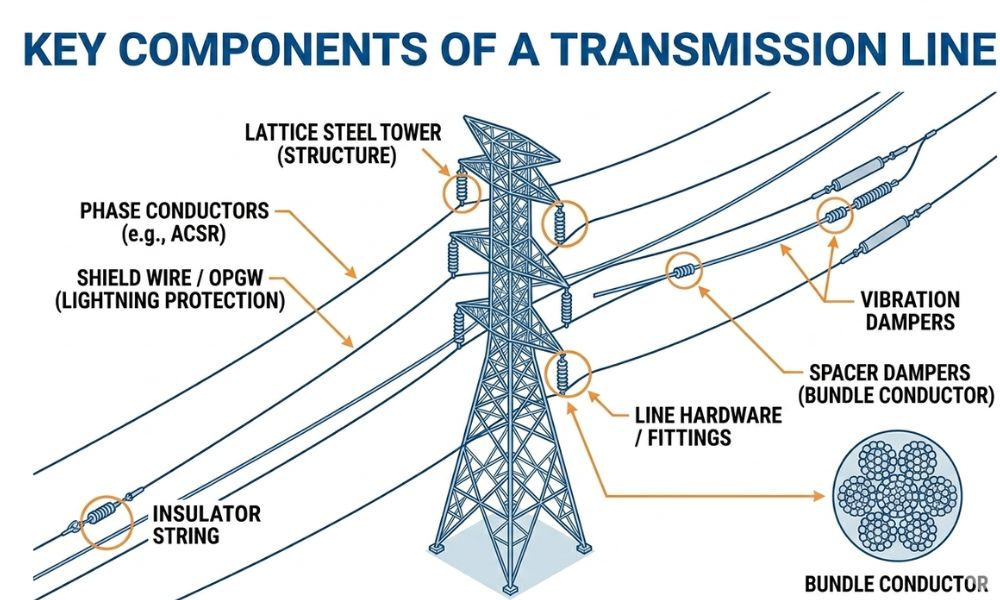
A transmission line system consists of several important parts. Each component must work together to deliver electricity safely.
Transmission Towers
These large steel structures support the conductors that carry electricity. Their design depends on terrain, voltage level, and environmental conditions.
Conductors
Conductors are the cables that transport electrical power. They are usually made of aluminum or aluminum alloys for high conductivity and durability.
Insulators
Insulators prevent electrical current from flowing into the tower structure. They maintain electrical separation between conductors and support structures.
Ground Wires
Ground wires protect transmission systems from lightning strikes and electrical faults.
Tools Used by Transmission Line Design Engineers
Modern engineering projects rely heavily on digital tools. A transmission line design engineer uses specialized software to design and analyze transmission systems.
Common tools include:
- CAD software for creating engineering drawings
- Power system analysis software for electrical simulations
- GIS tools for route planning and mapping
- Structural analysis programs for evaluating tower strength
These tools help engineers test designs virtually before construction begins.
Skills Required for Transmission Line Engineering
A successful transmission line design engineer must develop a combination of technical knowledge and practical skills.
Technical Skills
Engineers working in transmission design must understand:
- Electrical power systems
- Structural engineering principles
- Engineering calculations and modeling
- Design standards and safety codes
Soft Skills
Beyond technical knowledge, engineers must also demonstrate:
- Strong problem-solving ability
- Attention to detail
- Communication and teamwork skills
- Project coordination capabilities
Transmission projects often involve collaboration with multiple specialists, including civil engineers, environmental experts, and construction teams.
Career Opportunities in Transmission Line Engineering
As global energy demand continues to grow, the need for transmission infrastructure also increases. This creates strong career opportunities for transmission line design engineers.
Professionals in this field may work with:
- Electrical utility companies
- Engineering consulting firms
- Infrastructure development companies
- Government energy departments
Many engineers eventually advance into project management, grid planning, or senior engineering roles overseeing large-scale power projects.
The Future of Transmission Line Design
The energy sector is evolving rapidly. Renewable energy sources such as solar and wind power require expanded transmission networks to deliver electricity to cities and industries.
A transmission line design engineer plays an important role in supporting this transition. Engineers are now designing transmission systems capable of handling new energy sources while maintaining grid stability.
Future developments in transmission engineering will likely focus on:
- Integrating renewable energy into power grids
- Improving transmission efficiency
- Strengthening grid resilience against climate challenges
- Modernizing aging power infrastructure
Conclusion
Power transmission networks are essential for modern society. Without them, electricity generated at power plants would never reach homes, hospitals, schools, or industries.
A transmission line design engineer is responsible for designing the infrastructure that makes this energy delivery possible. Through careful planning, technical analysis, and engineering expertise, these professionals help build reliable power systems.
As communities grow and energy demand increases, the importance of transmission line design engineers will continue to rise. Their work supports stable electricity networks and helps power the future.