
In recent years, discussions of artificial intelligence have migrated from university classrooms and the silver screen to coffee shops, small businesses and local classroom. And what was once esoteric feels eerily close to home. At the core of such a change is a very special idea: deep learning basics.
Deep learning is not magic. It’s not some magical black box for the tech behemoths. It’s a systematic pursuit, constantly transforming itself on the basis of maths and data and computational models that attempt to replicate some aspects of human thought. While grasping it right, its bases are logical and delightful.
This course is intended to introduce students to deep learning and demystify this interesting subject. No unnecessary jargon. No convoluted abstractions. Nothing but clear explanations linking global progress with local relevance.
What Is Deep Learning?
Deep learning is a subset of machine learning, which in turn falls under the umbrella term of artificial intelligence. Where conventional software relies on clear and explicit instructions, deep learning systems learn by example by identifying patterns in data.
Rather than coding up every rule a driver might follow make way for oncoming traffic, pass bicyclists at arm’s length, or give cyclists the right-of-way at stop signs developers pour data into mathematical structures that form neural networks. The networks process patterns, change internal parameters and get better as they go. It is a similar process as learning by doing, and not by memorizing hard commands.
To understand deep learning theory and concepts, it starts with realizing this fundamental shift: from rule-based programming to data-driven learning.
Artificial Intelligence in Our Day to Day Life
Artificial intelligence has long since woven itself into the fabric of our daily routines. Voice assistants interpret spoken commands. Navigation apps predict traffic congestion. Recommendation system recommend items or movies according to the personal preference.
Most of these systems are driven by deep learning. At local companies, AI-powered tools are used to optimize inventory for retail, forecast customer demand and personalize marketing campaigns. Hospitals employ predictive models to aid in making diagnostic decisions. Programs using deep learning under the hood It appears that even smaller community-driven startups are testing out automation tools based on some of these core tenets.
The technology is not distant. It works quietly beneath the surface of contemporary civilization.
Neural Networks: The Core Architecture
At the heart of deep learning lies the neural network. Inspired loosely by biological neurons, artificial neural networks consist of interconnected nodes organized into layers.
There are typically three primary components:
- An input layer
- One or more hidden layers
- An output layer
Each node processes incoming information, applies mathematical transformations, and transmits results forward. This layered arrangement allows the system to extract increasingly abstract representations from raw data.
For example, when analyzing an image of a local landmark, early layers might detect edges and textures. Deeper layers identify shapes. Eventually, the network recognizes the landmark itself.
Such hierarchical representation is central to deep learning fundamentals and concepts.
Data: The Fuel Behind Learning
Deep learning systems require substantial volumes of data. Clean, structured, and relevant data. Without it, even the most sophisticated architecture falters.
Data can take many forms:
- Images
- Text
- Audio recordings
- Numerical records
- Sensor readings
In a local context, data might include retail transactions, agricultural yield records, weather patterns, or community health statistics.
The quality of data profoundly affects outcomes. Inaccurate or biased data leads to distorted predictions. Careful preprocessing cleaning, labeling, and normalizing are therefore indispensable in mastering deep learning fundamentals and concepts.
Training: How Models Improve
A neural network does not begin intelligent. It starts with random internal parameters known as weights and biases. Through a process called training, the model iteratively adjusts these values to reduce error.
Here is how it works:
- The model makes a prediction.
- The prediction is compared to the actual result.
- A loss function calculates the discrepancy.
- An optimization algorithm modifies internal parameters to reduce that discrepancy.
This cycle repeats across many iterations, often thousands or millions. Gradually, performance improves.
The mechanism behind these adjustments—backpropagation combined with gradient descent is foundational within deep learning fundamentals and concepts. It is precise, mathematical, and remarkably effective.
Supervised and Unsupervised Learning
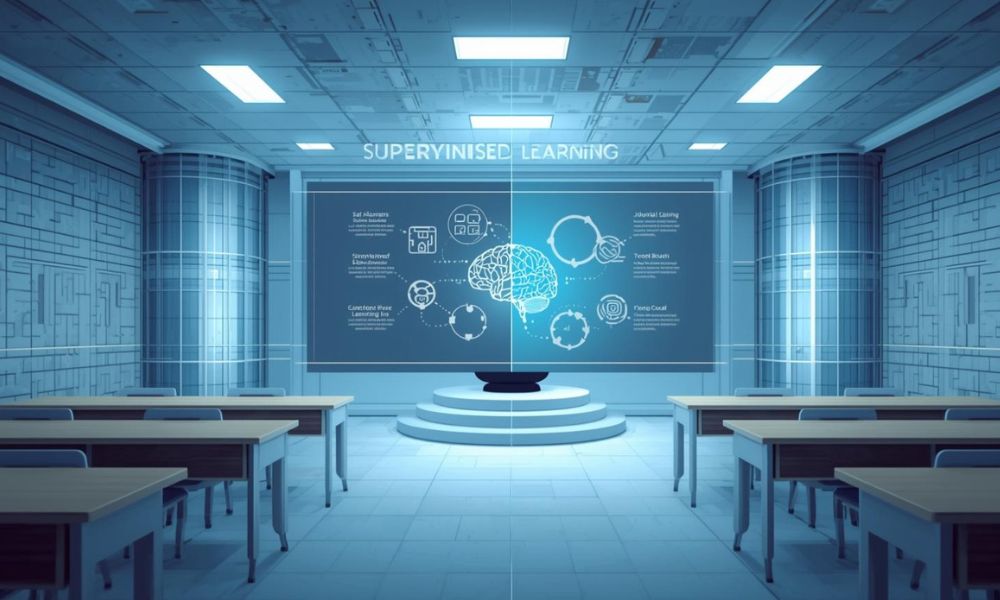
Deep learning applications generally fall into two major paradigms.
Supervised learning involves labeled data. For instance, a model might learn to classify emails as spam or not spam using previously categorized examples.
Unsupervised learning, on the other hand, works with unlabeled data. The system identifies patterns independently, grouping customers by purchasing behavior or detecting anomalies in financial transactions.
Both approaches are integral components of deep learning fundamentals and concepts, each suited to different types of challenges.
Real-World Applications in the Local Community
Deep learning is not confined to multinational corporations. Local enterprises increasingly harness its capabilities.
Retail shops use predictive analytics to optimize stock levels. Farmers analyze satellite imagery to monitor crop health. Healthcare providers deploy image recognition systems to assist in medical screenings. Educational institutions incorporate adaptive learning tools that respond to individual student progress.
These applications demonstrate how deep learning fundamentals and concepts translate into tangible community benefits.
Technology scales globally, but its impact is often felt locally.
Common Challenges and Misconceptions
Despite its potential, deep learning is frequently misunderstood.
Some assume it requires extraordinary mathematical genius. Others believe it demands vast financial resources. While advanced research can be complex, foundational understanding is accessible with structured learning and persistence.
Another misconception is that deep learning systems are infallible. They are not. They reflect the data they are trained on. Poor data yields poor outcomes.
Recognizing these limitations is an essential part of grasping deep learning fundamentals and concepts responsibly.
Ethical Considerations
With great computational power comes ethical responsibility.
Bias in data can reinforce inequality. Privacy concerns arise when handling sensitive information. Transparency becomes critical when algorithms influence decisions in healthcare, finance, or public services.
Communities adopting AI-driven solutions must ensure fairness, accountability, and inclusivity. Ethical awareness is not an optional accessory it is embedded within the responsible practice of deep learning fundamentals and concepts.
The Learning Path Forward
For those interested in exploring further, a practical path typically includes:
- Strengthening foundational mathematics, particularly linear algebra and calculus
- Learning a programming language such as Python
- Understanding basic machine learning principles
- Experimenting with frameworks like TensorFlow or PyTorch
Hands-on practice accelerates comprehension. Building small projects such as a simple image classifier or sentiment analysis tool transforms abstract theory into lived experience.
Mastery does not happen overnight. It unfolds incrementally. Curiosity fuels the journey.
Final Thoughts
Deep learning is transforming industries, reshaping workflows, and influencing how communities function. At its core, however, it is built on clear mathematical structures and logical processes. Understanding its fundamental concepts enables individuals, businesses, and institutions to actively engage in this technological shift rather than simply observe it. While the systems themselves can be complex, the underlying principles are accessible. Like any major innovation, meaningful progress in deep learning begins with a strong and well-grounded foundation.