
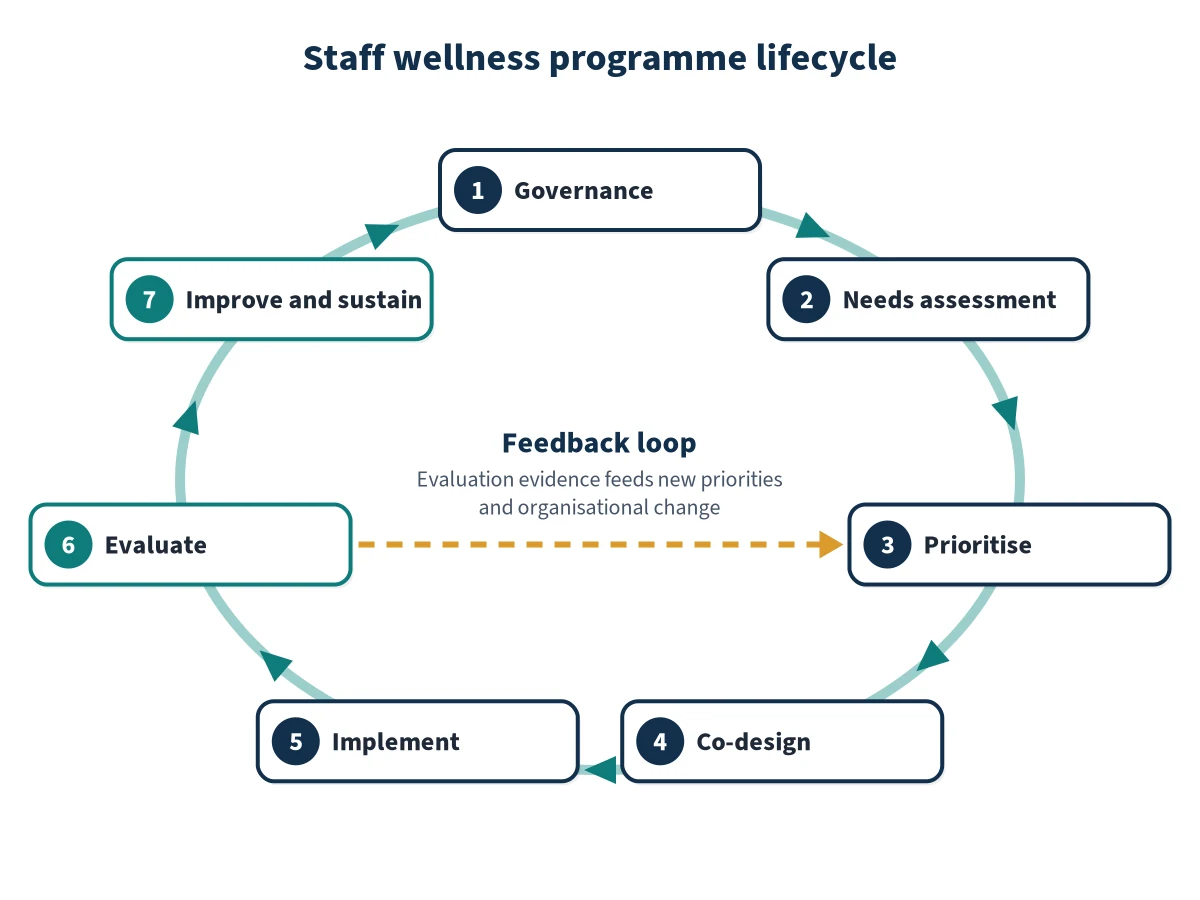
A hospital staff wellness program should move through a controlled cycle: establish governance, assess needs, prioritise risks, co-design interventions, implement them, evaluate both delivery and outcomes, and improve the programme. The process must address working conditions, leadership and systems alongside individual support. A campaign made only of awareness days or resilience sessions is not a complete wellbeing programme.
This process is designed for hospital leaders, occupational-health teams, human resources professionals, nursing managers and quality-improvement teams. It focuses on programme governance and evaluation rather than diagnosing or treating individual health conditions.
Staff wellness programme process at a glance
| Stage | Core activity | Decision or output |
|---|---|---|
| 1. Establish governance | Set scope, sponsorship, participation and safeguards | Charter, owners and decision rights |
| 2. Assess needs | Combine worker voice, organisational data and risk evidence | Segmented baseline and needs statement |
| 3. Prioritise | Rank problems by harm, reach, inequity and feasibility | Defined objectives and target groups |
| 4. Co-design | Select organisational and individual-level responses | Intervention logic and implementation plan |
| 5. Implement | Prepare leaders, resources, communication and access | Controlled rollout with feedback routes |
| 6. Evaluate | Measure reach, implementation, outcomes and unintended effects | Evidence of what changed and for whom |
| 7. Improve and sustain | Adapt, integrate and repeat the cycle | Updated actions, budget and accountability |
Why the process must start with work design
The US National Institute for Occupational Safety and Health (NIOSH) Impact Wellbeing Guide gives hospital leaders evidence-informed actions for improving healthcare worker wellbeing. Its approach places operational and organisational change at the centre rather than treating distress as an individual failure.
The World Health Organization (WHO) healthy workplace model also treats worker health, safety and wellbeing as connected to the physical and psychosocial work environment, personal health resources and the organisation’s relationship with the wider community. A robust hospital programme therefore examines workload, staffing, violence, discrimination, control over work, psychological safety and access to support.
1. Establish governance and trust
Appoint an executive sponsor and a programme lead with time, authority and access to workforce data. Create a steering group that includes occupational health, human resources, nursing, medical staff, allied health, operations, safety, quality, diversity and inclusion, data protection and representative frontline workers. Define how local units can raise issues and make decisions.
Write a programme charter covering scope, objectives, resources, confidentiality, escalation and reporting. Make clear that survey responses or support-seeking will not be used to penalise individuals. Separate identifiable clinical or employment information from programme evaluation data and publish the limits of confidentiality honestly.
Trust is an operational input. If workers expect no action, fear retaliation or cannot access a survey during working time, the baseline will be distorted. Leaders should commit in advance to report what they heard, what will change, what cannot change yet and why.
2. Complete a needs assessment
Use multiple sources rather than one annual survey. Combine confidential worker feedback with staffing, vacancy, turnover, sickness absence, overtime, roster instability, workload, incidents, violence, complaints, safety culture and access-to-support data. Review policies and pathways for psychological support, occupational injury, flexible work and return to work.
Segment results carefully by role, unit, shift, contract type and other relevant groups while protecting anonymity. An acceptable hospital average can conceal serious pressure in an emergency department, night shift or scarce professional group. Small-cell reporting rules are essential.
Ask workers what conditions help or harm their wellbeing and which changes would make the greatest difference. Use listening sessions, focus groups, walk-rounds and existing representative forums. The NIOSH healthcare worker stress and burnout guidance identifies organisational factors such as demanding work conditions and limited control as important areas for leadership action.
3. Prioritise needs and define measurable objectives
Translate evidence into a small number of problem statements. For example: “Night-shift nurses in two units report unpredictable redeployment and missed breaks, while overtime and turnover are rising.” This is more actionable than “staff are stressed”. It identifies the group, exposure and relevant organisational signals.
Prioritise using four criteria:
- Severity: potential effect on physical or psychological health, safety and care.
- Reach and equity: number affected and whether burden is concentrated in a disadvantaged group.
- Changeability: whether the organisation can alter the cause or reduce exposure.
- Readiness and feasibility: leadership commitment, resources, dependencies and implementation risk.
Set a measurable objective with a population, outcome and time frame, but avoid targets that encourage concealment. Reducing reported concerns may mean either genuine improvement or weaker reporting. Balance outcome measures with evidence about work conditions and implementation.
4. Co-design a balanced intervention portfolio
Map each priority to its causes and select interventions at the level where the cause sits. If workload, unsafe staffing or poor supervisory behaviour is the problem, a mindfulness application cannot be the main response. Individual resources can be valuable, but they should complement changes to work rather than substitute for them.
The WHO’s guidelines on mental health at work recommend organisational interventions that directly assess and modify psychosocial risks, alongside manager training, worker training and support for people returning to work. Use applicable occupational-health and employment requirements in each jurisdiction.
| Need | Organisational response | Supporting individual resource | Evaluation signal |
|---|---|---|---|
| Unmanageable workload | Review demand, staffing, workflow and low-value work | Access to recovery and support services | Workload, breaks, overtime and worker experience |
| Workplace violence | Prevention, reporting, security and post-incident response | Trauma-informed support | Exposure, reporting, response time and confidence |
| Poor line management | Role expectations, training, feedback and accountability | Coaching or peer support | Psychological safety and management behaviour |
| Roster instability | Scheduling rules, notice periods and escalation | Flexible-work guidance | Late changes, predictability and absence |
| Barrier to seeking help | Confidential pathways and policy review | Counselling and peer support | Awareness, access, waiting time and trust |
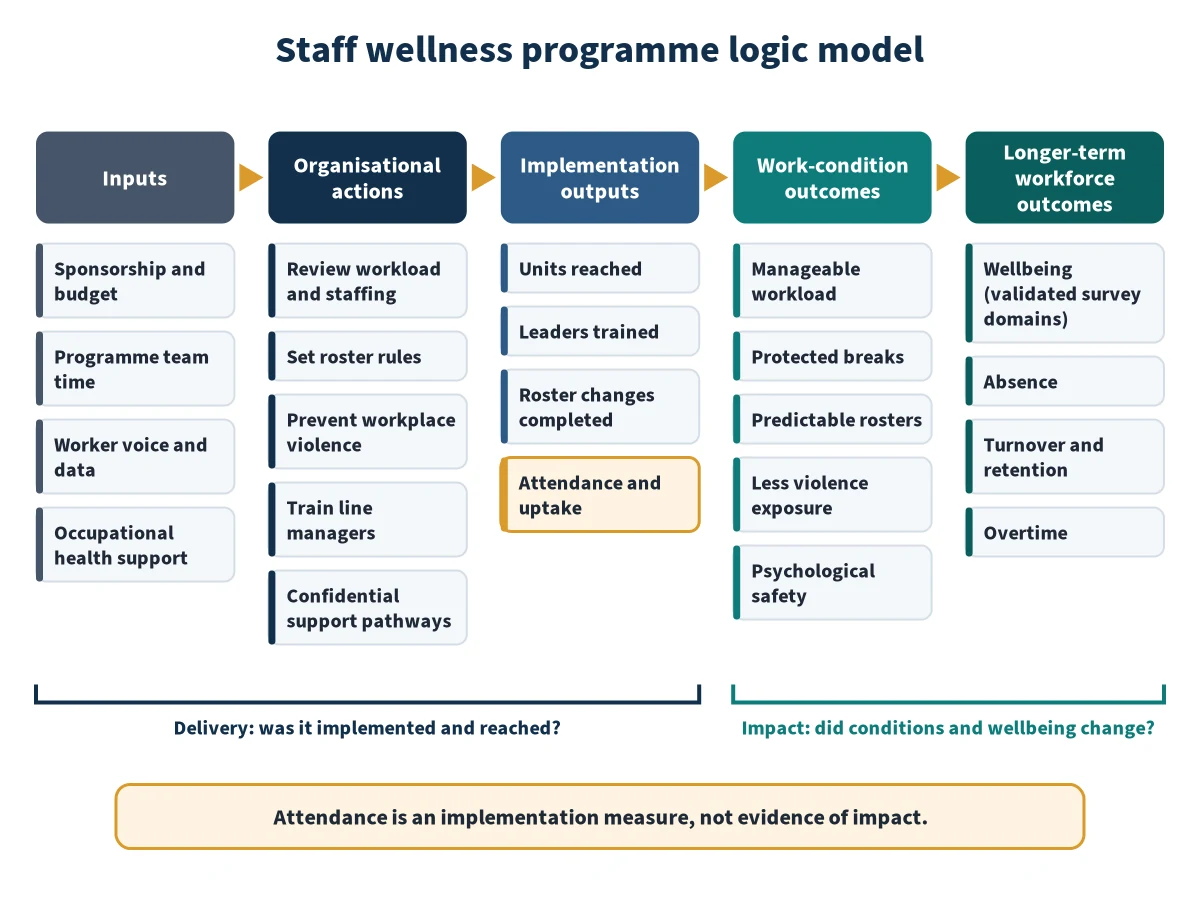
Document a simple logic model: inputs and actions should lead to immediate implementation outputs, changes in work conditions and longer-term outcomes. Involve the groups who will use or deliver the intervention. Co-design does not mean every idea is adopted; it means selection criteria and constraints are transparent.
5. Prepare and implement the programme
Convert the portfolio into a delivery plan with actions, owners, resources, milestones, risks and communication. Prepare managers before announcing changes. Ensure staff can participate during paid working time where appropriate, and provide access for night, remote, temporary and non-clinical workers rather than designing only for office hours.
Pilot higher-risk or complex interventions in representative settings. Track whether the intervention is delivered as designed, who participates and which groups are missed. Create a rapid feedback route so teams can correct barriers without waiting for an annual review.
A soft but practical development route is EPW’s Occupational Health and Staff Wellness Programs course, which connects occupational risk, programme design, leadership, implementation and evaluation.
6. Evaluate implementation and outcomes
Evaluation begins before rollout. Record the baseline, comparison period and data definitions. Decide which changes should occur first and how long later outcomes may take. Use a balanced measurement set rather than claiming success from participation alone.
| Evaluation question | Example measures | Interpretation risk |
|---|---|---|
| Was it delivered? | Units reached, leaders trained, roster changes completed | Activity does not prove benefit |
| Did workers access it? | Reach by role, shift and unit; waiting time | High uptake can reflect high need |
| Did work conditions change? | Workload, control, breaks, violence, roster predictability | Average results can hide subgroup harm |
| Did wellbeing change? | Validated survey domains and qualitative feedback | Changes may have external causes |
| Did workforce outcomes change? | Absence, turnover, overtime and retention | Lagging measures respond slowly |
| Were there unintended effects? | Work shifted to another team, access inequity, reporting decline | Apparent improvement may conceal displacement |
Use the same definitions across baseline and follow-up. Protect confidentiality and publish results even when the intervention did not work as expected. Where possible, combine quantitative trends with worker explanations. Avoid attributing every change to the programme when staffing, policy, demand or external events also changed.
7. Improve, integrate and sustain
Review evidence with workers and decide whether to continue, adapt, expand or stop each intervention. Assign corrective actions and report them through existing workforce, safety and quality governance. Integrate successful controls into budgets, job design, staffing, leadership objectives, procurement and unit operating standards.
Repeat the needs assessment at a proportionate interval and after major organisational change. Continue monitoring critical signals between surveys. The joint WHO and International Labour Organization policy brief on mental health at work reinforces the need for action on working conditions, protection and support within a coherent organisational approach.
Worked example: improving wellbeing on two inpatient units
A hospital’s baseline shows that two inpatient units have frequent last-minute roster changes, missed breaks and higher voluntary turnover. Listening sessions indicate that a central scheduling rule does not account for unit skill mix, while managers lack authority to resolve gaps early.
The steering group sets an objective to improve roster predictability and protected-break delivery. The intervention combines earlier roster finalisation, an escalation threshold for unfilled shifts, cross-training for a limited float pool, manager coaching and a clear break-coverage process. Confidential support remains available, but it is not presented as the solution to the scheduling problem.
Evaluation tracks late roster changes, unfilled shifts, breaks, overtime, staff feedback and turnover by unit. After a pilot, one workflow is adjusted because it moved administrative work into handover time. The final design is then incorporated into workforce planning and manager objectives.
Common programme mistakes
- Starting with activities: free fruit, apps or awareness days are chosen before the problem is defined.
- Ignoring worker participation: leaders design solutions without understanding shift-level barriers.
- Collecting sensitive data without trust: poor confidentiality and no visible action reduce participation.
- Measuring uptake as impact: attendance does not show that working conditions improved.
- Reporting only hospital averages: burden and access inequities remain hidden.
- Making line managers responsible without authority: they cannot change staffing, workflow or policy constraints.
- Running wellbeing separately from operations: lessons never enter workforce, quality or financial decisions.
Hospital staff wellness programme checklist
- Executive sponsorship and worker participation are formalised.
- Confidentiality, data access and escalation rules are clear.
- The needs assessment combines worker voice with operational evidence.
- Results are segmented without exposing small groups.
- Priorities name a population, work condition and desired change.
- Organisational interventions address organisational causes.
- A logic model and baseline exist before implementation.
- Reach, work conditions, wellbeing and workforce outcomes are measured separately.
- Unintended effects and equity are reviewed.
- Successful actions enter normal governance and budget cycles.
Connect wellbeing with workforce and leadership decisions
Wellbeing evidence becomes useful when leaders connect it to workload, staffing, culture and daily management. EPW’s article on the hospital workforce planning process shows how demand, supply, skill mix and deployment decisions affect sustainable capacity. Related development options include Nursing Leadership and Unit Management.
Ready to build an evidence-led programme for your organisation? Explore EPW’s Occupational Health and Staff Wellness Programs course, or review the wider Healthcare and Hospital Management Training Courses.
Sources and References
- National Institute for Occupational Safety and Health. Impact Wellbeing Guide: Taking action to improve healthcare worker wellbeing. Revised July 2024.
- National Institute for Occupational Safety and Health. Risk Factors for Stress and Burnout: Healthcare Workers. 23 April 2024.
- World Health Organization. Healthy workplaces: a model for action. 19 January 2010.
- World Health Organization. WHO guidelines on mental health at work. 28 September 2022.
- World Health Organization and International Labour Organization. Mental health at work: policy brief. 28 September 2022.