
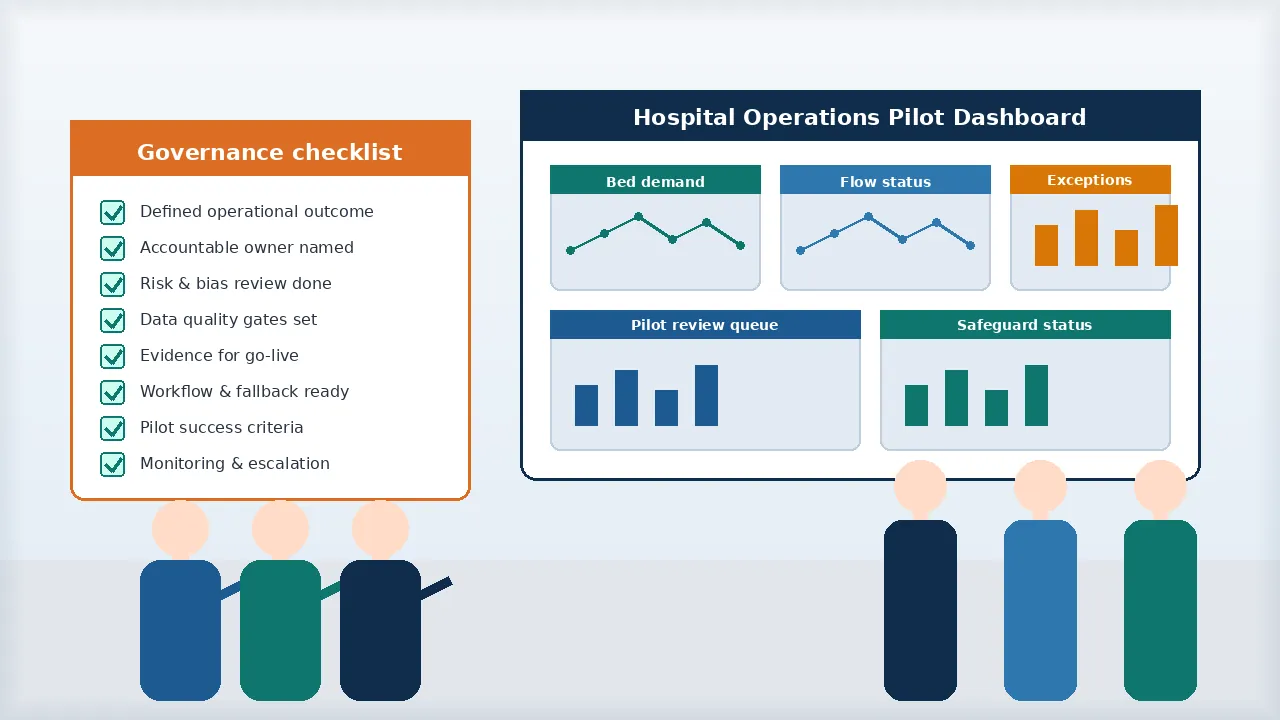
To implement artificial intelligence (AI) in hospital operations safely and effectively, leaders should begin with one measurable operational problem, classify the risk, establish accountable governance, test the system against the current workflow and scale only when evidence shows benefit without unacceptable harm. Technology selection comes after the outcome, data, users, controls and stop conditions are clear.
This approach is intended for hospital executives, operations managers, clinical leaders, digital teams, quality professionals and information-governance specialists. It applies to operational uses such as demand forecasting, scheduling, patient-flow support, documentation assistance, stock planning and anomaly detection. AI that diagnoses, recommends treatment or functions as a medical device requires additional clinical, legal and regulatory assessment.
Key takeaways
- Start with a specific operational outcome and baseline, not a general instruction to “use AI”.
- Match assurance, human oversight and monitoring to the potential impact on patients, staff and services.
- Test the complete AI-supported workflow, including exceptions and downtime, rather than model accuracy alone.
- Treat deployment as a controlled change programme with an owner, review gates and a documented route to pause or withdraw the system.
What must be ready before implementation?
Before approving a pilot, the hospital should be able to name the process owner, intended users, affected people, operational baseline, authorised data, expected decision or action, and the person accountable when the AI output is wrong. The World Health Organization’s guidance on AI for health places human autonomy, safety, transparency, accountability, equity and sustainability at the centre of governance.1
A hospital also needs a risk-management method that continues after launch. The US National Institute of Standards and Technology (NIST) organises AI risk work around four functions: Govern, Map, Measure and Manage.2 NIST describes the framework as voluntary and cross-sectoral; hospitals must still apply the laws, clinical-safety requirements, privacy rules and professional standards relevant to their jurisdiction and use case.
Operational readiness includes reliable data definitions, usable workflows and staff capacity. Teams planning access controls, data minimisation and cyber safeguards can connect the project with EPW’s Data Privacy and Cybersecurity in Healthcare course. If the use case depends on record data or workflow integration, the Electronic Health Records Implementation and Optimization course provides a related implementation perspective.
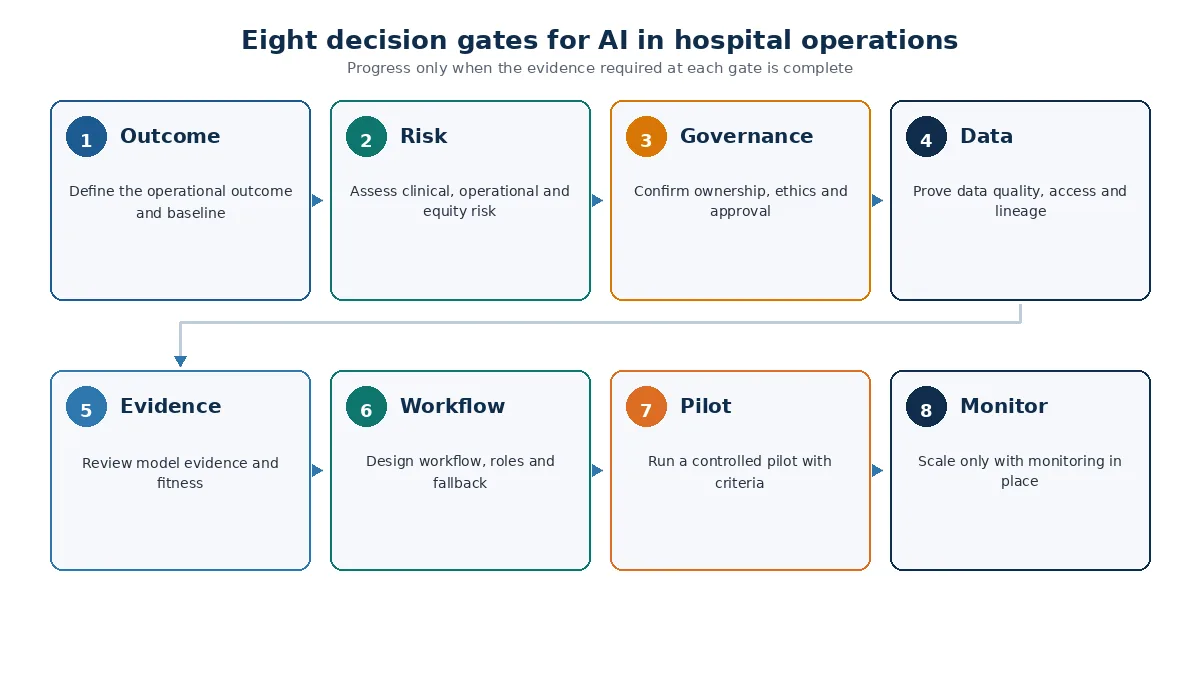
How to implement AI in hospital operations: eight steps
1. Define the operational outcome and baseline
Describe the problem in process language. “Reduce avoidable appointment gaps” is more useful than “automate scheduling”. Specify the population, setting, workflow boundary and balanced measures: for example, utilisation, waiting time, rebooking workload, access equity, complaints and safety incidents.
Record current performance before introducing AI. Without a baseline, the team can demonstrate activity or technical accuracy but cannot show that operations improved.
2. Classify the use case and its potential impact
Map how the output could influence patient access, prioritisation, staffing, resources or clinical work. A low-impact tool that groups internal documents is different from a model that changes queue priority. Assess foreseeable error, bias, privacy, security, automation reliance and service-continuity risks.
Determine which internal policies and external requirements apply. WHO’s 2023 regulatory considerations emphasise transparency, documentation, intended use, data quality, privacy, cybersecurity and collaboration among relevant stakeholders.3 The classification should be approved before procurement or development proceeds.
3. Establish multidisciplinary governance
Give one senior owner responsibility for the operational result. Create a decision group with relevant clinical, operational, technical, data, privacy, cyber, procurement, quality and patient perspectives. The group should approve the intended use, evidence threshold, pilot design, change controls and escalation route.
Governance is not a meeting added after development. It is the mechanism that decides what may be built, which evidence is sufficient and who can stop use. EPW’s Clinical Governance and Patient Safety Systems course explores the wider accountability and assurance structures that this work must join.
4. Assess process and data readiness
Map the current workflow from input to action. Identify delays, workarounds, duplicate entry, hand-offs and exceptions. If the underlying process is unstable or unnecessary, redesign it before automating it.
For every data element, document its source, meaning, quality, timeliness, permitted use, retention and known gaps. Check whether the development and test data represent the settings and groups in which the system will operate. Do not use sensitive data merely because it is technically available.
5. Evaluate the system and supplier evidence
Require a precise statement of intended use, limitations, training data provenance where available, validation method, subgroup performance, security arrangements, update process and incident support. Confirm what the model produces and what it does not establish.
Test with representative local data and realistic edge cases. Accuracy may be important, but it is not sufficient. Review false alarms, missed cases, calibration where relevant, user interpretation, operational capacity and the consequences of error. For generative AI, test unsupported statements, data leakage, prompt variation and whether outputs remain traceable to approved sources.
6. Design human oversight, workflow controls and fallback
Specify who reviews the output, what information they receive, when they may override it and how overrides are recorded. Human oversight must be meaningful: the reviewer needs time, competence and authority to challenge the system rather than simply approve its recommendation.
Build controls into the workflow. These may include confidence thresholds, restricted uses, independent checks for high-impact cases, visible limitations, exception queues and alerts for missing data. Document a safe manual process for downtime or withdrawal.
7. Run a limited, comparative pilot
Start in a defined service, shift or patient-flow segment with trained users and explicit eligibility criteria. Where feasible, compare the AI-supported workflow with the existing method over the same period or a well-matched baseline. Capture both benefits and burdens.
Review technical performance, operational outcomes, safety signals, equity, staff workload, patient experience and unintended workarounds. NIST’s AI Risk Management Framework Playbook offers voluntary actions aligned to Govern, Map, Measure and Manage, while warning that it is not a universal checklist.4
8. Decide whether to stop, revise or scale
Use pre-agreed criteria rather than enthusiasm or sunk cost. Stop when the use case lacks lawful data, safe fallback, reliable performance or a measurable operational benefit. Revise when problems are remediable. Scale only when the pilot evidence is transferable and the receiving service has equivalent readiness.
Assign ownership for post-deployment monitoring. Track data drift, workflow change, model updates, overrides, incidents, complaints and performance across relevant groups. Every material change should trigger proportionate revalidation and communication.
EPW’s eight-gate implementation test
| Gate | Evidence required | Decision question |
|---|---|---|
| Outcome | Problem statement, owner and baseline | Will success be observable in the service? |
| Risk | Impact classification and applicable requirements | Are safeguards proportionate to possible harm? |
| Governance | Decision rights, escalation and stop authority | Is accountability explicit? |
| Data | Authorised sources, quality assessment and gaps | Can the data support the intended use? |
| Evidence | Validation, limitations and subgroup results | Is performance adequate for this context? |
| Workflow | Human review, exceptions and fallback | Can people use and challenge the output safely? |
| Pilot | Comparative results and recorded incidents | Did outcomes improve without unacceptable trade-offs? |
| Scale | Monitoring plan, change control and resources | Can performance be sustained and withdrawn if necessary? |
The table is a governance aid, not a substitute for specialist review. A project should not pass a gate because documents exist; decision-makers should examine whether the evidence is credible and complete. Leaders can develop the process-improvement discipline behind these gates through EPW’s Hospital Operations and Quality Improvement course.
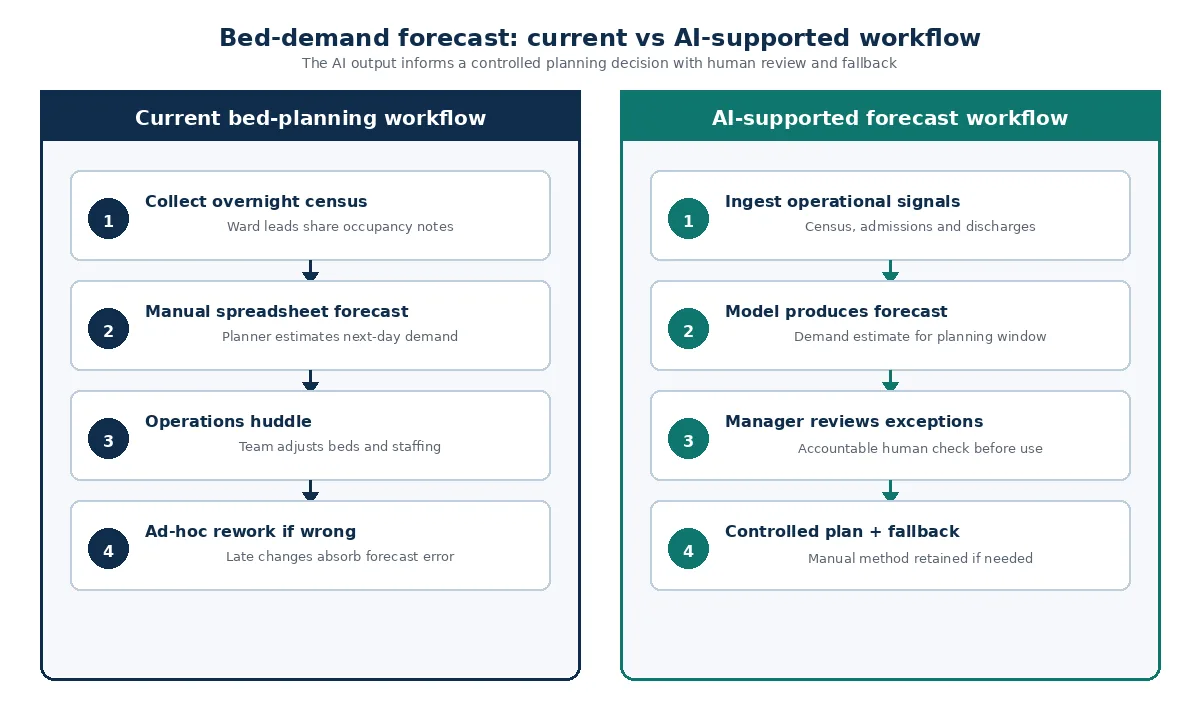
Worked example: forecasting bed demand
A hospital wants to improve the daily forecast of bed demand. The operations owner first records the current forecast error, late escalation rate, cancelled activity and staff time. The team maps data sources and excludes fields that are not justified. It then tests a model on historical periods, including seasonal peaks and service disruptions.
During the pilot, the model produces a forecast with an uncertainty range. A trained operations manager reviews it alongside current constraints and records any override. The daily decision remains with the manager. The team compares forecast error and operational outcomes with the existing method, checks whether particular services are consistently under-estimated and tests the manual fallback.
If forecast accuracy improves but false certainty leads to unsafe capacity decisions, the pilot has not succeeded. If the evidence is favourable, the hospital scales one service at a time and continues monitoring. This focus on the entire workflow also complements EPW’s article on the benefits of AI and machine learning for organisations, which distinguishes adoption activity from measurable value.
Common implementation errors
- Buying before defining the problem: the product determines the use case and evidence becomes an afterthought.
- Treating a pilot as proof of scale: a small controlled test may not represent other services, workloads or populations.
- Measuring the model rather than the service: technical performance improves while waiting time, workload or equity does not.
- Using nominal human oversight: staff approve outputs without the information or authority to challenge them.
- Ignoring workflow exceptions: unusual cases, missing data and downtime create unsafe workarounds.
- Failing to control updates: model or process changes alter performance without revalidation.
- Scaling without an exit plan: the hospital becomes dependent on a system it cannot pause or replace safely.
Implementation completion checklist
- The intended operational outcome, scope, owner and baseline are documented.
- The use case has an approved impact and regulatory classification.
- Data use, quality, representativeness, privacy and security have been assessed.
- Validation covers realistic local conditions, limitations and affected groups.
- Users understand the output, their responsibility and the escalation route.
- Human review, exception handling, downtime and withdrawal are tested.
- The pilot measures service outcomes, safety, workload, equity and experience.
- Scale-up criteria, monitoring, change control and review dates are assigned.
Conclusion
Safe and effective hospital AI implementation is an operational governance task supported by technology. Define the problem, classify the impact, build multidisciplinary accountability, establish data and workflow readiness, test the full service and scale only against pre-agreed evidence. This sequence helps hospitals pursue useful innovation while retaining human responsibility and the ability to stop.
For wider learning across quality, safety, information and service management, explore EPW’s Healthcare and Hospital Management Training Courses.
Ready to build a governed AI implementation roadmap? Review EPW’s Artificial Intelligence Applications in Hospital Operations course and discuss how its learning outcomes can be applied to a defined hospital use case.
Sources and references
- World Health Organization. Ethics and governance of artificial intelligence for health: WHO guidance. 2021.
- National Institute of Standards and Technology. AI Risk Management Framework. AI RMF 1.0 released 26 January 2023; NIST states that revision work is under way.
- World Health Organization. WHO outlines considerations for regulation of artificial intelligence for health. 19 October 2023.
- National Institute of Standards and Technology AI Resource Center. NIST AI RMF Playbook. Living implementation resource, accessed September 2026.