

AI-generated illustration created to represent the article’s subject. It does not depict an actual EPW course, trainer, participant, client, event or venue.
A GRC escalation framework is a documented system that defines which governance, risk and compliance matters must move beyond normal management, who receives them, how quickly they must be raised, what decision is required and how closure is evidenced. It turns vague instructions such as “escalate significant issues” into repeatable decision rules.
An effective framework does not send every exception to the board. It separates routine operational resolution from executive intervention and governing-body oversight. It also permits judgement when an event does not fit a preset threshold but could materially affect objectives, stakeholders, legal duties or organisational integrity.
Key takeaways
- Escalation thresholds should combine impact, urgency, control condition, external significance and leadership conflict.
- Every trigger needs a destination, time limit, accountable decision-maker and minimum information set.
- Management owns operational response; the board oversees material exposure and holds management accountable.
- Reports should state the decision required, not merely describe the problem.
- Closure requires evidence that exposure, action and residual risk have been independently reviewed where appropriate.
Contents
- What GRC escalation means
- Why escalation frameworks fail
- The five-layer GRC escalation model
- How to set severity thresholds
- Decision rights by escalation level
- The minimum escalation information pack
- Eight implementation steps
- How to measure framework effectiveness
- Strengthen senior-leader GRC judgement
What does GRC escalation mean?
Escalation is the controlled transfer of an issue, decision or risk acceptance to a person or body with the authority, independence and resources to act. It may move vertically to an executive or board committee, horizontally to legal, compliance, security or HR, or externally to a regulator, insurer, law-enforcement body or other stakeholder where required.
The purpose is not hierarchy for its own sake. Escalation is needed when the current owner cannot decide within authority, the exposure exceeds appetite or tolerance, independence is impaired, action spans several functions, a time-critical duty applies, or oversight is required.
The G20/OECD Principles of Corporate Governance 2023 identify strategic guidance, management monitoring, accountability, risk oversight and mechanisms for compliance with applicable law among central board responsibilities. They also recognise the value of distinguishing responsibilities assumed by the board from those for which management is accountable. An escalation framework makes that distinction operational.
Why escalation frameworks fail
Many organisations have reporting lines but no usable escalation design. Common weaknesses include:
- Ambiguous language: terms such as material, serious or urgent are not defined.
- Single-value thresholds: a monetary limit ignores safety, conduct, privacy, systemic control failure and senior involvement.
- No time requirement: the right issue reaches the right committee after the decision window has closed.
- Report without decision: recipients receive detail but cannot identify the approval, challenge or resource required.
- Conflicted routes: an allegation or control failure must pass through the person it concerns.
- Board overload: routine exceptions obscure the few matters that require governing-body attention.
- No closure discipline: actions remain open, residual risk is not accepted and lessons never change the framework.
Culture also matters. Employees will not escalate if leaders punish bad news, thresholds are used to allocate blame, or previous reports disappeared without feedback. The framework must be supported by conduct, resources and protection against retaliation.
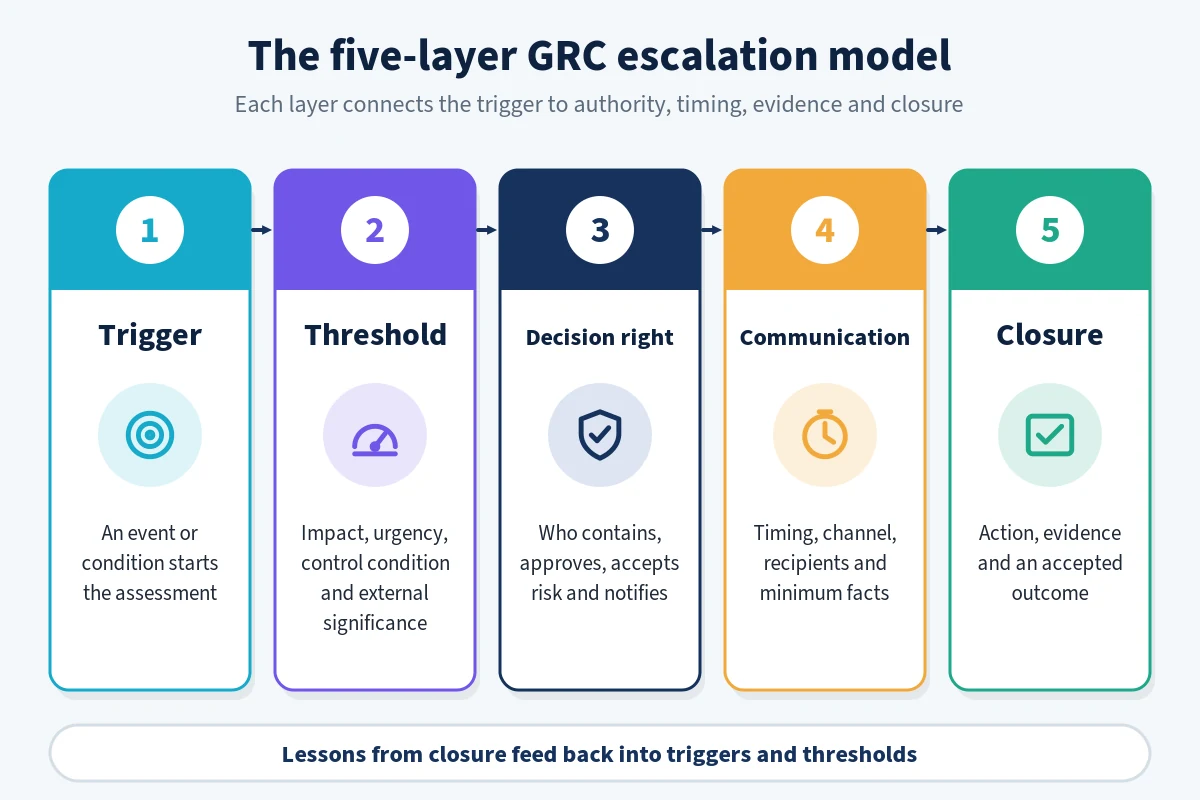
The five-layer GRC escalation model
Layer 1: defined triggers
List the events and conditions that start an escalation assessment. These may arise from incidents, risk indicators, control testing, compliance monitoring, internal audit, customer complaints, whistleblowing, litigation, regulatory change, third-party monitoring or strategic decisions.
Use observable language. “Data concerning more than 1,000 customers may have been disclosed” is more actionable than “possible major privacy issue”. Include qualitative triggers such as suspected senior-management misconduct, deliberate concealment, repeated override, inability to produce required evidence or a risk owner refusing action.
Layer 2: proportionate thresholds
Assess more than likelihood and financial impact. Include speed of harm, reversibility, stakeholder vulnerability, legal or regulatory duty, control-system implications, strategic significance, public-interest consequences and independence concerns. A low-value incident may require immediate board or external escalation if it involves safety, retaliation or senior leadership.
Layer 3: decision rights
For each level, state who may contain the issue, approve expenditure, accept residual risk, notify external parties, commission independent review and close the matter. Name alternates and conflict routes. Avoid assigning accountability to a committee without identifying the executive responsible for execution.
Layer 4: communication and timing
Define whether notification is immediate, within hours, by the next business day or through scheduled reporting. Specify the secure channel, required recipients and minimum facts. Urgent notification can be short; a fuller decision paper can follow. The framework should distinguish “inform”, “consult”, “approve” and “oversee”.
Layer 5: action, assurance and closure
Track the decision, action owner, deadline, residual exposure and evidence of completion. Determine whether legal, compliance, risk or internal audit validation is required. Close only when the authorised owner has accepted the outcome and any oversight body has received the promised evidence.
How to set GRC severity thresholds
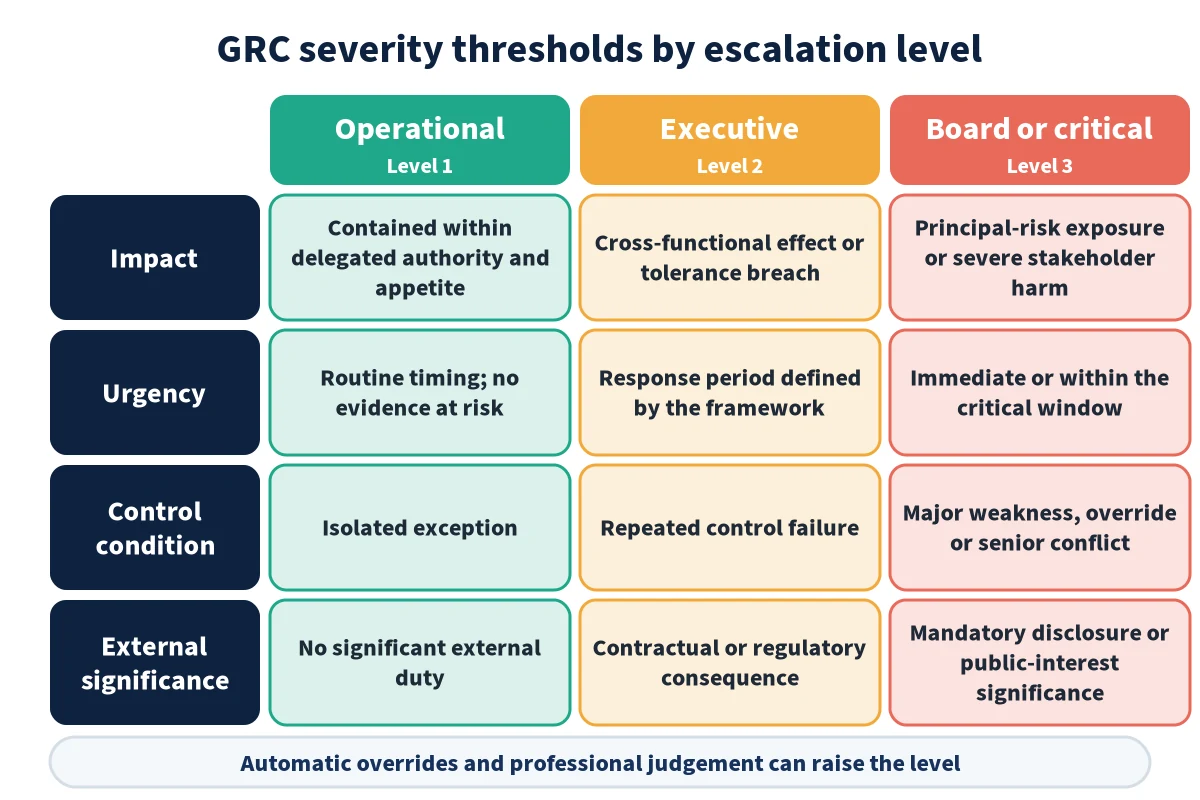
A practical model uses several dimensions and an override rule. Scores can support consistency, but they should not replace judgement. Use four core dimensions:
- Impact: potential effect on people, objectives, finance, operations, reputation and stakeholders.
- Urgency: speed of harm, deadline or evidence loss.
- Control condition: isolated exception, repeated failure, management override or systemic weakness.
- External significance: legal, regulatory, contractual, disclosure, insurance or public-interest implications.
Add automatic overrides for fatalities or serious safety risks, suspected board or executive misconduct, retaliation, deliberate concealment, potentially material misstatement, mandatory notification and events that threaten organisational viability.
| Level | Typical characteristics | Destination and timing |
|---|---|---|
| Level 1: operational | Within delegated authority and appetite; contained; no significant external duty | Process owner; routine reporting and documented closure |
| Level 2: executive | Cross-functional impact, tolerance breach, repeated control failure or material resource decision | Accountable executive and relevant control function within the defined response period |
| Level 3: board or critical | Principal-risk exposure, senior conflict, major control weakness, mandatory disclosure or severe stakeholder harm | Chair or relevant committee immediately or within the specified critical window |
Calibrate thresholds against risk appetite, incident history, regulatory duties and realistic scenarios. COSO’s guidance on understanding and communicating risk appetite explains why appetite must influence objectives and decisions. Escalation criteria are one mechanism for translating appetite into management action.
Decision rights by escalation level
| Decision | Operational management | Executive management | Board or committee |
|---|---|---|---|
| Immediate containment within approved limits | Act and record | Informed for Level 2+ | Informed for critical matters |
| Cross-functional resources | Request | Approve and prioritise | Challenge adequacy for material exposure |
| Residual-risk acceptance | Within delegated tolerance | Within executive appetite authority | Oversee or approve where reserved |
| External notification | Preserve facts and escalate | Decide with legal or compliance advice | Oversee material notification and disclosure |
| Independent investigation or assurance | Recommend | Commission unless conflicted | Commission where independence or senior involvement requires it |
| Final closure | Evidence routine remediation | Accept Level 2 closure | Review closure of critical matters and systemic actions |
The UK Corporate Governance Code 2024 requires boards within its scope to monitor the risk-management and internal-control framework and review its effectiveness. Provision 29 applies for financial years beginning on or after 1 January 2026. The FRC’s 2026 Provision 29 guidance highlights material financial, operational, reporting and compliance controls. Even where the Code does not apply, the underlying distinction is useful: management maintains the system; the board monitors and challenges its effectiveness.
The minimum escalation information pack
Every escalation should answer seven questions:
- What happened or may happen? Separate confirmed facts from allegations and uncertainty.
- Why does it meet the threshold? Identify dimensions, override triggers and affected objectives.
- What is the current exposure? State harm, duration, affected stakeholders and residual risk.
- What has already been done? Record containment, preservation and consultation.
- What decision is required? Specify approval, notification, resources, risk acceptance or independent review.
- By when? State the decision deadline and consequence of delay.
- Who owns follow-through? Name the accountable executive, action owners and assurance route.
Use a one-page urgent notification where time is critical, then add verified detail. Dashboards should never conceal uncertainty behind a colour. Include trend, threshold basis, data date, assumptions, overdue actions and the requested decision.
A worked example: repeated sanctions-screening overrides
A business unit records several screening overrides below its normal financial materiality threshold. At first sight, each transaction appears operational. The escalation assessment identifies three compounding factors: the overrides are repeated, the same senior manager approved them and evidence supporting the decisions is incomplete.
The control-condition and leadership-conflict thresholds move the matter to Level 3. Compliance preserves records, the organisation restricts further overrides, and the board committee receives an initial notification stating what is known, the immediate action and the decision required: approval of an independent review. Legal advisers assess reporting duties. Management remains accountable for operational containment, while the committee protects independence and monitors remediation.
The case closes only after the organisation determines root causes, tests similar activity elsewhere, changes override authority, completes review of prior transactions and validates the revised control. The threshold is then recalibrated so repeated exceptions escalate sooner.
Eight steps to implement the framework
- Map existing routes. Identify how incidents, breaches, risks, findings and complaints currently move.
- Define the taxonomy. Use consistent terms for event, issue, risk, breach, finding and action.
- Align to appetite and obligations. Convert tolerances and notification duties into observable criteria.
- Approve decision rights. Record authority, alternates, conflicts routes and reserved board matters.
- Design templates and secure channels. Make urgent notification fast and decision-focused.
- Test realistic scenarios. Include ambiguity, senior conflicts, weekends and incomplete data.
- Train users and recipients. Owners must know when to raise; leaders must know how to respond.
- Review outcomes. Analyse delays, overrides, unnecessary escalations, missed signals and closure quality.
The DOJ’s Evaluation of Corporate Compliance Programs asks whether gatekeepers know when and how to escalate concerns, whether reporting mechanisms are trusted, and how high investigative findings reach. Those questions can be converted directly into scenario tests and management assurance.
Related foundations include EPW’s explanation of governance, risk and compliance and its guide to setting up an effective internal audit function.
How to measure escalation-framework effectiveness
Track both speed and decision quality. Useful indicators include time from trigger to triage; critical notifications made within target; matters downgraded or upgraded after review; decisions returned because information was incomplete; overdue actions by severity; repeated issues after closure; use of conflict routes; unauthorised risk acceptance; and scenarios where staff failed to recognise a trigger.
Review false negatives through incidents, complaints and audit findings that should have escalated earlier. Review false positives where excessive escalation delayed normal management. The goal is not the largest volume of reports; it is timely attention at the lowest level with sufficient authority and independence.
Strengthen senior-leader GRC judgement with EPW
EPW’s five-day Governance Risk and Compliance for Senior Leaders Course develops the judgement required to connect governance, risk appetite, compliance obligations, culture, assurance and strategic decisions. Participants work with decision rights, escalation thresholds, board reporting, control effectiveness, scenarios and executive-level trade-offs.
The programme is suited to directors, executives and senior governance, risk, compliance and assurance professionals who need an integrated GRC operating model. Explore the wider Auditing, Governance, and Risk Compliance training portfolio for related courses.
Frequently asked questions
What should be escalated to the board?
Matters should reach the board when they affect reserved responsibilities, principal risks, material controls, senior-management accountability, significant external duties or exposure beyond management’s delegated authority. The organisation should define these criteria and retain a judgement override.
Is a red-amber-green dashboard enough for escalation?
No. Colour may summarise status, but leaders also need the threshold basis, trend, uncertainty, exposure, action owner, deadline and decision required. A green average can conceal a severe local event or repeated control override.
Who owns a GRC escalation?
The operational or executive owner remains accountable for action unless authority is formally reassigned. Risk, compliance and internal audit provide challenge or assurance according to their mandates. The board oversees rather than performs management’s response.
References
- OECD, G20/OECD Principles of Corporate Governance 2023: Responsibilities of the board.
- Financial Reporting Council, UK Corporate Governance Code 2024.
- Financial Reporting Council, Provision 29 Mythbuster, January 2026.
- Committee of Sponsoring Organizations of the Treadway Commission, Enterprise Risk Management guidance.
- US Department of Justice, Evaluation of Corporate Compliance Programs, updated September 2024.