

Contract law for project managers is the practical knowledge needed to recognise when a delivery decision may create, change or prejudice contractual rights. Project managers do not replace lawyers, but they should understand formation, authority, contract terms, risk allocation, change, payment, breach and remedies well enough to follow agreed procedures, preserve evidence and obtain specialist advice before a manageable issue becomes a dispute.
This guide uses English-law sources for illustration while focusing on transferable management practice. Governing law, sector rules and the wording of the signed agreement always take priority, so legal conclusions must be referred to qualified counsel in the relevant jurisdiction.
Why contract law matters during project delivery
A project contract is not merely a document used at procurement. It allocates responsibilities, sets the conditions for payment and change, defines required notices, distributes risk and establishes remedies. Everyday conduct—issuing an instruction, accepting late work, approving a design deviation or promising extra time—can affect the parties’ positions.
The UK Government’s Project Delivery Teal Book states that procurement and contract management should secure value for money at an acceptable level of risk, with accurate performance reporting and early escalation of risks and underperformance. This makes contract literacy a project-control capability, not a task reserved for the legal department.
| Legal or contractual issue | Project-management decision | Evidence to retain |
|---|---|---|
| Authority | Who may instruct, approve or vary the work? | Delegations, approval limits and authorised correspondence |
| Scope and terms | What performance is actually required? | Signed documents, hierarchy, specifications and clarifications |
| Change | Is the request a variation, instruction or clarification? | Change request, quotation, impact analysis and approval |
| Time and payment | What notice or application is due, and when? | Programme updates, payment records, notices and delivery proof |
| Breach and remedy | Should the team cure, reserve rights, escalate or terminate? | Decision log, mitigation evidence and legal advice |
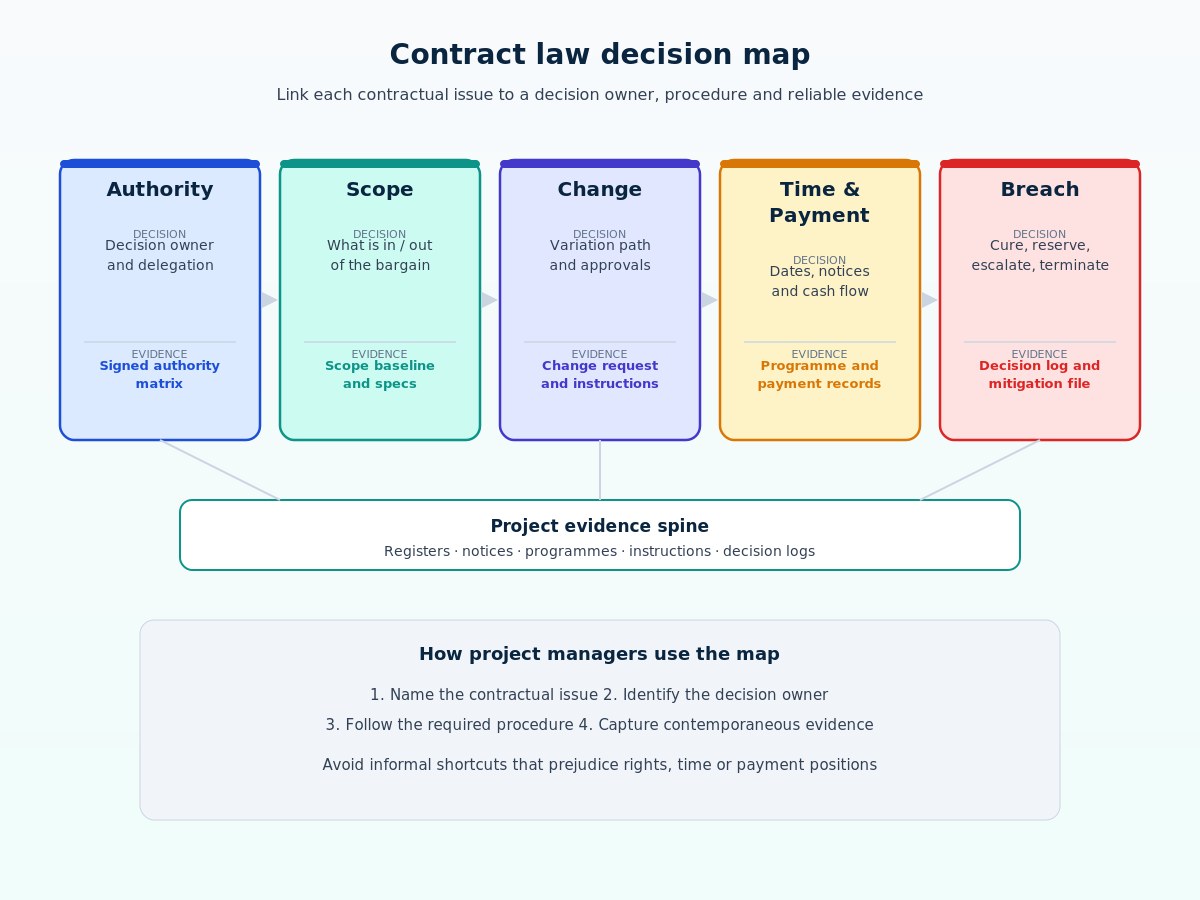
Seven contract-law fundamentals project managers should understand
1. Formation and signing authority
Before relying on an agreement, confirm the parties, effective date, required signatures and any conditions precedent. The fact that a person manages the work does not automatically mean that person can bind the organisation. A project governance plan should show who may sign, issue instructions, approve expenditure, waive a requirement or settle a claim.
Electronic communication can also carry legal significance. The Law Commission’s electronic-execution work concluded in 2019 that an electronic signature can generally satisfy a statutory signature requirement under English law when the signatory intends to authenticate the document and applicable formalities are met. Teams should still follow the contract’s execution method and obtain advice for deeds, regulated documents or cross-border transactions.
2. Express terms, implied terms and document hierarchy
Project managers need a controlled, complete contract set. The agreement may incorporate specifications, schedules, drawings, pricing documents, policies and tender clarifications. If those documents conflict, the hierarchy or precedence clause may decide which prevails. Never resolve an inconsistency by using the most convenient document without recording the issue and applying the agreed interpretation process.
Some obligations may also arise from legislation or be implied by law. The relevant rules depend on the contract type, parties and jurisdiction. Operational teams should flag the issue; they should not assume that silence in the written contract means no obligation exists.
3. Third-party rights and interfaces
Projects routinely involve funders, end users, subcontractors, designers, operators and group companies. Under section 1 of the UK Contracts (Rights of Third Parties) Act 1999, a third party may enforce a term in specified circumstances, subject to the contract and statutory exceptions. Managers should therefore understand beneficiary clauses, collateral warranties, assignments, novations and exclusions of third-party rights before altering an interface.
4. Risk allocation and relief
Contracts allocate risk through scope, warranties, indemnities, liability limits, insurance, securities, force-majeure provisions and relief events. The project team’s task is to translate each allocation into an owner, control and escalation threshold. A risk allocated to a supplier is not managed simply because the contract says so; the team must monitor the obligation and preserve any required notice or evidence.
5. Change and variation control
Change is one of the clearest points where project behaviour and legal effect meet. A disciplined process identifies the proposed change, authority, price, programme impact, risks and approval before implementation. In Rock Advertising Ltd v MWB Business Exchange Centres Ltd [2018] UKSC 24, the UK Supreme Court upheld the effectiveness of a contractual clause requiring variations to be in writing and signed. The decision reinforces the practical need to follow agreed formalities.
6. Notices, payment and time
Many entitlements depend on correct content, method, recipient and timing. Maintain a notice register that distinguishes routine correspondence from formal contractual notices. In qualifying construction contracts in Great Britain, Part II of the Housing Grants, Construction and Regeneration Act 1996 includes statutory rules on adjudication, payment notices, notified sums and suspension. Sector and territorial scope must be checked rather than assumed.
7. Breach, mitigation and remedies
When performance fails, classify the obligation, evidence the failure and assess contractual cure, damages, service credits, liquidated damages, suspension, termination or dispute escalation. Do not describe every failure as “material breach”. The legal threshold and available remedy depend on the term, facts, causation, loss, exclusions and governing law.
The team should also preserve mitigation evidence. That may include resequencing, alternative supply, recovery plans, cost records and attempts to prevent further loss. Commercial action and legal analysis should proceed together.
The EPW 5D contract decision discipline
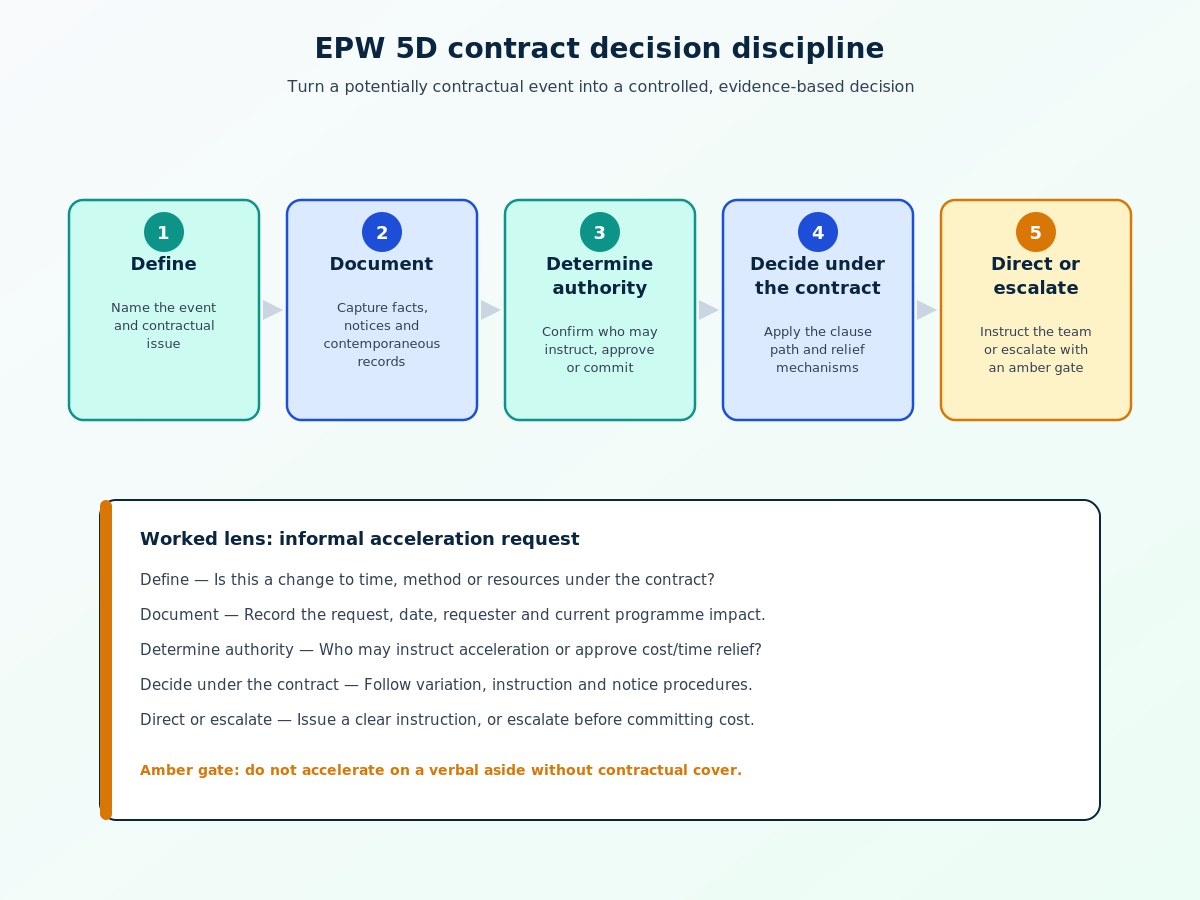
Use this five-stage model whenever a project event may have contractual consequences:
- Define: State the event, affected deliverable, relevant date and operational consequence without assigning blame.
- Document: Preserve the signed contract, instructions, programme, meeting records, costs and contemporaneous communications.
- Determine authority: Confirm who may instruct, approve, reject, reserve rights or escalate.
- Decide under the contract: Identify the applicable clause, deadline, decision criteria and required notice. Record assumptions and uncertainty.
- Direct or escalate: Take the authorised action, monitor completion and seek commercial or legal advice when the issue exceeds delegated competence.
The model is deliberately procedural. It helps the project team create a reliable decision trail while leaving legal interpretation and privileged advice with appropriately qualified professionals.
Worked example: an informal acceleration request
A client representative asks a contractor during a progress meeting to complete two work packages three weeks early. The request appears practical, but it may affect sequencing, overtime, access, testing, price and liability for delay.
Under the 5D discipline, the project manager records the request and affected milestones, checks whether the representative has authority, identifies the change clause and obtains a documented impact proposal. The authorised decision-maker then approves, rejects or modifies the proposal using the contractual process. If work must begin urgently, the parties should use any permitted interim instruction route and clearly reserve unresolved cost and time matters.
The poor alternative is to rely on meeting minutes alone, start acceleration and argue about entitlement later. The disciplined approach does not eliminate disagreement, but it makes authority, scope, timing and evidence visible before resources are committed.
Common mistakes and safer controls
- Acting outside delegated authority: publish an authority matrix and verify it before commitments are made.
- Treating all emails as interchangeable: use the contractually specified address, subject, content and delivery method for formal notices.
- Starting changed work before evaluation: apply the variation procedure or an authorised interim route, with reservations recorded.
- Letting the baseline drift: reconcile approved changes with scope, cost, schedule and risk registers.
- Delaying escalation: define thresholds for legal referral, material exposure, potential termination and threatened proceedings.
- Creating damaging admissions: separate factual incident reporting from legal conclusions and obtain advice where privilege or liability is relevant.
Develop practical contract-law capability
EPW’s Contract Law Fundamentals for Project Managers course covers formation and authority, contract terms, risk allocation, change, notices, breach, remedies and dispute escalation through project-delivery scenarios. Professionals can also explore the wider Contracts Management and Law training portfolio.
Professional review flag: This article discusses legal concepts and uses English-law sources for illustration. A qualified lawyer in the governing jurisdiction should review it before publication and advise on any live contract, notice, claim, suspension or termination. It is general professional education, not legal advice.
Sources and References
- EPW — Contract Law Fundamentals for Project Managers Course
- UK Government Project Delivery Function — Teal Book, Chapter 25: Procurement and contract management
- Law Commission — Electronic execution of documents
- UK Parliament — Contracts (Rights of Third Parties) Act 1999, section 1
- UK Supreme Court — Rock Advertising Ltd v MWB Business Exchange Centres Ltd [2018] UKSC 24
- UK Parliament — Housing Grants, Construction and Regeneration Act 1996, Part II