
Generative AI emerged as one of the most powerful technologies of recent times. Generative AI, unlike traditional AI, which specializes in interpreting and predicting data as closely as possible to what exists, is capable of producing completely new content—be it text, images/audio or even videos. Given its capacity to produce fresh material, it has created new avenues in various fields including marketing, entertainment, medicine, gaming and even creative design.
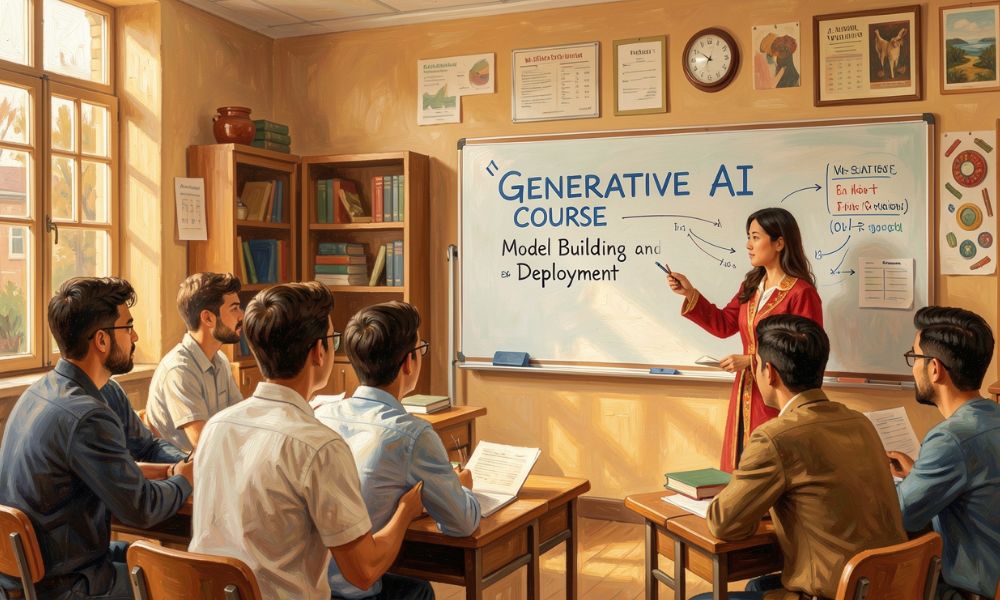
If you are looking to get into the field of artificial intelligence or hone your skills, generative AI course on model building and deployment can be a good first step. An advanced interactive course does not only teach theory but also provides learners with practical knowledge to construct, train and implement AI models in a professional environment.
Understanding Generative AI
Generative AI is, at its core, about creation. Whereas traditional AI systems specialize in classification or prediction, generative models generate output that resembles the training data but does not replicate it. This type of technology is dependent on advanced neural networks including Generative Adversarial Networks (GANs), Variational Autoencoders (VAEs), and diffusion models.
GANs, for example, employ two networks—one a generator, the other a discriminator—that compete with each other. The generator generates new data samples, and the discriminator evaluates their authenticity. Eventually, this toxic dance produces convincing images and other media. VAEs function in a different manner, where the input data is compressed into lower-dimensional space and then decoded to recreate new data that holds similarity with the original one. Recently, diffusion models have emerged as another class of generative models capable of producing high-fidelity images and videos.
These techniques need to be understood before applying them practically — hence a structured course will typically start off understanding the mechanics behind these, before moving on to practical applications.
Data Collection and Preparation
Everything in generative AI is based on data. Your model output is only as good as the quality of data pipeline. By enrolling in an all-encompassing course, the followers will be instructed on collecting market-unique datasets to resolve the business issue, cleaning out noise and preprocessing data for uniformity. We usually introduce data augmentation techniques to augment datasets artificially, enhancing the model performance.
In addition, contemporary courses give importance to ethical usage of data. As privacy and bias come under increased scrutiny, AI practitioners are responsible for complying with data protection law (where applicable) and being transparent on how data is collected and used. Through this fusion of technical proficiency and ethical consciousness, we help guarantee that the AI models heretical are trustworthy as well as responsible.
Building Generative AI Models
Once the data has been properly prepared, the next step is building the generative AI model, where theory truly meets hands-on practice. This stage allows learners to transform their understanding of AI concepts into functional systems capable of generating original content. Using popular frameworks such as TensorFlow, PyTorch, or Hugging Face, learners gain the flexibility to experiment with different model types, including GANs, VAEs, and transformer-based models for text generation.
Key aspects of model building include:
- Designing neural network architectures suited to the task
- Selecting appropriate layers and activation functions
- Choosing hyperparameters that optimize model performance
- Implementing and debugging code efficiently
- Testing outputs to ensure quality and relevance
By the end of this phase, learners not only develop technical proficiency but also gain the confidence to create AI systems capable of producing high-quality, meaningful outputs. This stage bridges the gap between theoretical knowledge and practical implementation, laying a strong foundation for deployment and real-world applications.
Training and Fine-Tuning
Building a model is only the beginning. Training is where the model learns patterns from the data and refines its ability to generate outputs. Efficient training requires understanding computational resources, learning rates, loss functions, and strategies to prevent overfitting. Most generative AI courses provide learners with guidance on using GPUs or cloud-based computing to handle resource-intensive training processes.
Fine-tuning pre-trained models is another crucial aspect. Instead of starting from scratch, learners can adapt existing models to their specific tasks. For example, a pre-trained text generation model can be fine-tuned to produce marketing copy, while an image generation model can be adjusted to create product visuals for e-commerce. This approach not only saves time but also enhances model performance for specialized applications.
Deployment of Generative AI Models
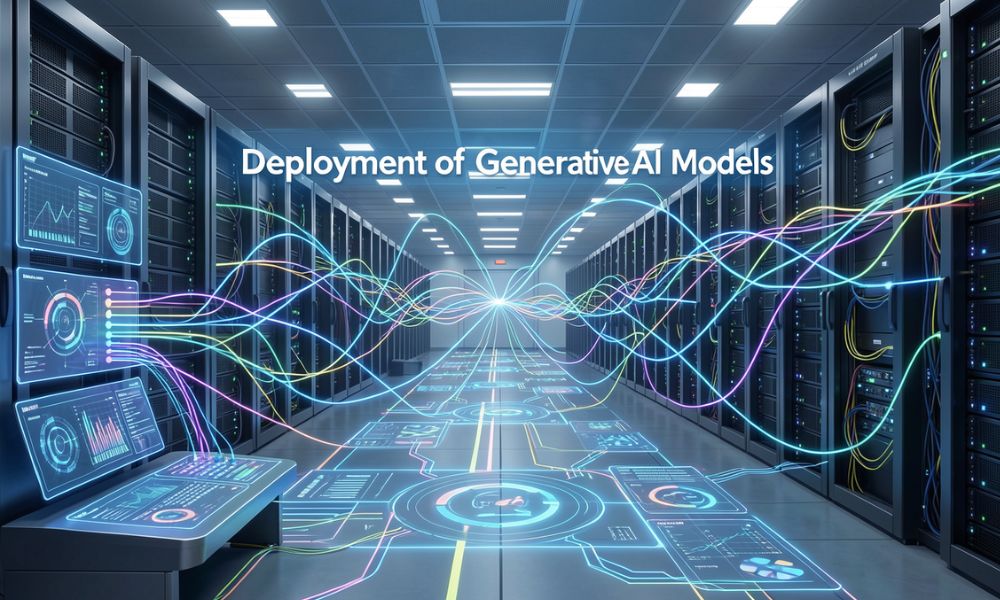
The true value of generative AI emerges when models are deployed for practical use. Deployment involves making the model accessible to end-users or integrating it into software systems. Modern AI courses teach deployment through cloud platforms such as AWS, Azure, or Google Cloud, as well as deploying models as APIs that can be accessed programmatically.
Deployment also includes creating user interfaces, monitoring performance, and updating the models to maintain quality over time. By learning deployment, students gain skills that ensure their models are not just theoretical projects but functioning applications capable of delivering real-world value.
Ethics and Responsible AI
Generative AI can be incredibly powerful, but it also comes with ethical responsibilities. Courses now include sections on AI ethics, emphasizing the importance of minimizing bias, ensuring privacy, and maintaining transparency. Understanding these principles is essential for gaining trust from users and ensuring that AI solutions are applied responsibly.
Being trained in ethical AI practices allows professionals to create systems that are not only effective but also socially responsible—a key differentiator in today’s AI-driven industries.
Tools and Frameworks
A high-quality generative AI course provides learners with hands-on experience using industry-standard tools. TensorFlow and PyTorch are staples for model creation, while Hugging Face is widely used for natural language processing tasks. For image and video generation, specialized GAN and diffusion model libraries are covered. Additionally, cloud deployment tools such as AWS SageMaker or Google AI Platform enable learners to scale their models efficiently. Mastering these tools ensures that students are job-ready and capable of contributing immediately in professional environments.
Career Opportunities in Generative AI
AI Engineering and Data Science
Completing a generative AI course equips learners with skills to pursue roles as AI engineers or data scientists. These professionals design, train, and optimize models for various applications, including predictive analytics, content generation, and automation. Organizations across industries increasingly rely on AI experts to develop innovative solutions, making these positions highly sought-after and well-compensated.
Creative AI and Multimedia Applications
Generative AI skills are also in demand within creative industries. Specialists can work on automating design workflows, generating multimedia content such as images, videos, or music, and creating interactive AI-driven experiences. Companies in gaming, marketing, and entertainment seek professionals who can leverage AI to enhance creativity and productivity.
Freelancing and Portfolio Building
Freelancing offers opportunities for AI practitioners to provide specialized services to clients globally. A strong portfolio, showcasing projects like image synthesis, text generation, or music creation, significantly boosts credibility and marketability. Real-world project experience helps learners demonstrate practical expertise, opening doors to both freelance contracts and full-time positions.
Benefits of Learning Generative AI
The benefits of taking a generative AI course go beyond technical skills. Hands-on experience ensures that learners can confidently build and deploy models. Understanding both the theory and practical implementation positions students as experts in a rapidly growing field. Additionally, exposure to ethical AI practices ensures that their work is responsible and trustworthy.
Courses also encourage creativity and innovation. By learning how to generate original content with AI, professionals can bring new ideas to life in industries ranging from entertainment to healthcare. The ability to automate tasks, generate insights, or enhance creative workflows is a powerful advantage in any career.
Choosing the Right Course
Selecting the right generative AI course is critical. Look for courses that cover the full spectrum of learning—from foundational concepts to model building, training, fine-tuning, and deployment. Hands-on projects should be included, as they are essential for developing practical skills. Courses led by experienced instructors or industry professionals provide insights that go beyond textbooks. Additionally, courses that offer certification or recognized credentials can provide an edge when pursuing career opportunities.
Conclusion
Generative AI is more than just a technological advancement—it represents the next frontier of creativity and automation. By enrolling in a generative AI course focused on model building and deployment, learners gain the skills needed to create, train, and deploy models capable of generating original content for a wide range of applications.
From understanding fundamental concepts to mastering hands-on model deployment, such courses prepare learners for both professional success and creative exploration. Whether you aspire to work in AI engineering, data science, creative industries, or freelance projects, mastering generative AI equips you to innovate and make a real-world impact.
The future of AI is generative, and with the right skills, you can be at the forefront of this transformation. By taking a structured course, you invest not only in your knowledge but also in your ability to deliver functional, scalable, and ethical AI solutions that meet the demands of today’s industries.