
In the past few years, deep learning has emerged as a game-changer in advances of technology, particularly image recognition. With the ability to allow machines to accurately process visual data, an efficiency that was previously unimaginable but now made possible — deep learning is changing business practices and entire industries. Whether it’s diagnosing diseases, automating customer service, or improving security systems deep learning image recognition is enabling unparalleled efficiency and accuracy.
This article investigates how industries are being disrupted by deep learning, how smart solutions are giving companies an edge, and the kind of innovation is be powered through sectors like healthcare, retail, security and even agriculture.
What is Deep Learning?
Deep learning performs within the area of machine learning, which is also a subset of AI. Deep learning, in contrast to classical machine learning, which requires human experts to select features from data for processing, automatically finds patterns through the enormous amount of respective data. Those models are based on neural networks that replicate the way the human brain operates.
Deep learning works especially well for image recognition because it has the capability to learn from raw pixel data without requiring pre-programmed rules. Deep-learning models become more accurate and better at identifying intricate patterns as they are trained, which in turn makes them ideal for any industry that requires fine image analysis.
Deep Learning and Image Recognition
Before choosing a model, compare computer vision and image recognition to decide whether the application needs a class label, an object location or a video track.
Healthcare: Revolutionizing Diagnostics
In the medical field, deep learning has shown great success in improving medical imaging. Through training on thousands of medical images, deep learning models can now spot tumors, fractures and other abnormalities in X-rays, MRIs and CT scans with astonishing accuracy. These systems help doctors diagnose things more quickly, improving the speed and reliability of medical decision-making.
Moreover, deep learning has also become an indispensable technology in early diagnosis of cancer. For instance breast cancer screening which aims to discover subtle abnormalities that may be missed by human radiologists.
Agriculture: Optimizing Crop Management
Deep learning image recognition is an increasingly popular solution among farmers for better management of crops and maximised yields. Deep learning models using aerial footage that has been shot from drones or satellites can detect the pests, diseases and nutrient deficiencies in the plants which could be at an early stage to quickly act upon.
This tool allows farmers to better monitor the well being of their crops, adapt irrigation strategies and forecast harvest windows more precisely. At the end of the line this means cutting costs while increasing yield.
Retail: Improving Customer Experience
Deep learning is also revolutionizing the retail sector through better product search and recommendation systems. With visual search, shoppers can snap a photograph of the product they want or are interested in purchasing and deep learning technology matches that image to similar items available for sale, personalizing the shopping experience like never before.
Furthermore, deep learning can also be used as an inventory management tool by automatically monitoring a stock and pinpointing an out of place or depleted item. Retailers can leverage real-time information on inventory to better manage overall efficiency.
Security: Enhancing Surveillance Systems
Deep learning’s image recognition has proved particularly useful for security systems. Deep learning here means that machine learning models are used to process video in real time.” This could result in the detection of unusual behaviours, threats or even facial recognition.
It has proved to be a big benefit for public safety now that the police can trace suspects and missing persons more speedily. What’s more, deep-learning systems can automatically indicate when they detect suspicious activity. Taking some of the workload off human surveillance and increasing its effectiveness.
How Deep Learning Boosts Image Recognition Accuracy
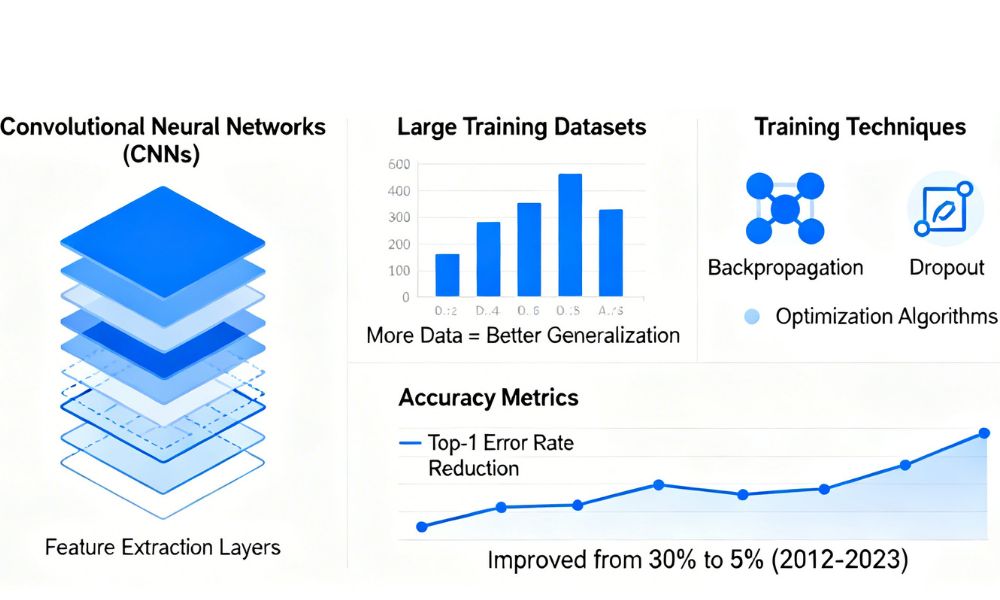
One of the primary reasons deep learning has become so integral to image recognition is its high accuracy. Traditional image recognition systems often struggled with challenges like varying lighting conditions, obscured objects, or complex backgrounds. Deep learning models, however, can learn from large datasets, identifying even the most subtle patterns in images.
This continuous learning process makes deep learning systems highly adaptable. As they process more data, they become better at identifying objects, even in challenging conditions. This level of accuracy is unmatched by earlier recognition methods, making deep learning indispensable for many industries.
The Future of Deep Learning in Image Recognition
The future of deep learning image recognition holds great promise. As computational power and data availability continue to increase, deep learning models will become even more accurate and capable. Here are a few potential future developments:
- Autonomous Vehicles: Deep learning will continue to be integral to the development of self-driving cars, enabling vehicles to process real-time images of the road and identify obstacles, pedestrians, and road signs with high precision.
- Smart Cities: Real-time image recognition systems will play a crucial role in the development of smart cities. From monitoring traffic patterns to ensuring public safety and improving urban planning.
- Edge Computing: The integration of deep learning with edge computing will allow for faster, real-time image analysis without needing constant cloud computing, opening up new possibilities for mobile devices, drones, and IoT systems.
Conclusion
The applications of deep learning image recognition are vast and growing. From healthcare and agriculture to retail and security, deep learning is not only improving efficiency but also driving innovation. The ability to process and analyze visual data with unparalleled accuracy is transforming industries and creating new opportunities for businesses and consumers alike.
As deep learning technology evolves, we can expect it to become even more deeply embedded in our everyday lives, shaping everything from autonomous vehicles to personalized retail experiences. For industries looking to stay ahead. Embracing deep learning for image recognition is no longer a luxury—it’s a necessity for progress.



One thought on “How Deep Learning Enhances Image Recognition Across Fields”
Comments are closed.