
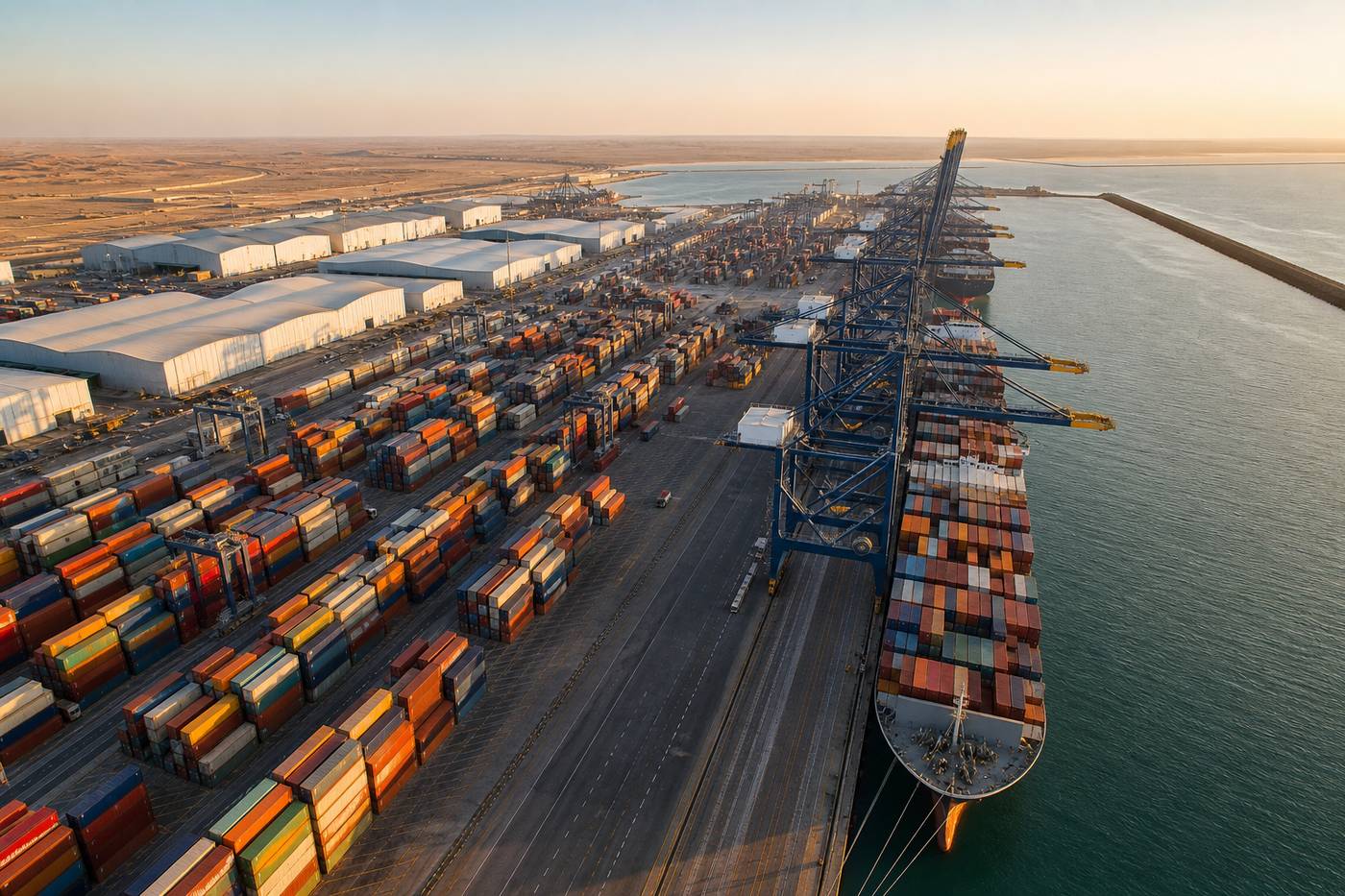
AI-generated illustration created to represent the article’s subject. It does not depict an actual EPW course, trainer, participant, client, event or venue.
Logistics and supply chain management is the discipline of planning, sourcing, producing, moving and delivering goods from raw material to end customer. Supply chain management coordinates the entire network; logistics is the function within it that physically moves and stores the goods. Together they determine what a business can deliver, how fast, at what cost, and how well it survives disruption.
It is one of the few business functions that touches every other one. Procurement decisions set your cost base. Planning decisions set your working capital. Logistics decisions set your customer experience. When the field works well it is invisible; when it fails, everything else stops.
This guide covers what the discipline actually contains, the processes and metrics that run it, the technology behind it, the careers available in it, and how to qualify — with particular attention to the Gulf and African markets, where supply chain investment is currently among the fastest-growing in the world.
What Is Logistics and Supply Chain Management?
The phrase is usually used as a single term for one field of practice, but it names two related things.
Supply chain management (SCM) is the coordination of every organisation, process and resource involved in creating a product or service and delivering it to the end customer. It spans upstream suppliers, internal operations and downstream distribution, and manages three simultaneous flows: goods, information and money.
Logistics is the function within that network responsible for the physical movement and storage of goods — transportation, warehousing, inventory, order fulfilment and returns.
The relationship is containment, not partnership. Logistics sits inside supply chain management. Every logistics activity is a supply chain activity; most supply chain activity is not logistics.
Where the two genuinely differ is in scope, time horizon and objective — supply chain management makes strategic decisions about who you buy from and where you produce, while logistics executes tactically against those decisions. We cover that boundary in detail in our guide to the difference between logistics and supply chain management.
Why the field exists as one discipline
Until the 1980s, companies managed purchasing, manufacturing, warehousing and distribution as separate departments with separate budgets. Each optimised its own numbers. Purchasing bought in bulk to lower unit price, which flooded the warehouse. Manufacturing ran long batches for efficiency, which built stock nobody had ordered. Distribution consolidated shipments to cut freight, which delayed customers.
Every department hit its target and total cost went up. Supply chain management emerged specifically to manage the trade-offs between functions rather than within them. That is still its core purpose, and it is why the field is treated as one discipline rather than several.
The Core Components of Logistics and Supply Chain Management
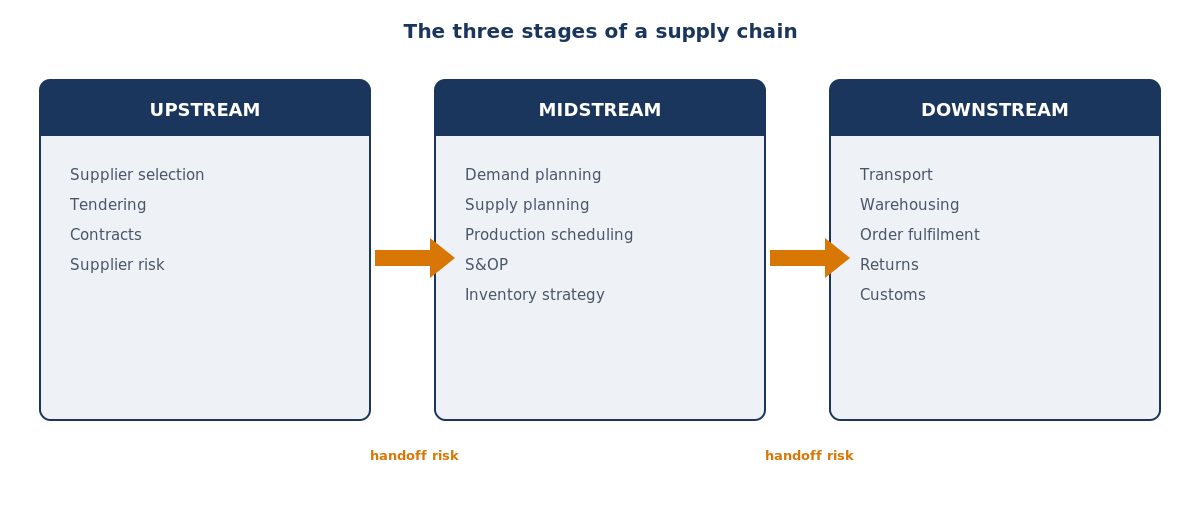
A working supply chain has three stages. Most organisational failures happen at the handoffs between them.
Upstream: sourcing and procurement
Everything that happens before production. Identifying and qualifying suppliers, running tenders, negotiating contracts, managing supplier performance, and assessing supplier risk. Upstream decisions set the cost base and most of the risk profile for everything downstream — a sole-source supplier in a single country is a decision made here that a warehouse manager can never recover from.
Related discipline: procurement planning and cost control.
Midstream: planning and production
- Demand planning and forecasting — predicting what customers will buy so capacity, stock and cash are committed against real demand.
- Supply planning — matching that demand to available materials, capacity and lead times.
- Production planning and scheduling — sequencing manufacturing runs, balancing capacity and utilisation.
- Sales and operations planning (S&OP) — the monthly cross-functional cycle that reconciles the commercial plan with the operational plan. Where S&OP is weak, sales promises what operations cannot deliver.
- Inventory strategy — deciding what to hold, where, and how much. A strategic decision, distinct from the day-to-day inventory control that logistics performs.
Downstream: logistics and distribution
- Transportation — mode selection across road, sea, air and rail; carrier appointment; route and load planning; freight cost management.
- Warehousing — facility location and layout, slotting, picking strategy, space and labour utilisation.
- Inventory management — reorder points, safety stock, cycle counting, stock accuracy.
- Order fulfilment — picking, packing, documentation and dispatch.
- Reverse logistics — returns, repairs, recycling and disposal, now a major cost centre as e-commerce and sustainability regulation expand.
- Customs and trade compliance — documentation, tariff classification, Incoterms and clearance. Critical for anyone operating across the Gulf, Europe and Africa.
The Seven Rs of Logistics
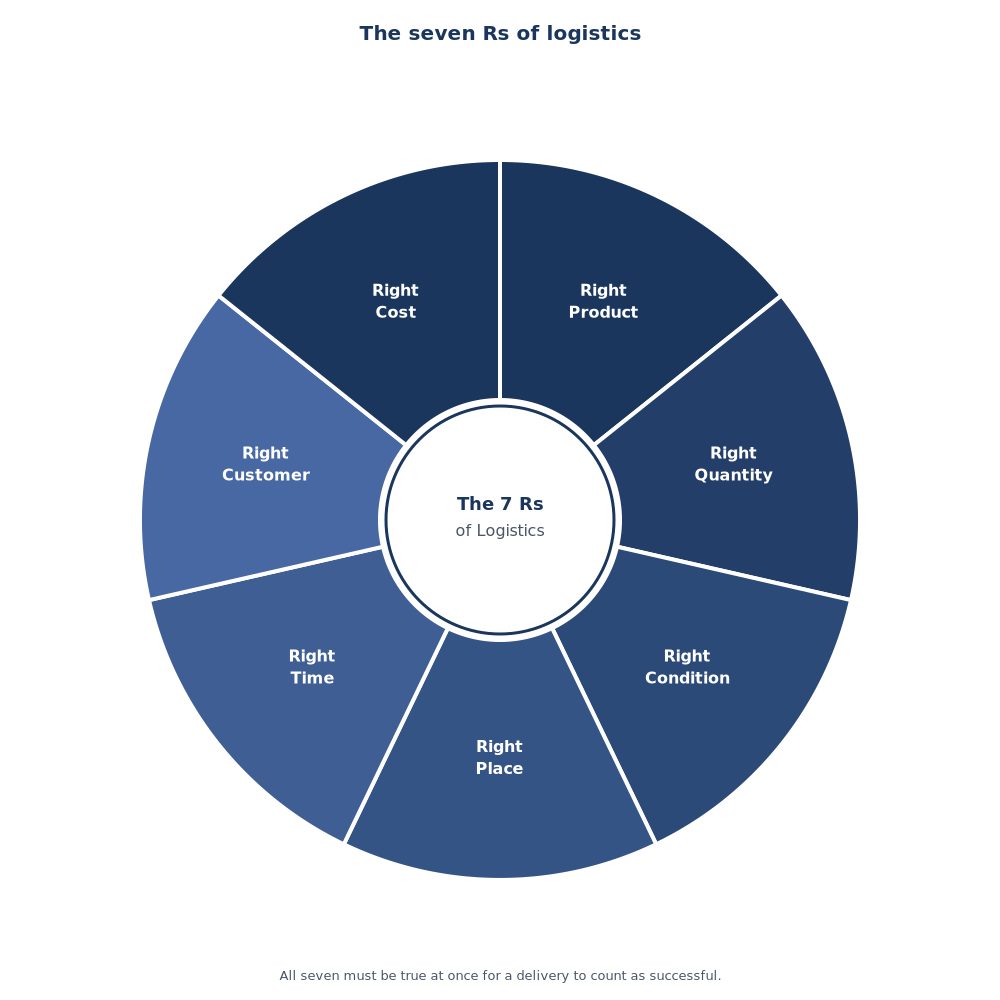
The classic operating standard for the logistics function, and a useful diagnostic. A delivery must be:
- The right product
- In the right quantity
- In the right condition
- At the right place
- At the right time
- To the right customer
- At the right cost
The value of the framework is that all seven must be true simultaneously. A delivery that is on time but damaged has failed. One that is perfect but cost three times the freight budget has also failed. When a supply chain is underperforming, working through the seven usually identifies which specific dimension is breaking.
How the Processes Fit Together: The SCOR Model
The Supply Chain Operations Reference (SCOR) model is the most widely used framework for structuring supply chain processes. It organises the entire chain into six process areas:
| Process | What it covers | Typical owner |
|---|---|---|
| Plan | Balancing demand against supply, setting the operating plan | Demand and supply planners |
| Source | Selecting suppliers, purchasing, receiving and inspecting materials | Procurement |
| Make | Converting materials into finished goods, quality control | Manufacturing / operations |
| Deliver | Order management, warehousing, transport, customer delivery | Logistics and distribution |
| Return | Reverse flows — defective goods, excess stock, end-of-life products | Logistics and customer service |
| Enable | Data, compliance, contracts, risk, performance management | Supply chain leadership |
SCOR matters practically because it gives cross-functional teams shared language. Most supply chain dysfunction is a handoff problem — Source and Plan disagreeing on lead times, Deliver discovering a constraint Make already knew about. A common process map is the precondition for fixing that.
The Three Flows Every Supply Chain Manages
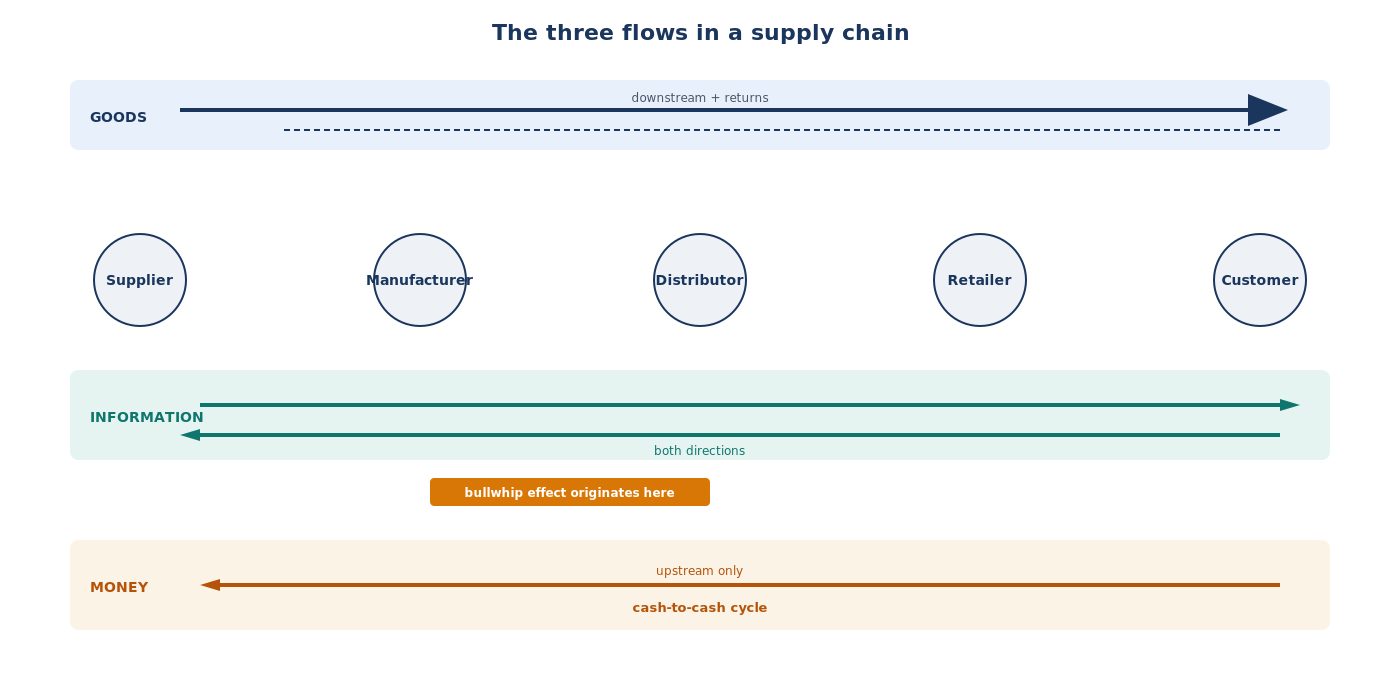
A common mistake is treating supply chain as a goods problem. It is three problems running in parallel:
The flow of goods moves forward, from supplier to customer — and backward, through returns. This is the visible layer, and the one logistics owns.
The flow of information moves in both directions: forecasts and purchase orders upstream, order confirmations, shipping notices and delivery status downstream. Information distortion is the source of the bullwhip effect — small variations in end-customer demand amplifying into large swings in orders further up the chain, because each tier reacts to its immediate customer’s orders rather than to real demand. Poor information sharing, not poor logistics, is the usual cause of chronic overstock and shortage cycling in the same business.
The flow of money moves upstream as payment. It is the flow most often ignored by operational teams and the one finance cares about most, because it determines the cash-to-cash cycle — how long capital is trapped between paying suppliers and being paid by customers. A supply chain can be operationally excellent and still starve the business of working capital.
Key Metrics: How Performance Is Measured
| Metric | What it tells you | Level |
|---|---|---|
| Perfect order rate | Percentage of orders delivered complete, on time, undamaged and correctly documented | Supply chain |
| Cash-to-cash cycle time | Days between paying suppliers and collecting from customers | Supply chain |
| Total landed cost | True cost per unit including freight, duty, handling, insurance and inventory carrying | Supply chain |
| Forecast accuracy | How closely demand plans match actual sales | Planning |
| Supplier on-time in-full (OTIF) | Supplier reliability — the constraint on everything downstream | Procurement |
| Inventory turnover | How many times stock is sold and replaced per year | Planning / logistics |
| On-time delivery | Percentage of customer deliveries meeting the promised date | Logistics |
| Cost per unit shipped | Freight and handling efficiency | Logistics |
| Order accuracy / pick accuracy | Warehouse execution quality | Logistics |
One caution that separates experienced practitioners from newcomers: optimising a logistics metric can damage a supply chain metric. Cutting safety stock improves inventory turnover and lowers carrying cost, while quietly increasing stockout risk and lost sales. Consolidating to a single carrier lowers cost per unit shipped and raises exposure. Total landed cost and perfect order rate are the numbers that reveal whether the whole system is improving — the function-level metrics only show whether one part is.
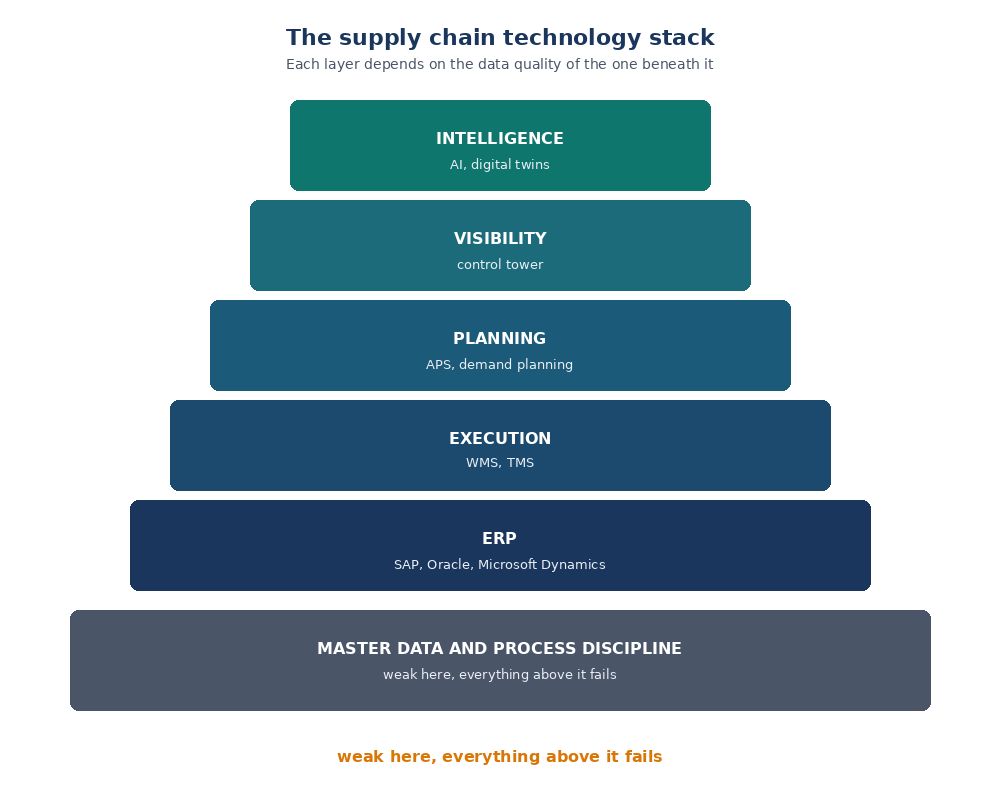
The Technology Stack
- ERP (SAP, Oracle, Microsoft Dynamics) — the transactional backbone holding orders, inventory, financials and master data.
- WMS — warehouse management systems directing receiving, put-away, slotting, picking and dispatch.
- TMS — transportation management systems handling carrier selection, rating, routing, load consolidation and freight audit.
- APS / demand planning tools — statistical forecasting and constraint-based supply planning.
- Supply chain control towers — a single visibility layer across suppliers, plants, carriers and inventory, increasingly the priority investment for large organisations after the disruptions of recent years.
- AI and machine learning — demand sensing, dynamic route optimisation, anomaly detection in supplier performance, and automated exception handling.
- Digital twins — simulation models of the physical network used to test scenarios (a port closure, a supplier failure, a new distribution centre) before committing capital.
Technology fails in this field for a consistent reason: it is deployed onto broken processes and poor master data. A control tower over inaccurate inventory records produces confident, incorrect visibility. Process and data discipline come first.
The Challenges Defining the Field Right Now
Resilience versus efficiency. Decades of lean, single-source, just-in-time design produced supply chains that were extremely cost-efficient and extremely fragile. The correction — dual sourcing, nearshoring, strategic buffer stock — costs money. Deciding how much fragility to buy out is now the central strategic question in the discipline.
Visibility beyond tier one. Most organisations know their direct suppliers and almost nothing about their suppliers’ suppliers. Disruptions routinely originate two or three tiers up, where nobody was looking.
Geopolitical and trade volatility. Tariff changes, sanctions regimes, shipping-lane disruption and customs regime shifts have moved from background risk to routine planning input.
Sustainability and reporting obligations. Emissions reporting increasingly extends to purchased goods and transport, making the supply chain the primary source of a company’s reported footprint — and putting supplier selection under environmental scrutiny.
The talent gap. Demand for people who can combine operational understanding with analytics and commercial judgement consistently outstrips supply. This is the field’s structural constraint, and it is why formal qualification carries unusual weight here.

Careers in Logistics and Supply Chain Management
The field offers two broad tracks that share a foundation and then diverge.
| Track | Entry roles | Mid-level | Senior |
|---|---|---|---|
| Logistics / operations | Warehouse supervisor, transport coordinator, dispatcher | Logistics manager, distribution manager, 3PL account manager | Head of logistics, operations director |
| Supply chain / commercial | Buyer, demand planner, supply chain analyst | Supply chain manager, category manager, S&OP lead | Supply chain director, chief supply chain officer |
Outlook is strong. The US Bureau of Labor Statistics projects 19% job growth for logisticians between 2023 and 2033, well above the average across occupations — and the Gulf and West African markets are expanding faster still on the back of major infrastructure and industrial investment.
Compensation generally favours the supply chain track at equivalent seniority, because those decisions carry more capital and more risk. Company scale matters as much as job family, though — a senior logistics role at a large multinational can outpay a junior supply chain role comfortably. For a detailed breakdown, see our guide to salary expectations in supply chain management.
If you are weighing this field against a broader operations career, our comparison of supply chain and operations management sets out that boundary.
The skills that actually differentiate
- Analytical capability — data handling, scenario modelling, and enough statistics to judge a forecast rather than accept it.
- Commercial negotiation — contract structuring and supplier relationship management.
- Financial literacy — total landed cost, working capital impact, and the ability to defend a decision in P&L terms.
- Cross-functional influence — you will spend most of your time aligning people who do not report to you and whose incentives conflict with yours.
- Risk and scenario thinking — mapping single points of failure before they fail.
Qualifications and certifications
Because the field rewards demonstrable capability over generic credentials, professional certification carries real weight. The most recognised routes include:
- CSCP and CPIM (ASCM/APICS) — broad supply chain and production/inventory management respectively.
- CIPS — the leading procurement and supply qualification, particularly strong in the UK, Gulf and Africa.
- CILT — logistics and transport focused, with wide international recognition.
- Intensive practitioner training — short-format professional courses, which suit working professionals who need applied capability quickly rather than a multi-year academic programme.
Logistics and Supply Chain Management in the Gulf and Africa
The generic literature on this subject is written almost entirely from a North American or Western European perspective. The operating reality across the Gulf and West Africa differs in ways that matter.
The Gulf has positioned itself as a transhipment and re-export hub rather than purely a consumption market. Jebel Ali and the surrounding free zones, alongside major Saudi logistics investment under national diversification programmes, mean supply chain professionals in the region routinely manage flows that never terminate locally. Free-zone customs treatment, re-export documentation and multi-country distribution from a single hub are core competencies here and barely feature in standard curricula.
West Africa presents a different profile: port congestion and long dwell times, complex and variable customs procedures, infrastructure constraints on inland distribution, and foreign exchange availability affecting import planning. Supply chains in Nigeria and Ghana are typically designed around buffer and contingency in ways that would look inefficient by European standards and are entirely rational locally.
The practical consequence: textbook lean principles applied without regional adjustment tend to fail. Professionals working these markets need frameworks they can adapt, not templates to copy.
Frequently Asked Questions
What is logistics and supply chain management in simple terms?
It is the work of getting a product from raw material to customer. Supply chain management plans and coordinates the whole network — who supplies what, what gets made where, how much stock to hold. Logistics is the part that physically moves and stores the goods.
Is logistics the same as supply chain management?
No. Logistics is one function inside supply chain management, alongside sourcing, demand planning, production planning and network design. All logistics is supply chain work; most supply chain work is not logistics.
What does a supply chain manager actually do?
They balance demand against supply, manage supplier relationships and performance, set inventory strategy, control total landed cost, and coordinate between commercial, operations and finance teams. In practice much of the role is resolving conflicts between functions whose targets pull against each other.
Do you need a degree to work in logistics and supply chain management?
Not necessarily. Many logistics professionals enter through operational roles and progress on experience. For supply chain and planning roles, employers increasingly expect either a relevant degree or a recognised professional certification, because the analytical and commercial demands are higher.
Which pays more, logistics or supply chain management?
Supply chain roles generally pay more at equivalent seniority, reflecting greater capital and risk exposure in the decisions. Seniority and company scale influence pay more than the job family alone.
What is the bullwhip effect?
Small variations in real customer demand amplifying into progressively larger order swings further up the supply chain, because each tier responds to its immediate customer’s orders rather than to actual end demand. Better information sharing across tiers is the primary remedy.
How long does it take to build supply chain capability?
Foundational competence in a specific function can be built in months. Broad cross-functional capability — the kind that qualifies someone to run a network rather than a warehouse — typically takes years of exposure, which is why structured training is used to compress the analytical and commercial parts of that curve.
Key Takeaways
- Supply chain management coordinates the entire network from raw material to customer; logistics is the function within it that moves and stores goods.
- The discipline exists to manage trade-offs between functions — optimising each department separately reliably raises total cost.
- Every supply chain runs three flows at once: goods, information and money. Neglecting the information flow causes the bullwhip effect; neglecting the money flow starves working capital.
- Total landed cost and perfect order rate reveal whether the whole system is improving. Function-level metrics only show whether one part is.
- Technology amplifies whatever process and data quality already exist — it does not substitute for them.
- The binding constraint on the field is people who combine operational understanding with analytical and commercial judgement.
EPW delivers intensive five-day professional programmes in this field in Dubai, London and Paris, including Supply Chain Management and Logistics Optimization and Procurement Planning and Cost Control Methods, designed for working professionals who need applied capability rather than theory.