
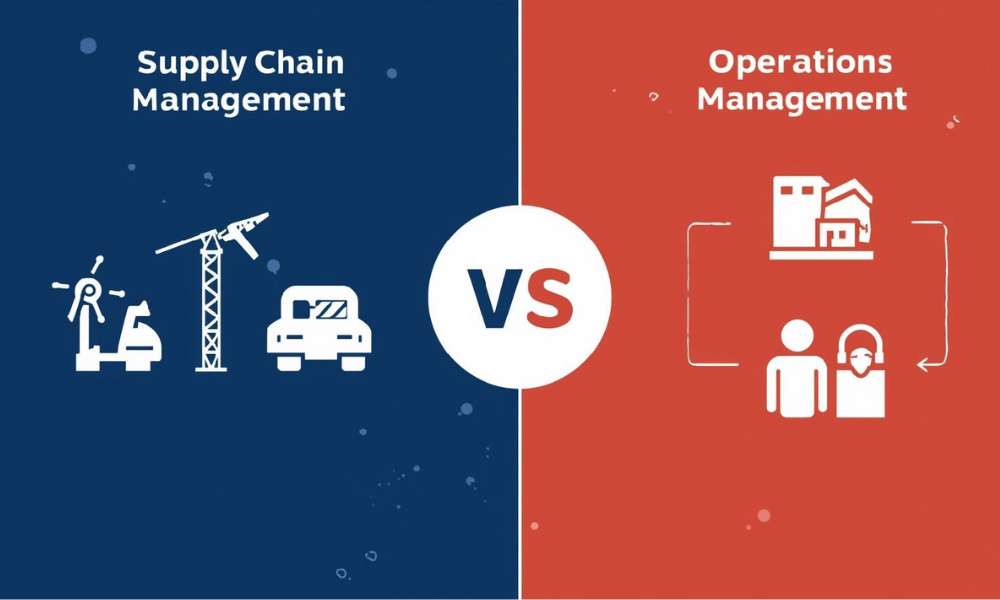
In today’s market competition, business success depends upon operational efficiency, cost cutting and customer satisfaction. The difference between Supply Chain Management (SCM) and Operations management is the key to leverage those few things that can bring about vast improvements in both domains for companies. While they both work to optimize business operations, they are concerned with different parts of the supply and production chains. This article explains the differences between supply chain management and operations management along with their roles in company productivity.
What Is Supply Chain Management (SCM)?
Supply Chain Management (SCM) is the management of flow of goods, services and information from point of origin to point of consumption. It all of course, covers from raw materials sourcing to logistics and inventory management to distribution. The objective of SCM is to create a more efficient supply for less cost, and deliver products on time through maintaining close relationships with suppliers and partners. SCM is essential for the flow of goods through each stage of the supply chain.
What Is Operations Management (OM)?
Operations Management (OM) is an internal business process that’s concerned with how the production of goods or services are carried out within a company. Production services OM ensures that production can be run smoothly, controlling everything from planning to material supply through quality and process performance monitoring. OM’s objective is to streamline the organization processes and ensure in time product delivery to meet customers expectation.
How SCM and OM Differ in Purpose
While both SCM and OM contribute to business efficiency, they differ in their scope and focus:
- SCM focuses on the overall network of suppliers, manufacturers, and distributors, aiming to streamline the entire supply chain.
- OM focuses on internal processes, working to improve production and the use of resources within the company.
Supply Chain Management: of Goods and RelationshipsFlowLayouts
SCM is mainly concerned with the movement of products and services between different stages of a supply chain. This encompasses material sourcing, inventory management, and logistics optimization all while maintaining strong supplier relationships. Quickly reaching the products to the customer, keeping a check on quality and getting it there at minimum costs is one of the biggest challenges that SCM aims to resolve.
Operations Management: Improving Internal Processes
Operations Management focuses on the effectiveness of a company’s internal processes, i.e. production scheduling and control, inventory management and control, and quality assurance. OM exists to ensure production is effective, resources are efficiently used and standards of quality are met. OM is aiming to raise efficiency and lower development cost inside the company.
Key Components of Supply Chain Management
SCM involves several components that contribute to its success:
- Sourcing and Procurement: Acquiring raw materials or components necessary for production.
- Logistics and Distribution: Managing the transportation and delivery of goods to various locations.
- Inventory Management: Maintaining the right inventory levels to prevent stockouts or excess stock.
- Supplier Relationships: Collaborating with suppliers to ensure product quality and timely delivery.
Key Components of Operations Management
Operations Management involves key functions that improve the efficiency of internal processes:
- Production Planning: Organizing the production schedule to meet demand efficiently.
- Quality Control: Ensuring that the products meet the required quality standards.
- Capacity Planning: Managing resources such as labor and equipment to meet production goals.
- Process Improvement: Continuously improving production processes to eliminate inefficiencies.
Time Frames: Long-Term vs Short-Term Focus
One of the most significant differences between SCM and OM is their focus on time:
- SCM has a long-term focus, as it deals with managing supplier relationships, forecasting demand, and optimizing the global supply chain.
- OM, on the other hand, has a short-term focus, concentrating on daily production schedules, resource allocation, and immediate customer needs.
Role of Technology in SCM and OM
Technology plays a significant role in both SCM and OM:
- In SCM, software solutions and technologies like logistics management systems, real-time tracking systems and inventory management software can improve the efficiency in the movement of goods and timely delivery.
- In OM, automation, AI and ERP systems employed in the process of enhancing productivity and efficiency in production, as well as value-added results of resource deployment and control over the manufacturing process.
Cost Management: How SCM and OM Approach Costs
Cost management strategies in SCM and OM differ:
- SCM focuses on minimizing costs across the supply chain, such as sourcing, transportation, and inventory management. By negotiating better contracts with suppliers and optimizing distribution routes, SCM helps businesses reduce operational costs.
- OM focuses on reducing production costs by optimizing resource usage, streamlining processes, and reducing waste in manufacturing.
Impact on Customer Satisfaction
Both SCM and OM directly influence customer satisfaction:
- SCM ensures that products are delivered on time, in the right quantities, and in the proper condition, directly impacting customer satisfaction and retention.
- OM ensures that the products produced are of high quality and meet customer specifications, resulting in timely deliveries and consistent product quality.
Measuring Success: Key Metrics in SCM and OM
Key Performance Indicators (KPIs) help measure the effectiveness of SCM and OM:
- In SCM, important KPIs include on-time delivery, inventory turnover, order fulfillment rates, and supplier performance.
- In OM, KPIs such as production efficiency, resource utilization, quality control pass rates, and cycle time reduction are used to evaluate performance.
Collaboration Between SCM and OM
Despite their differences, SCM and OM must work together to ensure operational success:
- A strong supply chain provides the necessary materials and components for operations management to produce finished goods.
- Effective operations management ensures that the produced goods meet quality standards and are delivered on time, contributing to the overall efficiency of the supply chain.
Conclusion
The distinction between supply-chain management and operations is important for businesses to efficiently improve processes. Whereas SCM is concerned with the external flow of goods and supplier network relationships, OM focuses on internal LEs. Mastering both SCM and OM enables an organization to optimize its operations, cut costs and serve customers well – for the foundation of long-term business success.
Both SCM and OM are valuable, and their joint contribution ensures a smoothest possible operation that is constructed to provide mutual satisfaction; of both the company producer/supplier of goods, that can be easily accessed into life cycles within reasonable costs and customers.




One thought on “Comparing Supply Chain and Operations Management Differences”
Comments are closed.