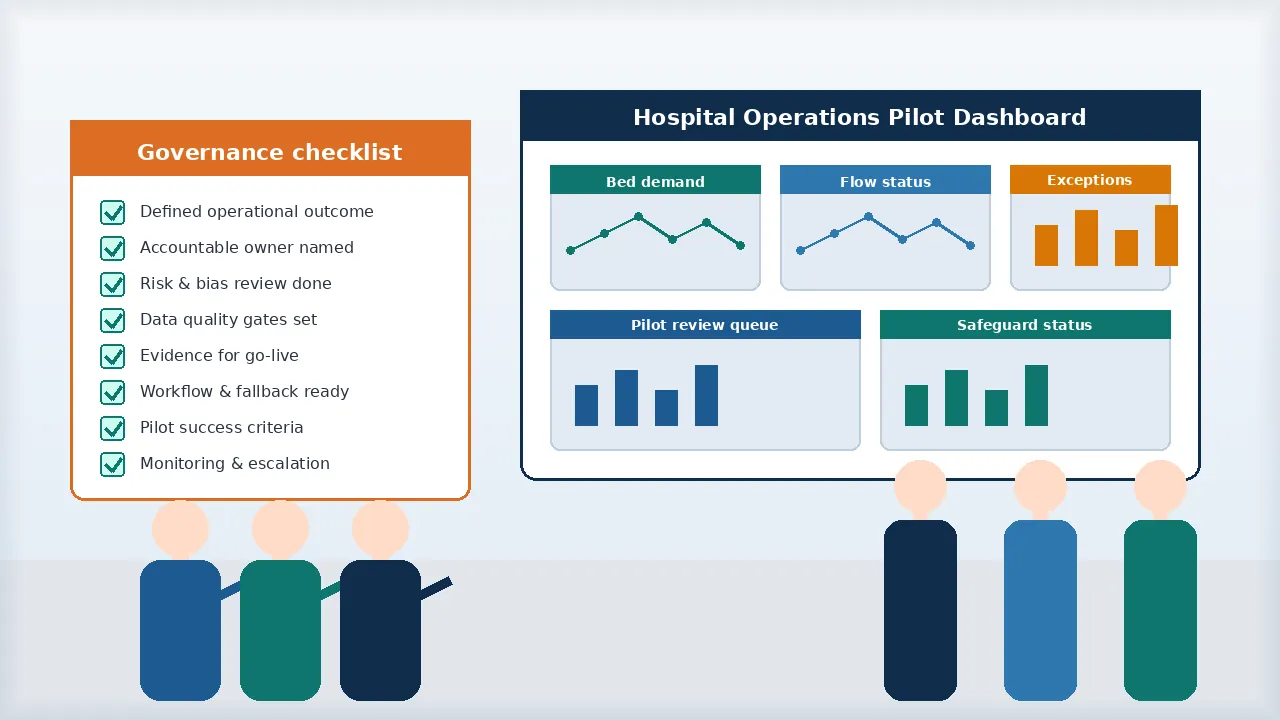

AI-generated illustration created to represent the article’s subject. It does not depict an actual EPW course, trainer, participant, client, event or venue.
Clinical governance best practice means creating a dependable system in which leaders and clinicians are jointly accountable for quality, safety and continuous improvement. The strongest systems combine clear ownership, patient involvement, evidence-based standards, proportionate risk controls, clinical audit, workforce competence and transparent follow-through. Committees and policies matter only when they change decisions and care.
This article is for board members, medical and nursing leaders, quality and patient-safety teams, service managers, risk professionals and clinical auditors. It presents practical governance principles that can be adapted to local law, regulation and professional standards; it does not replace jurisdiction-specific clinical or legal advice.
Key takeaways
- Clinical governance should connect board assurance with frontline learning and measurable service improvement.
- Every material risk and improvement action needs a named owner, deadline, evidence of completion and effectiveness review.
- Patient experience, incident learning, audit, outcomes and workforce evidence should be considered together.
- A good governance system encourages proportionate learning rather than equating accountability with blame.
What is the objective of clinical governance?
The objective is to make high-quality care an organisational responsibility rather than a collection of isolated professional efforts. In England, Care Quality Commission Regulation 17 requires registered providers to operate effective systems for assessing, monitoring and improving service quality and safety and for assessing and mitigating risks.1 Other health systems may use different terminology, but the practical question is similar: how does the organisation know care is safe, effective, person-centred and improving?
Governance should therefore create a line of sight from policy and evidence to day-to-day care, from a safety concern to learning, and from an action plan to verified improvement. EPW’s Healthcare Risk Management and Compliance course develops related skills in obligation mapping, risk assessment, controls, incident learning and assurance.
Eight clinical governance best practices
1. Define accountability and decision rights
Assign executive and clinical accountability for quality and safety, then define what services, committees and individuals must decide. Terms of reference should state authority, escalation thresholds, information requirements and how conflicts are resolved.
Keep an action log that names the responsible owner, due date, evidence required and review forum. “Discussed” is not an outcome. A closed action should demonstrate both completion and whether the action controlled the risk.
2. Involve patients and families in governance
Patient involvement should extend beyond satisfaction scores. Use complaints, experience data, patient stories, co-design and patient-representative participation to identify risks and test whether improvement plans address what matters to people receiving care.
Close the feedback loop by explaining what was heard, what changed and what could not change. The World Health Organization’s Global Patient Safety Action Plan 2021–2030 includes patient and family engagement as a strategic objective for eliminating avoidable harm.2
3. Translate evidence into controlled practice
Maintain an approved process for receiving, assessing and implementing new clinical guidance. Record the owner, affected services, required policy or pathway changes, training implications and implementation date. Local protocols should identify the evidence and approval history behind them.
National Institute for Health and Care Excellence (NICE) quality standards set out concise, measurable statements designed to support improvement in particular areas of care.3 Organisations outside the relevant jurisdiction should use applicable national sources, while retaining the discipline of translating evidence into measurable local expectations.
4. Manage risk and incidents as learning systems
Combine prospective risk assessment with responsive incident management. Staff need accessible reporting routes, proportionate triage and protection from retaliation for raising genuine concerns. Investigations should examine system conditions, not stop at individual error.
NHS England’s Patient Safety Incident Response Framework (PSIRF) promotes proportionate responses selected for learning and improvement rather than a fixed investigation threshold for every event.4 A hospital should adapt its response method to the potential for learning, the needs of those affected and applicable regulatory duties.
5. Use clinical audit and improvement as complementary tools
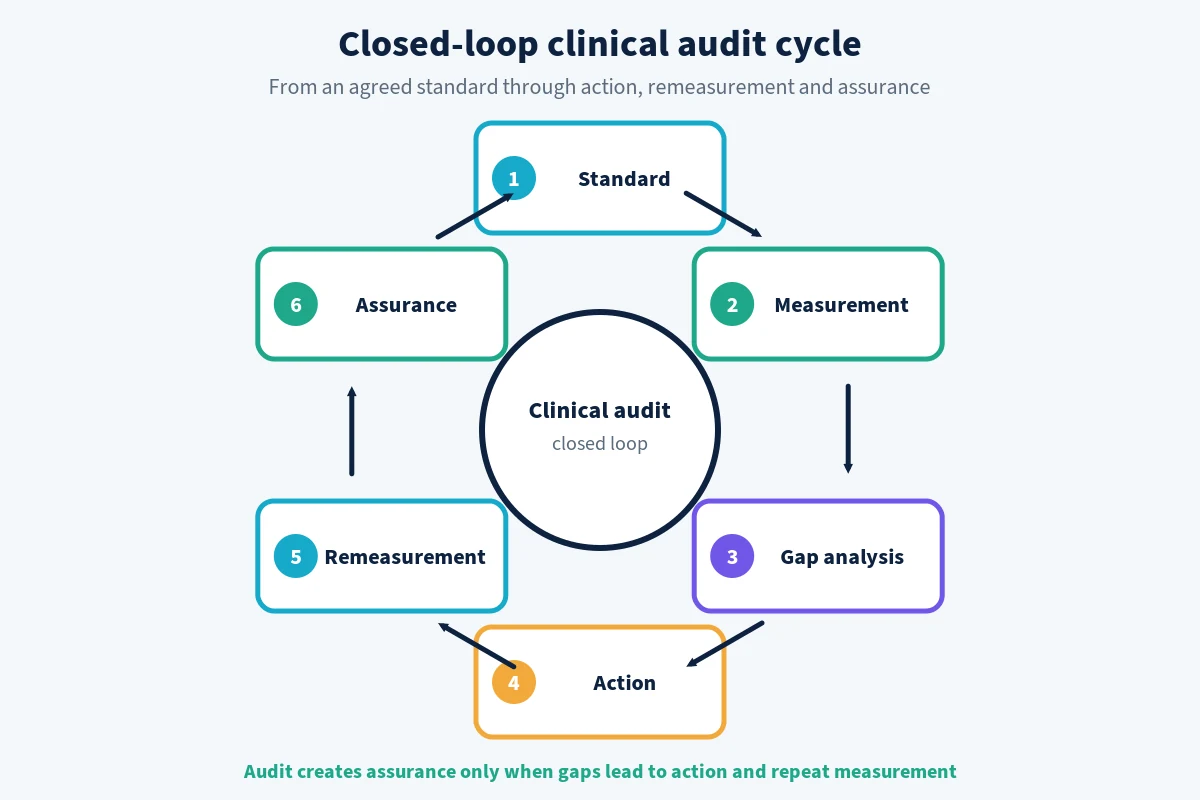
Clinical audit tests practice against explicit criteria or standards. Quality improvement uses structured methods to understand a problem, test change and monitor whether better performance is sustained. Audit can show a gap; improvement work closes it.
Select a small number of priorities linked to important risks and outcomes. For each, define a standard, data source, responsible clinical team, action plan and re-audit or monitoring date. EPW’s Hospital Operations and Quality Improvement course connects governance decisions with patient flow, process redesign, performance data and sustained team improvement.
6. Maintain workforce competence and a speaking-up culture
Define role-specific competencies, induction requirements, supervision, credential checks and continuing development. Training attendance alone does not prove competence; use observation, simulation, case review or practical assessment where appropriate.
Leaders should respond consistently to concerns, distinguish human error from reckless behaviour and examine workload, staffing, equipment, communication and process design. Psychological safety does not remove accountability. It makes accurate reporting and early escalation more likely.
7. Build trustworthy information and balanced measures
Governance decisions depend on reliable data. Define every indicator, numerator, denominator, population, source, owner, refresh schedule and limitation. Validate unexpected changes before drawing conclusions and segment data where averages could conceal unequal outcomes.
Use a balanced set of evidence: outcomes, process reliability, patient experience, incidents, complaints, staffing, competence, audit results and operational pressure. A single favourable metric should not outweigh a material safety signal.
8. Verify that actions work and learning spreads
Review high-risk actions after implementation. Ask whether the control is used, whether it changed the target measure, whether it created a new risk and whether other services need the same learning. Record the evidence supporting closure.
Share learning in forms that fit the work: updated standard procedures, safety huddles, simulation, decision aids, dashboards and targeted supervision. EPW’s published comparison of Standard and Transmission-Based Precautions illustrates how a governance requirement becomes a point-of-care decision sequence rather than remaining an abstract policy.
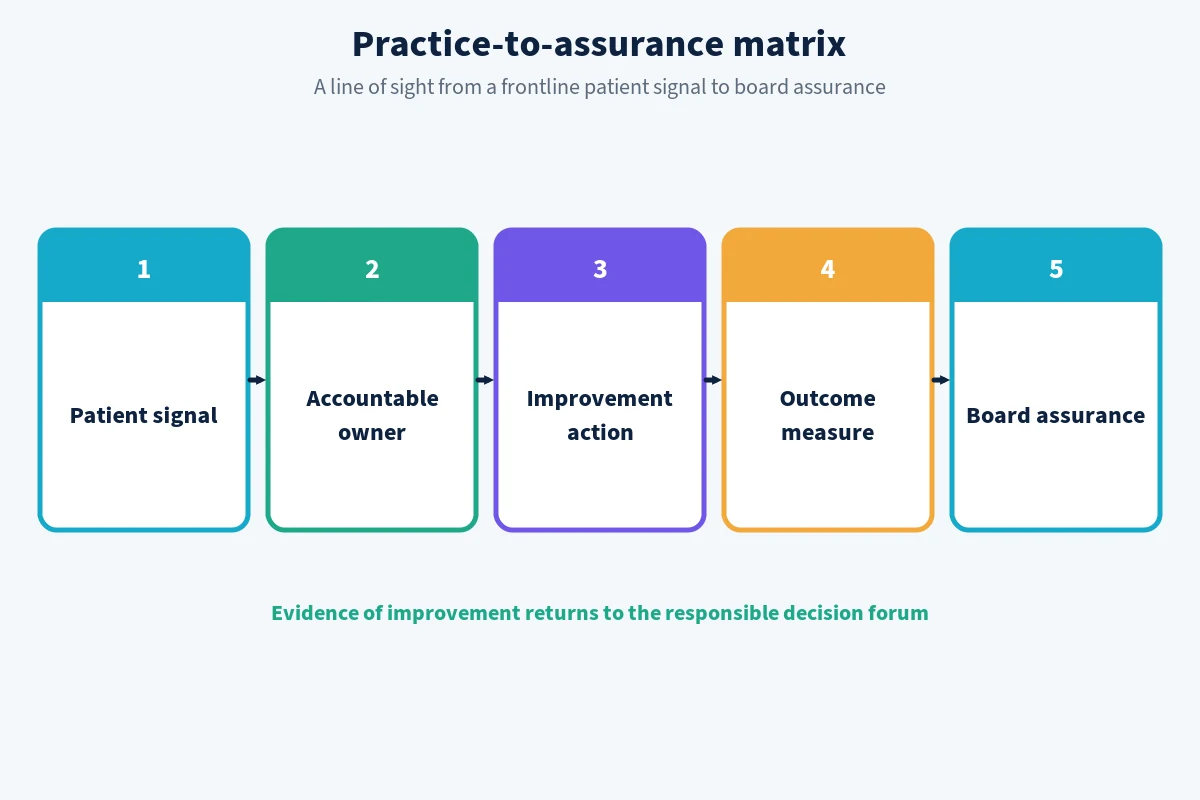
EPW’s practice-to-assurance matrix
| Governance practice | Accountable role | Evidence for assurance | Useful review question |
|---|---|---|---|
| Ownership and escalation | Board and executive clinical lead | Decision map, risk thresholds, action log | Can a concern reach someone authorised to act? |
| Patient involvement | Service and experience lead | Co-design records, themes and feedback loop | How did patient evidence change the decision? |
| Evidence implementation | Clinical effectiveness lead | Guideline register, approved pathway, compliance data | Is current evidence visible in everyday practice? |
| Risk and incident learning | Patient-safety lead | Risk review, response rationale, learning actions | Did the response address system conditions? |
| Audit and improvement | Clinical audit or quality lead | Criteria, baseline, action and remeasurement | Was the improvement sustained? |
| Workforce competence | Professional and service leads | Competency assessment, supervision and staffing review | Can staff perform and escalate safely? |
| Information quality | Data and governance owners | Indicator definitions, validation and limitations | Is the evidence trustworthy enough for this decision? |
| Learning and closure | Action owner and assurance committee | Effectiveness review and spread decision | What proves the risk is better controlled? |
This matrix prevents a common governance failure: presenting activity as assurance. A committee may receive a report, staff may complete training and a policy may be issued, yet none proves that practice changed. Evidence should match the claim being made.
Worked example: responding to delayed recognition of deterioration
A governance committee identifies several reports of delayed recognition of patient deterioration. A weak response would circulate a reminder and close the action after staff acknowledge it. A stronger response begins by defining the affected services, reviewing patient and staff accounts, analysing workflow and equipment factors, and checking practice against approved escalation criteria.
The service lead owns a time-limited improvement plan. Measures include completion of observations, timeliness of escalation, response time, balancing measures for workload and evidence from case review. Training is targeted to identified gaps and paired with practical competency checks. The team tests changes on one ward, reviews unintended effects and repeats measurement.
The action closes only after the committee sees credible evidence that the new process is used and effective. Residual risk remains visible, and learning is considered for other services. If the issue relates to external standards, the organisation can also connect the evidence with its accreditation programme through EPW’s Healthcare Accreditation and Regulatory Standards course.
Common clinical governance failure modes
- Committee-heavy governance: meetings multiply while ownership and decision rights remain unclear.
- Policy as proof: approval of a document is mistaken for reliable implementation.
- Blame-centred incident response: the investigation ends with an individual and misses system conditions.
- Training as the default action: education is prescribed even when staffing, workflow, equipment or leadership is the main cause.
- Metric overload: boards receive large dashboards without thresholds, interpretation or decisions.
- Premature closure: actions close when completed rather than when their effectiveness is demonstrated.
- Isolated learning: one service improves, but related services are not assessed.
A 90-day improvement checklist
- Map the governance forums, owners, escalation routes and duplicated decisions.
- Select three material quality or safety risks and trace each from frontline evidence to board assurance.
- Review open actions for named ownership, due dates, closure evidence and effectiveness checks.
- Test whether patient, complaint and incident evidence changes priorities.
- Check one clinical standard from approval through training, practice observation, audit and remeasurement.
- Simplify one dashboard so that definitions, thresholds, variation and required decisions are explicit.
- Review whether staff can raise concerns and receive timely, proportionate feedback.
- Report what changed, what evidence supports the change and what residual risk remains.
The Care Quality Commission’s fundamental standards for regulated services in England include person-centred care, safe care, staffing, complaints, duty of candour and good governance.5 These standards are jurisdiction-specific, but they illustrate why clinical governance must integrate several forms of assurance rather than operate as a single audit function.
Conclusion
Clinical governance is effective when accountability, evidence and learning form a closed loop. Leaders define expectations, staff and patients surface risks, teams improve practice, and decision-makers verify whether the change worked. The practical test is not how many governance activities occurred, but whether the organisation can explain and demonstrate how care became safer and more reliable.
Explore EPW’s Healthcare and Hospital Management Training Courses for related learning in patient safety, quality, risk, operations and leadership.
Ready to strengthen accountability and assurance in your organisation? Review EPW’s Clinical Governance and Patient Safety Systems course and relate the course outcomes to a live governance priority.
Sources and references
- Care Quality Commission. Regulation 17: Good governance. Accessed September 2026.
- World Health Organization. Global Patient Safety Action Plan 2021–2030. 2021.
- National Institute for Health and Care Excellence. About quality standards. Accessed September 2026.
- NHS England. Patient Safety Incident Response Framework. Accessed September 2026.
- Care Quality Commission. The fundamental standards. Accessed September 2026.