
AI-generated illustration created to represent the article’s subject. It does not depict an actual EPW course, trainer, participant, client, event or venue.
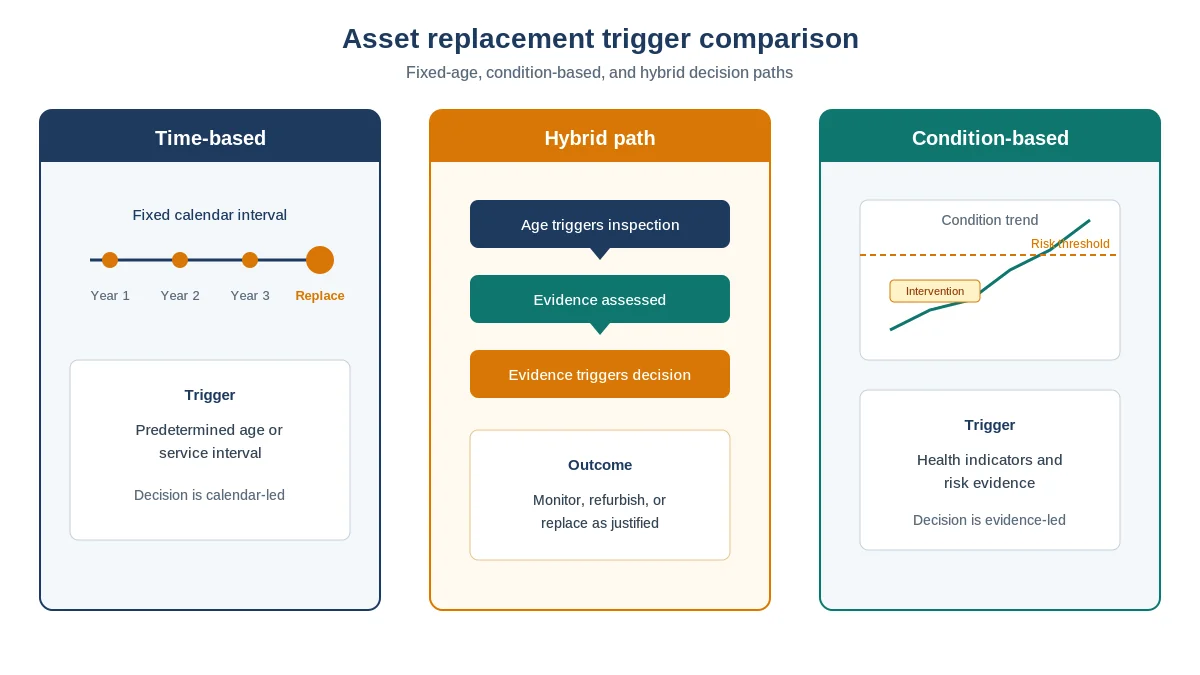
Condition-based asset replacement uses measured or assessed health, failure likelihood, consequence and system need to determine when intervention is justified. Time-based replacement uses a predetermined age, interval or design-life assumption. However, neither policy is universally better: fixed intervals offer simplicity and planning certainty, while condition-based decisions can defer unnecessary expenditure or accelerate action on deteriorating high-risk assets. Therefore, most utilities need a controlled hybrid policy.
This comparison is intended for utility asset managers, power-system planners, maintenance leaders and investment committees. More specifically, it distinguishes replacement policy from maintenance scheduling and provides a practical selection framework for transformers, switchgear, cables and other network assets.
Key takeaways
- Age is a useful exposure indicator, but it is not a direct measurement of condition or remaining useful life.
- Condition-based replacement is strongest when diagnostics are repeatable, failure consequences are understood and intervention lead time is available.
- Time-based rules remain appropriate where deterioration is predictable, inspection is weak or regulation and safety require fixed action.
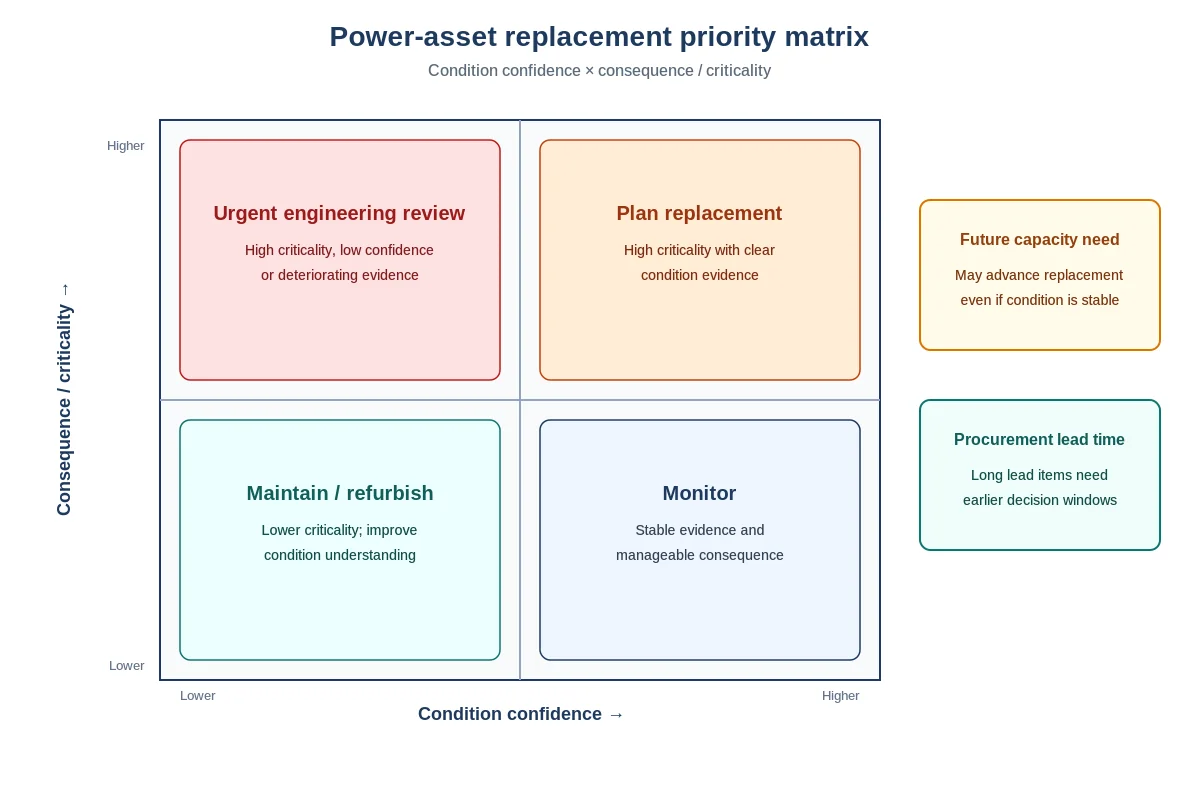
- Criticality, common risk and network need should be assessed separately from asset health.
- A hybrid policy uses time to trigger inspection or planning and evidence to authorise refurbishment, life extension or replacement.
Condition-based vs time-based asset replacement: the immediate difference
In simple terms, the central difference is the decision trigger. A time-based policy asks whether the asset has reached a specified age or interval. By contrast, a condition-based policy asks whether current evidence shows that continued service, refurbishment or replacement produces the best balance of performance, risk and expenditure.
More broadly, ISO 55001:2024 frames asset management around controlling the asset lifecycle and balancing performance, risk and expenditure in pursuit of organisational objectives. Therefore, that principle supports a decision framework rather than an automatic “old equals replace” rule. ISO 55001:2024 overview
Comparison across the main decision criteria
| Criterion | Time-based replacement | Condition-based replacement |
|---|---|---|
| Primary trigger | Calendar age, operating hours, duty cycles or stated design life | Observed condition, health index, failure likelihood, performance and risk |
| Data requirement | Asset register, age and interval rules | Inspection, tests, monitoring, defect history, loading, environment and diagnostics |
| Planning certainty | Usually higher and easier to budget | Depends on inspection cycles, thresholds, degradation and lead time |
| Risk of premature replacement | Higher where assets age differently | Lower when condition evidence is credible |
| Risk of late intervention | Possible if deterioration accelerates before the interval | Possible if indicators miss defects or monitoring is infrequent |
| Technical complexity | Lower | Higher; requires diagnostic rules, uncertainty treatment and governance |
| Best fit | Predictable ageing, limited diagnostics, mandated intervals or low-cost standard assets | High-value or heterogeneous assets with informative diagnostics and variable duty |
What the policies have in common
In both cases, utilities require a controlled asset register, defined decision authority, procurement lead times, outage planning and assurance that the replacement delivers the required future function. In addition, neither policy should ignore network demand, obsolescence, spare strategy, cybersecurity, environmental obligations or the consequence of taking an asset out of service.
ISO 55000:2024 presents asset management as a lifecycle discipline for realising value from assets. As a result, replacement is one option among continued operation, enhanced monitoring, repair, refurbishment, duty reduction and system redesign. ISO 55000:2024 overview
When time-based replacement is the stronger policy
Time-based replacement is appropriate when age or use is a dependable proxy for loss of function and the cost of a missed failure is unacceptable. However, it is also practical where condition tests cannot detect the dominant failure mechanism with enough warning to complete engineering, procurement and outage preparation.
- Mandated or manufacturer-controlled intervals: a legal, safety or approved technical requirement sets a maximum interval.
- Predictable wear-out: duty cycles or consumable life provide a repeatable end-of-life signal.
- Low-value, standardised assets: detailed monitoring and analysis would cost more than planned replacement.
- Weak condition observability: available tests do not reveal the dominant degradation mechanism.
- Long lead time with little warning: waiting for a condition threshold could leave insufficient time to secure a replacement.
However, the limitation is heterogeneity. Two transformers of the same age may have different loading histories, environments, designs, maintenance quality and defect exposure. Consequently, a universal retirement age can remove a serviceable unit while leaving a younger but riskier unit in operation.
When condition-based replacement is the stronger policy
In particular, condition-based replacement is strongest where reliable inspections or monitoring can identify deterioration early enough to act. For example, IEC’s smart-energy roadmap explains that condition monitoring can support availability, performance and useful-life decisions. It also stresses that monitored assets should be selected through risk-informed and cost-benefit analysis. IEC asset management and condition monitoring overview
In addition, suitable evidence varies by asset class. Transformer evidence may include loading, cooling, oil quality, bushings, tap changer condition, dissolved-gas analysis and electrical tests. By comparison, switchgear evidence may include operation count, timing, contact wear, mechanism performance and insulation evidence. Cable evidence may include installation history, sheath testing, partial discharge and other technology-specific diagnostics.
For instance, CIGRE Technical Brochure 858 describes asset health indices as a route to classifying changing likelihood of in-service failure and supporting prioritised maintenance and replacement plans for substation equipment. However, a health index should organise evidence; it should not conceal missing data or convert an ordinal score into an unjustified failure probability. CIGRE asset-health-index guidance
Condition-based policy is not “replace when a dashboard turns red”. Instead, it needs confirmed defects, repeatable tests, trend interpretation, criticality, operating constraints, uncertainty and an intervention window. Moreover, a sudden failure mode with no detectable precursor still needs redundancy, protection, spares or a time-based control.
A practical asset replacement framework
Use a six-part decision record for every candidate asset: function, health, likelihood, consequence, options and timing. Therefore, this approach separates facts that are often collapsed into one score.
- Define the future function. Confirm the capacity, voltage, fault duty, controllability, resilience and compliance the network will require over the planning horizon.
- Assess condition and confidence. Combine inspections, tests, monitoring, defects and operating history. Record data quality and whether the dominant failure modes are observable.
- Estimate likelihood of failure. Use asset-class evidence, condition modifiers and expert review. Do not treat age alone as condition or a health score as a probability unless it has been calibrated.
- Evaluate consequence and criticality. Consider safety, environment, customers, system security, repair duration, spares, reputation and financial effects. Model common-mode and site dependencies where relevant.
- Compare intervention options. Test continued service, monitoring, maintenance, repair, refurbishment, duty restriction, redundancy and replacement using lifecycle cost and risk.
- Set timing and control gates. Account for engineering, approvals, procurement, outages and construction. Define inspection thresholds and the latest safe decision point.
Decision matrix
| Evidence and risk pattern | Preferred policy | Typical control |
|---|---|---|
| Predictable wear, weak diagnostics, clear maximum interval | Time-based | Replace at approved interval; inspect for unexpected acceleration |
| Variable ageing, credible diagnostics, long deterioration warning | Condition-based | Trend condition and act at approved risk or health threshold |
| High consequence, incomplete diagnostics, long procurement lead time | Hybrid | Age-based planning gate plus enhanced monitoring and contingency |
| Good condition but future duty will exceed capability | Need-based replacement or redesign | Plan against forecast function, not asset age |
| Poor condition but low criticality and strong contingency | Risk-controlled deferral may be possible | Document operating limits, monitoring and trigger points |
IEC 60300-3-11:2009 provides guidance for developing equipment failure-management policies using reliability-centred maintenance analysis. In practice, its continued relevance is the discipline of selecting a policy according to function, failure consequence and applicable preventive action rather than applying one interval to every asset. IEC 60300-3-11 overview
Worked portfolio example
Assume a utility has three hypothetical power transformers approaching the same planning age. Unit A has stable condition indicators, moderate loading and a viable network transfer. However, Unit B is younger but has a worsening diagnostic trend and no nearby spare. Meanwhile, Unit C is healthy, but forecast demand will exceed its firm-capacity role before the next investment cycle.
A time-only rule would rank Unit A first because it is oldest. However, the hybrid framework reaches a different portfolio: continue Unit A with normal surveillance; accelerate engineering and contingency for Unit B because condition and consequence combine; and plan Unit C’s uprating or replacement because future function, not deterioration, is the driver.
In addition, CIGRE’s 2025 transformer-maintenance guide describes maintenance as a lifecycle process and notes that decisions about repair, refurbishment or replacement should consider safety, environmental, system-reliability and cost factors. CIGRE transformer-maintenance guide
This example is illustrative and contains no real asset results. Therefore, actual decisions require approved diagnostics, safety assessment, engineering studies and accountable authorisation.
Where each policy can fail
Time-based policy failure modes
- Replacing healthy assets early and consuming capital that could address higher risk.
- Assuming identical ageing across different designs, duty and environments.
- Missing rapidly developing defects between scheduled interventions.
- Using accounting life as if it were engineering life.
Condition-based policy failure modes
- Relying on an indicator that does not detect the dominant failure mechanism.
- Using thresholds without calibration, repeatability or uncertainty limits.
- Waiting for confirmation until procurement and outage lead time has disappeared.
- Ignoring common-cause exposure, obsolescence or future network requirements.
- Allowing commercial pressure to redefine a technical threshold after the fact.
Accordingly, CIGRE’s June 2026 review of transmission and distribution modernisation argues that fixed asset lifetimes alone are insufficient. Instead, condition, risk, performance, system value and cost should inform replacement or life-extension decisions. CIGRE regulatory-framework review
Asset replacement governance and implementation checklist
- Replacement criteria are approved for each asset class and linked to organisational objectives.
- Age, condition, likelihood of failure, consequence and future need are stored as separate fields.
- Inspection and monitoring methods are appropriate to credible failure modes.
- Health indices disclose weights, missing data, confidence and version.
- Diagnostic alarms have verification, escalation and decision time limits.
- Procurement, outage and construction lead times are included in trigger settings.
- Life-extension assumptions and operating restrictions have accountable owners.
- Portfolio decisions compare maintenance, refurbishment, redundancy and replacement.
- Deferrals record residual risk, contingency and the next mandatory review.
- Policy performance is reviewed against failures, false alarms, cost and service outcomes.
Build asset-planning and lifecycle decision skills
Professionals responsible for asset replacement, network planning, asset health, reliability risk and capital prioritisation can review EPW’s five-day Power System Planning and Asset Management course. It forms part of EPW’s broader Electrical Power and Energy Engineering training portfolio.
Conclusion
Condition-based replacement is not automatically superior to time-based replacement. In practice, its advantage appears when condition evidence genuinely changes the decision and arrives early enough to act. However, fixed intervals remain valuable where wear is predictable or diagnostics are weak. Therefore, a controlled asset replacement policy normally provides the best balance: time starts the planning conversation, while condition, consequence and future function determine the intervention.
Ready to strengthen power-asset renewal and investment decisions? Explore EPW’s Power System Planning and Asset Management course and review available dates and locations.
Sources and References
- International Organization for Standardization. ISO 55000:2024 — Asset management: Vocabulary, overview and principles. Published July 2024. Source.
- International Organization for Standardization. ISO 55001:2024 — Asset management system: Requirements. Published July 2024. Source.
- International Electrotechnical Commission. IEC 60300-3-11:2009 — Reliability centred maintenance. Published 17 June 2009; stability date 2027. Source.
- International Electrotechnical Commission, SyC Smart Energy. Management of assets and condition monitoring system. Accessed 13 September 2026. Source.
- CIGRE Working Group B3.48. Asset health indices for equipment in existing substations. Technical Brochure 858, 2022. Source.
- CIGRE Working Group A2.69. Guide for transformer maintenance — 2025 edition. Technical Brochure 962, June 2025. Source.
- CIGRE Working Group C5.37. Regulatory framework on modernisation and extension of useful life of transmission and distribution assets. Technical Brochure 985, June 2026. Source.
- EPW Training. Power System Planning and Asset Management Course. Accessed 13 September 2026. Source.