

AI-generated illustration created to represent the article’s subject. It does not depict an actual EPW course, trainer, participant, client, event or venue.
Useful project risk examples describe an uncertain event, its cause and its effect on an objective. Common examples include late approvals, inaccurate estimates, resource conflicts, supplier failure, requirements volatility, integration defects and weak operational readiness. Project managers should adapt—not copy—the examples below, assign an accountable owner and select mitigation that changes the likelihood or impact.
A risk is not merely a problem statement. ISO 31000 provides principles, a framework and a process for managing uncertainty, while PMI’s project-risk guidance covers techniques and good practices across portfolios, programmes and projects. Both sources support a structured approach connected to objectives and decisions rather than a static list maintained for compliance. ISO 31000:2018; PMI Risk Management in Portfolios, Programs, and Projects.
15 project risk examples at a glance
| # | Risk event | Early warning | Primary mitigation direction |
|---|---|---|---|
| 1 | Strategic priorities change | Sponsor decisions are repeatedly deferred | Confirm decision gates and strategic alignment |
| 2 | Approval arrives late | Review comments remain unresolved | Plan evidence, reviewers and deadlines |
| 3 | Estimate is materially inaccurate | Assumptions lack evidence | Use ranges, reference data and review |
| 4 | Requirements continue to change | Acceptance criteria are unstable | Prioritise, trace and control change |
| 5 | Critical dependency is late | External milestone has no confirmed owner | Integrate schedules and agree triggers |
| 6 | Technical integration fails | Interfaces are untested | Define interfaces and test early |
| 7 | Quality defects require rework | First-pass acceptance declines | Strengthen prevention and staged control |
| 8 | Data migration is incomplete | Reconciliation differences persist | Profile, cleanse, rehearse and reconcile |
| 9 | Supplier performance deteriorates | Milestones and submittals slip | Set measures, recovery routes and alternatives |
| 10 | Price or currency movement raises cost | Exposure exceeds an agreed threshold | Allocate, hedge or hold contingency appropriately |
| 11 | Specialist capacity is unavailable | Overallocation or turnover increases | Secure capacity and cross-train |
| 12 | Stakeholder resistance slows adoption | Participation and readiness remain low | Engage by impact and prepare users |
| 13 | Safety or regulatory requirement changes | New guidance or review comments emerge | Monitor obligations and preserve evidence |
| 14 | Operational handover is rejected | Readiness evidence is incomplete | Agree acceptance and rehearse transition |
| 15 | External disruption affects delivery | Lead times or access conditions worsen | Develop scenarios and continuity options |
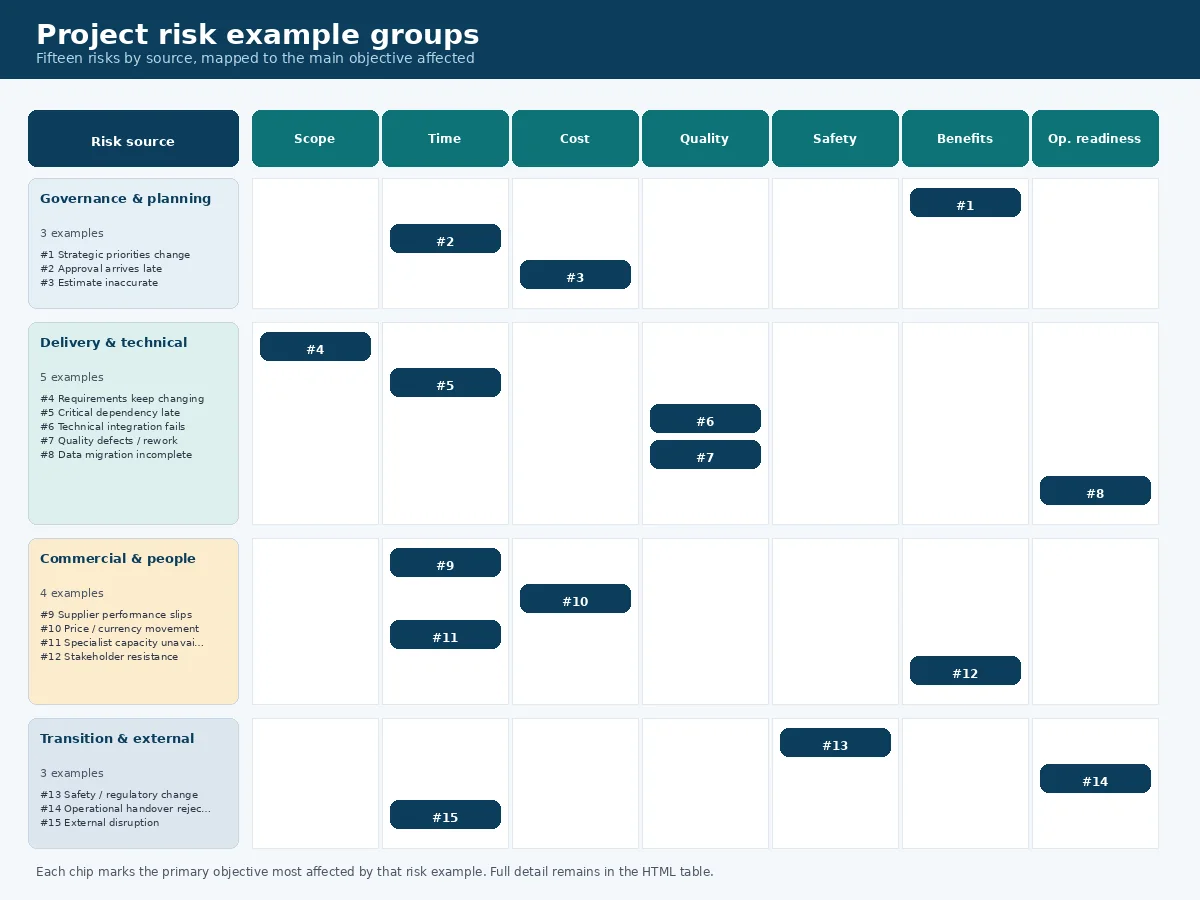
Governance and planning risks
1. Strategic priorities change
Example: If organisational priorities change before the next funding decision, the project may lose sponsorship or investment, delaying or stopping delivery. Mitigation: agree strategic decision gates, maintain a current benefits case and define which assumptions would trigger re-evaluation. Contingency: prepare options to pause, reduce or resequence scope rather than continuing by inertia.
2. A critical approval arrives late
Example: If design, legal or investment approval is not received by the required date, dependent work may start late. Mitigation: identify approvers early, agree evidence requirements, schedule pre-reviews and track unresolved comments. Trigger: escalate when the forecast approval date reaches the schedule’s available tolerance.
3. The estimate is materially inaccurate
Example: If quantities, rates or productivity assumptions are unreliable, the approved budget or completion date may be unrealistic. Mitigation: document assumptions, use reference-class information where available, express uncertainty as ranges and require independent challenge for material estimates. EPW’s Advanced Project Planning and Control Techniques course is relevant where estimating, baselines and control need to work as one system.
Delivery and technical risks
4. Requirements continue to change
Example: If users cannot stabilise priority requirements, the team may redesign work and miss acceptance dates. Mitigation: make requirements testable, trace them to objectives, prioritise them and apply change control to the approved baseline. The Association for Project Management defines change control as capturing, evaluating and then approving, rejecting or deferring requests to alter a baseline. APM change-control guidance.
5. A critical dependency is late
Example: If an enabling project, permit or client-supplied item is late, the delivery sequence may fail. Mitigation: place dependencies in the integrated schedule, assign owners on both sides and agree evidence-based status dates. Contingency: identify work that can be safely resequenced before the trigger is reached.
6. Technical integration fails
Example: If interfaces between systems, packages or disciplines are incomplete, components may work separately but fail together. Mitigation: define interface ownership, freeze critical specifications progressively, use prototypes and test the highest-risk interfaces early.
7. Quality defects create rework
Example: If preventive controls are weak or acceptance criteria are ambiguous, outputs may fail inspection and require costly rework. Mitigation: define acceptance evidence, review capability, inspect at points where correction remains practical and analyse recurring causes rather than only repairing each defect.
8. Data migration is incomplete or inaccurate
Example: If source data is poor or transformation rules are incorrect, the new solution may produce unreliable records at launch. Mitigation: profile and cleanse data, define reconciliation rules, rehearse migration using representative volumes and require accountable sign-off.
Commercial and people risks
9. Supplier performance deteriorates
Example: If a supplier misses submittals or production milestones, dependent project work may be delayed. Mitigation: use measurable obligations, inspect leading indicators, hold structured recovery reviews and maintain proportionate alternatives for critical supply. EPW’s Project Procurement and Vendor Coordination course provides a related capability route.
10. Price or currency movement increases cost
Example: If an exposed commodity or currency moves beyond the estimating assumption, the project may exceed its approved budget. Mitigation: quantify the exposure, allocate it clearly in contracts, consider approved financial or purchasing responses and set thresholds for drawing contingency. Specialist financial advice may be required; a project team should not improvise hedging.
11. Specialist capacity is unavailable
Example: If a scarce expert is diverted or leaves, critical design, review or commissioning work may stop. Mitigation: confirm named capacity, cross-train suitable colleagues, document critical decisions and plan succession for single-person dependencies.
12. Stakeholder resistance slows adoption
Example: If affected users do not understand or accept the new process, technically complete outputs may not produce intended benefits. Mitigation: assess impacts by stakeholder group, involve credible operational representatives, address concerns, prepare role-specific support and measure actual use. For deeper stakeholder practice, see EPW’s Project Leadership and Stakeholder Engagement course.
Transition and external risks
13. A safety or regulatory requirement changes
Example: If a relevant obligation or approval interpretation changes during delivery, completed work may need redesign or further evidence. Mitigation: assign regulatory ownership, monitor authoritative notices, maintain traceability and involve competent reviewers before irreversible decisions.
14. Operational handover is rejected
Example: If training, support, asset information or acceptance evidence is incomplete, operations may refuse handover. Mitigation: define readiness criteria with operational owners, plan transition activities as delivery work and rehearse critical cutover and recovery procedures. EPW’s Monitoring Evaluation and Project Closure Excellence course supports related closure and evaluation capability.
15. External disruption affects delivery
Example: If severe weather, infrastructure failure, civil restriction or another external event affects access or supply, milestones may be missed. Mitigation: develop plausible scenarios, identify critical resources and lead times, maintain continuity options and monitor indicators tied to decisions. Avoid vague labels such as “force majeure risk”; describe the event and the affected objective.
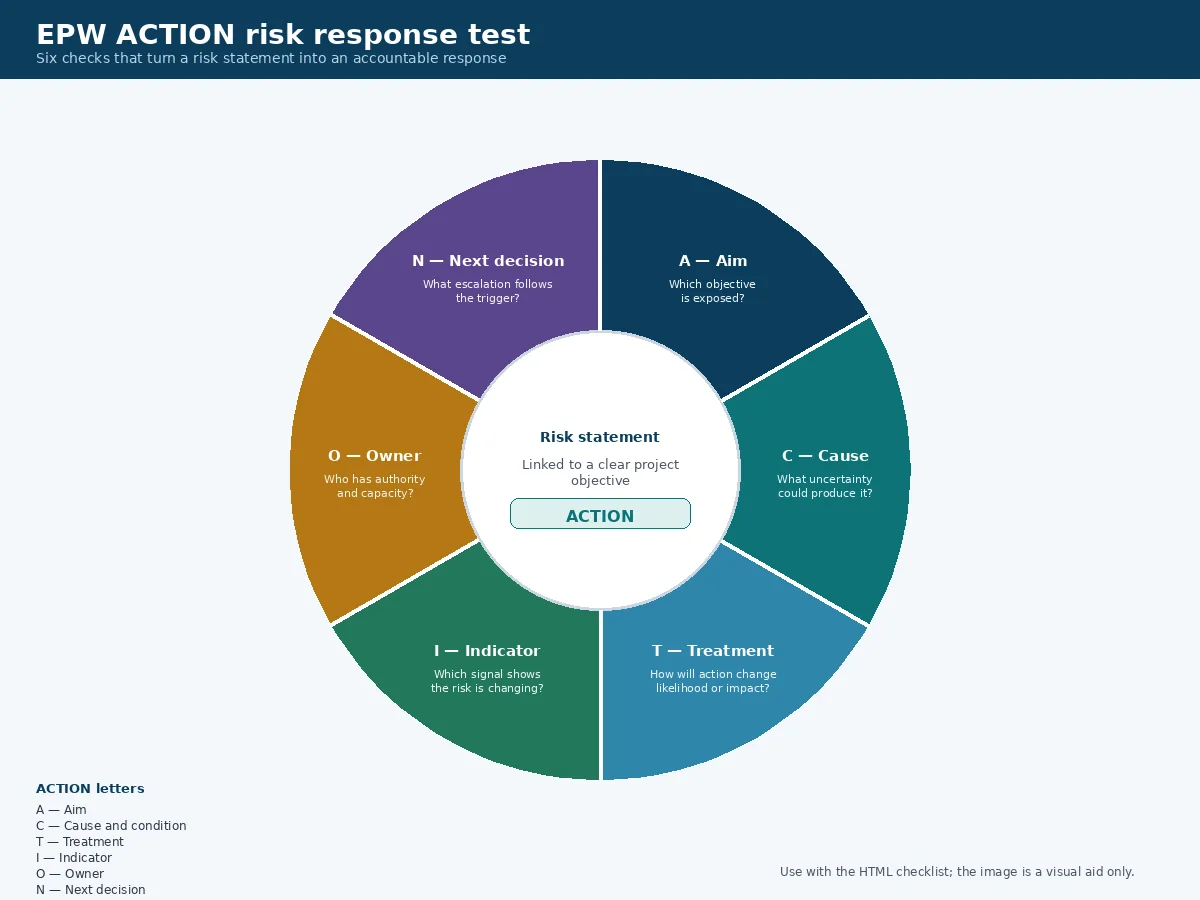
Use the EPW ACTION response test
For each material project risk, test the response with six questions:
- A — Aim: Which objective is exposed?
- C — Cause and condition: What uncertainty could produce the event?
- T — Treatment: How will the action change likelihood, impact or exposure?
- I — Indicator: Which measurable signal shows the risk is changing?
- O — Owner: Who has authority and capacity to manage the response?
- N — Next decision: What contingency or escalation follows the trigger?
This original EPW test prevents “monitor closely” from passing as a mitigation. A valid response has a mechanism, owner, evidence and decision point. The UK Government’s Orange Book likewise states that risk management should be integral to informed decision-making from project inception through implementation and service delivery. The Orange Book: Management of Risk.
Professionals who want to practise identification, analysis, mitigation and monitoring can explore EPW’s Project Risk Management and Mitigation Strategies course.
How to use these examples in a risk workshop
- Start with the project’s objectives, assumptions, interfaces and decisions.
- Use the 15 examples only as prompts; rewrite each relevant risk for the actual context.
- Record causes, event, effects, existing controls and current exposure separately.
- Prioritise using the organisation’s approved method and risk appetite.
- Assign actions that change exposure, plus dates, resources and owners.
- Define indicators and contingency triggers before the event occurs.
- Review residual and secondary risks after responses are planned.
The Government Project Delivery Teal Book advises beginning with the sponsoring organisation’s risk appetite, policies and procedures, then applying identification, assessment, response, monitoring and reporting in context. The Teal Book, Chapter 20: Risk Management. Teams needing the broader foundation can also review EPW’s Project Management Fundamentals and Best Practices course.
Turn examples into decisions
A strong risk register is specific to the project, current enough to influence action and proportionate to the decisions at stake. Use these project risk examples to widen identification, then replace generic wording with real causes, events, objectives, owners, mitigations and triggers.
Browse the full Project Management Training Courses category for connected development options.
Ready to strengthen project risk identification and response planning? Explore EPW’s Project Risk Management and Mitigation Strategies course, review the available options or enquire about tailored in-house training.
Sources and References
- International Organization for Standardization. ISO 31000:2018 — Risk Management: Guidelines.
- HM Government. The Orange Book: Management of Risk — Principles and Concepts. Updated 29 July 2026.
- Government Project Delivery. The Teal Book, Chapter 20: Risk Management.
- Project Management Institute. Risk Management in Portfolios, Programs, and Projects: A Practice Guide.
- Association for Project Management. What Is Change Control?.