
Machine learning can produce an accurate prediction and still fail to improve a business decision. The usual cause is not the algorithm. It is a gap between the model’s output, the action available to a decision-maker and the outcome the organisation actually values.
A sound machine-learning business case therefore begins with a decision, not a dataset or a fashionable model. It identifies who must act, what choices are available, when the prediction is needed and what a useful improvement would be. Only then should a team decide whether machine learning is the right intervention.
This article presents EPW’s practical DECIDE framework for framing, evaluating and implementing machine learning for business decision-making. It is designed for managers, analysts and technical teams who need a common method for moving from an operational problem to measurable value.
Why machine-learning projects often miss the business decision
A model metric answers a technical question. For example, precision describes how many positive predictions were correct, while recall describes how many actual positive cases the model found. Neither metric, on its own, proves that a workflow became faster, safer or more profitable.
Google’s official guidance on framing machine-learning problems separates business success metrics from model evaluation metrics. That distinction is crucial. A service team may improve a classification score while response times remain unchanged because no staff capacity was assigned to act on the alerts. A forecast may become more accurate while inventory costs rise because the replenishment rule was not redesigned.
Machine learning creates value only through a complete chain:
business objective → decision → model output → operational action → measured outcome.
If any link is missing, the project is an experiment rather than an operating capability.
Should the problem use machine learning at all?
Not every decision needs a predictive model. A simple rule, a process change or conventional reporting may be cheaper, clearer and more reliable. Use the following screening table before committing to development.
| Situation | Best starting approach | Reason |
|---|---|---|
| The decision follows stable, explicit policy | Rules or workflow automation | The logic can be stated, tested and audited directly. |
| The question is what happened or why | Business intelligence or statistical analysis | Descriptive evidence may answer it without prediction. |
| Patterns recur across many examples and cannot be expressed reliably as rules | Machine learning | A model may learn useful relationships from historical evidence. |
| The process is inconsistent or poorly defined | Process redesign first | Automating confusion usually scales the confusion. |
| Outcomes cannot be observed, actions cannot change, or errors are unacceptable | Do not automate; investigate alternatives | The project lacks a valid learning signal or a safe operating path. |
A good candidate normally has a repeated decision, sufficient relevant data, a measurable outcome, a meaningful choice that can change and an acceptable way to manage errors. The potential value should also exceed the full cost of data preparation, integration, monitoring, user training and governance.
The EPW DECIDE framework
DECIDE is a six-stage model for keeping business purpose, analytical evidence and operational delivery connected.
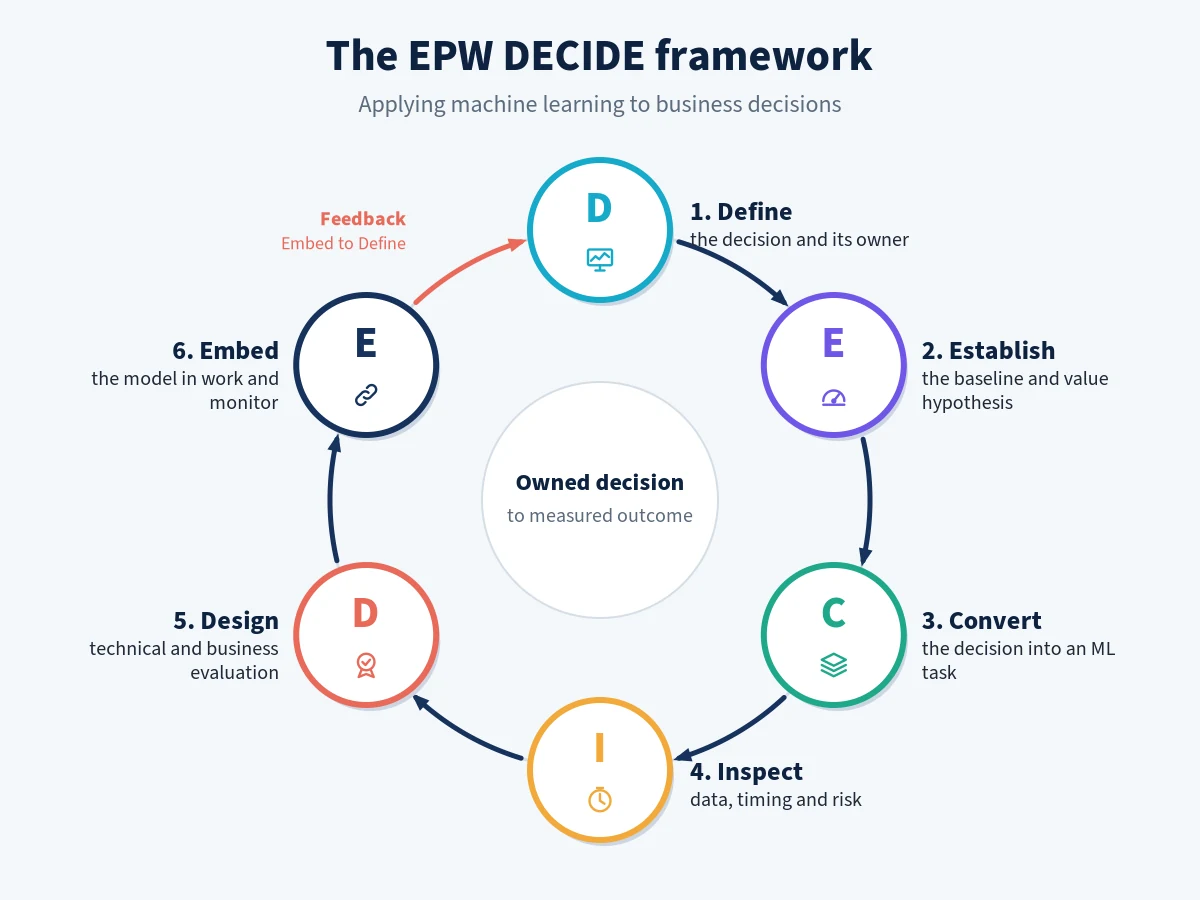
1. Define the decision and its owner
Write the decision as a choice made by a named role at a defined moment. “Predict customer dissatisfaction” is incomplete. “Help the service supervisor choose which open cases receive a same-day intervention before 10:00” is operationally testable.
Document the current options, constraints and people affected. Ask whether the model will advise, prioritise, approve, reject or automate. Identify who owns the final outcome, who can override the output and who investigates harm. This prevents a technical team from becoming the accidental owner of a business policy.
2. Establish the baseline and value hypothesis
Measure how the decision works today. The baseline might be a manual queue, a fixed threshold, an analyst’s judgement or no intervention. Record present costs, delays, error rates and outcome variation. Without this comparison, a model can look impressive while adding little value.
Create a value hypothesis in one sentence: “If we identify high-risk service cases early enough for supervisors to act, then preventable escalations should fall without increasing unnecessary interventions beyond available capacity.” Include the expected benefit, cost of action, cost of each error type and minimum improvement required to justify deployment.
3. Convert the decision into a machine-learning task
Choose an output that supports the real choice. Classification can predict a category; regression can estimate a number; ranking can order cases; forecasting can estimate future demand; clustering can explore groups. The output should arrive at the right level of detail and before the action deadline.
Define the target carefully. A label such as “escalated case” may reflect historic staffing, inconsistent recording or unequal access to complaint channels rather than underlying need. Specify the observation window, prediction horizon, unit of analysis and how ambiguous outcomes will be handled. Avoid choosing a method before the decision has been framed.
4. Inspect data, timing and risk
Confirm that every feature would genuinely be available at prediction time. Remove information created after the outcome, unreliable proxies and fields that cannot be used lawfully or responsibly. Check missingness, representation, sample selection and whether the future operating population resembles the training data.
Review risk in proportion to the decision’s consequences. Consider privacy, discrimination, security, explainability, human oversight and what happens when the model is wrong. The NIST AI Risk Management Framework treats AI risk management as a lifecycle activity involving governance, context mapping, measurement and management—not a single approval at the end.
5. Design technical and business evaluation together
Select model metrics that reflect error consequences. When missed urgent cases are costly, recall may matter; when staff capacity is tight, precision may constrain false alarms. Examine calibration, performance by meaningful segment and behaviour under realistic shifts. Do not optimise one aggregate score while hiding unacceptable outcomes for a smaller group.
Then specify business measures: resolution time, prevented escalations, cost per successful intervention, customer outcome and workload. Define success and failure thresholds in advance. A pilot or controlled trial should compare the model-supported process with the baseline, including adoption and operational side effects.
6. Embed the model in work and monitor outcomes
Design the interface, queue, explanation and escalation route around the user’s actual workflow. State what the score means, what it does not mean and which action is expected. Train users to challenge unreliable outputs rather than defer automatically to them.
Monitor data quality, model behaviour, operational adoption and business outcomes separately. Define alert thresholds, review frequency, retraining criteria and a safe fallback. A declining prediction metric, a shift in intervention capacity or a change in policy can each break the value chain even if the software remains available.
Worked example: prioritising service-recovery cases
Suppose a company receives 2,000 open service cases each morning, but its specialist recovery team can review only 120. Managers want to reduce avoidable escalations.
The weak framing is “build a model to predict complaints”. The DECIDE framing is more precise:
- Decision: which 120 open cases should receive specialist review before noon?
- Owner: the service operations manager, with documented override authority.
- Baseline: cases are currently sorted by age and stated urgency.
- Model output: a ranked probability of escalation within seven days, calculated only from information available at 08:00.
- Action: a specialist reviews the case and chooses an approved recovery response; the model does not contact or compensate a customer automatically.
- Success: fewer preventable escalations and shorter resolution time, subject to limits on unnecessary interventions and unequal performance across customer groups.
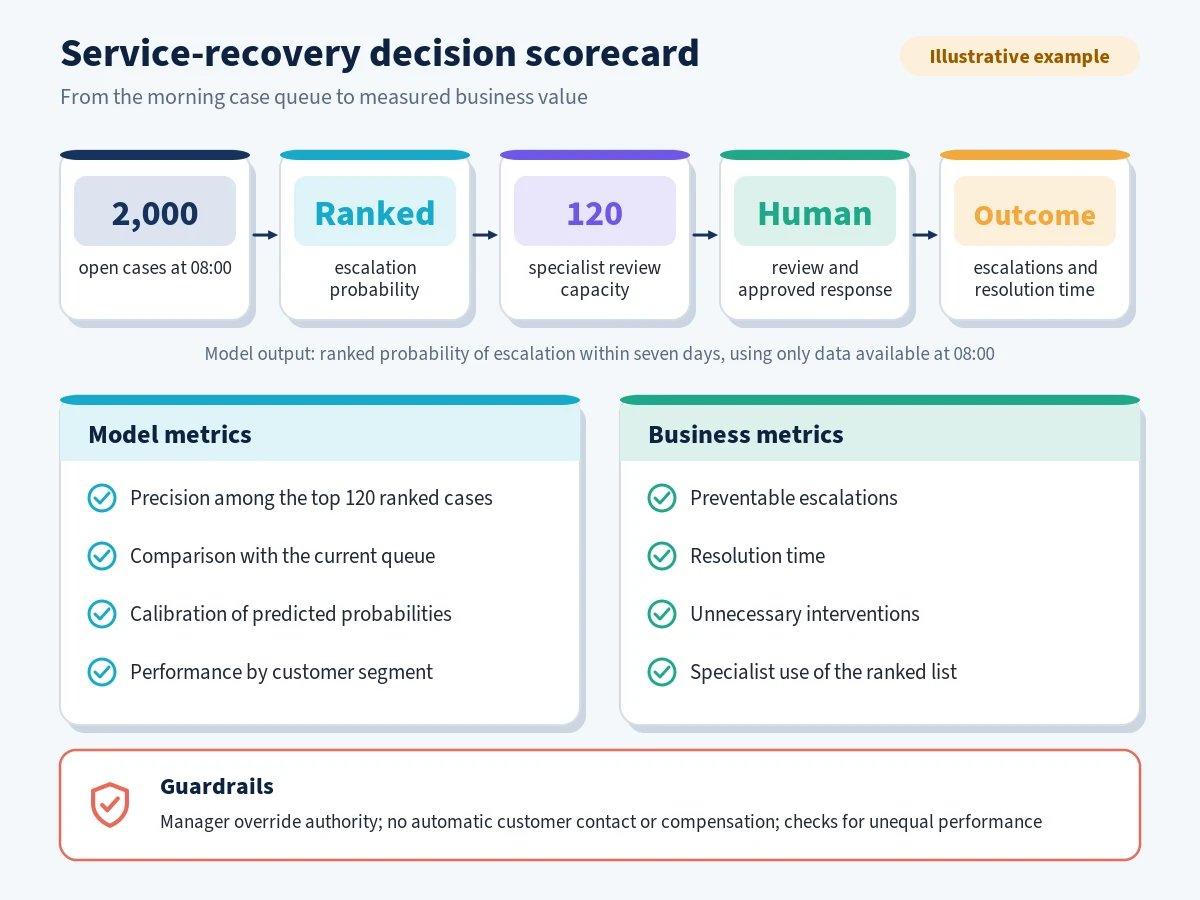
An offline test might compare precision among the top 120 ranked cases with the current queue. That is necessary but insufficient. The pilot must also measure whether specialists used the list, whether their interventions caused improvement and whether the prioritisation shifted burdens unfairly. If the team cannot act differently, even a strong ranking model has no pathway to value.
A two-level measurement scorecard
| Level | Example measures | Management question |
|---|---|---|
| Model evidence | Precision at capacity, recall, calibration, subgroup performance, stability | Does the output provide reliable information at the operating threshold? |
| Decision process | Adoption, override rate, time to action, queue coverage | Are people using the output appropriately and in time? |
| Business outcome | Escalations prevented, resolution time, cost per intervention, customer impact | Did the changed decision improve the intended result? |
| Risk and control | Complaints, adverse segment effects, incidents, data-quality failures | Is value being created within acceptable boundaries? |
The operating threshold belongs in this scorecard. A team with capacity for 120 reviews needs evidence at that capacity, not merely a metric averaged across every possible threshold. If capacity changes, the threshold and value hypothesis may also need to change.
Machine-learning business decision checklist
- Can the proposed decision be written as a choice, owner, timing and affected population?
- Is the current baseline documented with comparable outcome data?
- Would a rule, report or process improvement solve the problem more simply?
- Is the target observable, meaningful and free from avoidable leakage?
- Will every input be available and permissible at the moment of prediction?
- Are false positives and false negatives translated into operational consequences?
- Do model metrics, workflow measures and business outcomes have separate thresholds?
- Can users understand, challenge and override the output when necessary?
- Is there a controlled pilot, fallback process and named monitoring owner?
- Will the team stop or redesign the system if value or safety conditions are not met?
Build decision capability, not just model knowledge
Professionals do not need to become research scientists to govern a machine-learning initiative well. They do need to ask precise questions about targets, timing, thresholds, errors, workflow and value. EPW’s Applied Machine Learning for Business Decision Making Course develops that decision-focused capability through business cases, evidence review and implementation planning.
For a wider view of organisational value and risk, read Benefits of AI and Machine Learning for Organisations. The central lesson is consistent: useful AI is not defined by novelty or a high score. It is defined by a better, accountable decision that can be demonstrated in practice.
References
- Google for Developers, Framing an ML Problem, last updated 25 August 2025; accessed 3 September 2026.
- National Institute of Standards and Technology, AI Risk Management Framework, accessed 3 September 2026.
- EPW Training, Applied Machine Learning for Business Decision Making Course, accessed 3 September 2026.