

AI-generated illustration created to represent the article’s subject. It does not depict an actual EPW course, trainer, participant, client, event or venue.
A supervised learning framework for model development is a gated method for turning labelled examples into useful predictions. The essential stages are to define the task, audit the data, reserve an honest evaluation, compare models, judge operational usefulness and monitor real-world performance. Algorithm choice is only one part of that system.
Supervised learning uses examples that pair input features with a known target. A classification model might predict whether a service case will escalate; a regression model might estimate the time required to resolve it. In both cases, good historical fit is insufficient. The model must generalise to relevant future cases and support a decision whose errors are understood.
Key takeaways
- Begin with the decision and prediction horizon, not with an algorithm.
- Protect evaluation data from training decisions and target leakage.
- Compare every candidate with a simple, relevant baseline.
- Select metrics and thresholds according to the consequences of errors.
- Treat deployment as the start of monitored use, not the end of development.
What a supervised learning framework must control
A sound framework controls both the statistical system—features, targets, sampling, fitting and evaluation—and the operational system: who uses the prediction, what action follows and what an error costs.
Google's introduction to supervised learning distinguishes regression, which predicts numerical values, from classification, which predicts classes or class probabilities. The scikit-learn supervised-learning documentation shows the range of estimators available for these tasks. A framework prevents that choice of estimator from overshadowing the larger design decisions that determine whether results are credible.
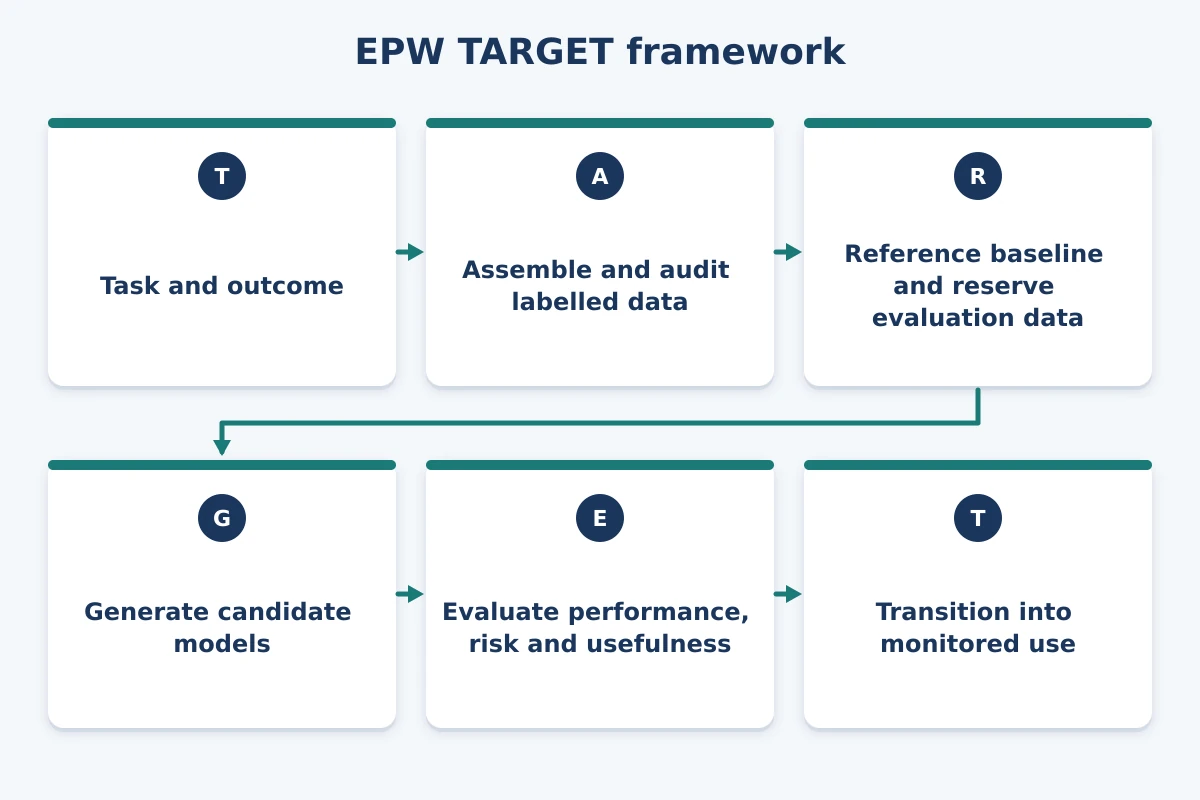
The EPW TARGET framework is an original professional decision aid, not an external technical standard. Its six stages are designed to produce an explicit output and a decision gate before the next stage proceeds.
The EPW TARGET framework
TARGET stands for Task and outcome, Assemble and audit, Reference baseline and reserve evaluation, Generate candidates, Evaluate usefulness and risk, and Transition into monitored use.
| Stage | Controlling question | Required output | Decision gate |
|---|---|---|---|
| T — Task and outcome | Which future outcome must be predicted, for whom and by when? | Prediction specification and success measures | The prediction can lead to a defined action |
| A — Assemble and audit | Do the features and labels represent the intended cases? | Data inventory, label audit and leakage review | Data is usable, permitted and sufficiently representative |
| R — Reference and reserve | What must the model beat, and how will performance be tested honestly? | Baseline plus training, validation and test design | Evaluation remains independent of model selection |
| G — Generate candidates | Which small set of suitable approaches should be compared? | Reproducible candidate pipelines | Comparison is controlled and proportionate |
| E — Evaluate usefulness and risk | Does the model improve the decision without unacceptable harm? | Performance, segment, error and risk analysis | Operational acceptance criteria are met |
| T — Transition and monitor | How will the model be used, observed, corrected and retired? | Operating, monitoring and fallback plan | An accountable owner approves controlled use |
T — Define the task and outcome
Write the prediction task as a sentence: Using information available at a stated moment, predict a stated target for a stated population and time horizon so that a named user can take a defined action. This separates a genuine prediction problem from a broad ambition such as “improve customer service with machine learning”.
Specify whether the target is continuous or categorical, when the prediction is made and how late the real outcome becomes known. Then define both model and operational success. A case-escalation classifier, for example, needs a quality measure and a rule for how many cases specialists can review.
Stop at this gate if no useful action follows the prediction, the outcome is not observable, or the required lead time makes intervention impossible. Better predictive performance cannot rescue an irrelevant target.
A — Assemble and audit labelled data
List each data source, feature owner, permission, coverage period and known quality limitation. Audit the target label separately. Labels may reflect delayed reporting, inconsistent human judgement or a previous policy rather than the outcome the new process intends to improve.
Remove information that would not exist at prediction time. Target leakage occurs when a feature reveals the outcome directly or indirectly, creating impressive test results that cannot be reproduced in use.
Check missingness, duplicates, unusual values and representation across relevant groups or periods. The result is evidence that the dataset is fit for the defined task, with limitations recorded.
R — Establish a reference and reserve evaluation data
Create a baseline before optimising. A baseline might always predict the most common class, repeat the last observed value, use a simple business rule or reproduce the current process. It defines the minimum improvement needed to justify additional complexity.
Separate data by the way the model will encounter new cases. Random splitting can mislead when records from the same customer, machine or period appear on both sides; grouped or out-of-time splits may better represent deployment. The scikit-learn cross-validation guide explains why fitting and evaluating on the same data is a methodological error.
Use training data to fit parameters and validation data or cross-validation to compare choices. Keep the test set untouched until the pipeline and decision rule are fixed. Any preprocessing that learns from data must be fitted within the training process, not on the full dataset.
G — Generate candidate models
Compare a small, justified set of candidates rather than searching every available algorithm. Include an interpretable reference model and only add complexity when it addresses a task requirement such as non-linear relationships, interactions, high-dimensional features or calibrated probabilities.
Build each candidate as a reproducible pipeline and apply the same folds, metrics and data exclusions to every comparison. Repeated inspection of the test set quietly converts it into another validation set.
Record more than a headline score. Stability, calibration, explanation needs, maintenance burden and data dependencies can change which model is most suitable. Prefer the simplest model that meets the operational criteria reliably.
E — Evaluate performance, usefulness and risk
Choose metrics from the consequences of errors. Accuracy may conceal weak performance when one class is rare. Precision answers how often a positive alert is correct; recall answers how many true positive cases are detected. For regression, mean absolute error is easy to interpret, while squared-error measures place more weight on large mistakes.
Evaluate the decision threshold separately from the fitted model. Lowering a classification threshold may detect more important cases while increasing false alarms and specialist workload. A useful threshold sits within operational capacity and risk limits, not simply at the software default.
Inspect results by time and relevant segment, review representative errors and compare with the baseline. The peer-reviewed guide How to avoid machine learning pitfalls emphasises independent test data, appropriate cross-validation, simple baselines and attention to leakage and dataset shift.
For consequential uses, broaden evaluation beyond technical performance. The NIST AI Risk Management Framework organises risk work around governance, context mapping, measurement and management. Translate that principle into named owners, documented limitations, human-review rules and evidence that affected groups have been considered.
T — Transition into monitored use
Define where the prediction enters the workflow, who can see it and what happens when it is missing, delayed or outside its validated range. Document fallback rules, access controls, versioning, incident handling and the authority to pause use.
Monitor input quality, predictions, performance when labels arrive, operational outcomes, overrides and unintended effects. A stable accuracy score can coexist with an overloaded review team.
Set review and retraining triggers before launch. Examples include a sustained performance decline, a change in policy, a material shift in input data, unacceptable segment results or loss of the data source. Retraining is a controlled response to evidence, not an automatic cure for every alert.
Completed example: predicting service-case escalation
Consider a service department that wants to identify new cases likely to require specialist escalation within 48 hours. The aim is to prioritise early review, not to deny service or replace the case owner.
- Task and outcome: At case creation, predict the probability of escalation within 48 hours using information already available. The duty manager will assign early specialist review to high-risk cases. Success combines recall for escalated cases, alert precision, review capacity and resolution outcomes.
- Assemble and audit: Use initial case type, channel, customer history available at creation and approved operational attributes. Exclude notes, reassignment codes and resolution fields created after the prediction point. Audit whether escalation practices changed during the data period.
- Reference and reserve: Compare with the current priority rule and a simple logistic-regression baseline. Split older cases for development and newer cases for final out-of-time testing. Group linked cases so that near-duplicates do not cross the split.
- Generate candidates: Compare the baseline with a regularised logistic model and a tree-based ensemble using the same preprocessing and validation windows. Calibrate probabilities if the raw scores do not correspond well to observed escalation rates.
- Evaluate: Choose a threshold that fits the specialists' daily review capacity. Examine precision, recall, calibration, resolution time, false alarms and results across major case types. Review errors with service experts to identify data or process problems.
- Transition: Show the score as decision support with an explanation and fallback to the existing rule if scoring fails. Monitor alert volume, overrides, delayed labels, segment performance and resolution results. Assign an owner and establish pause and review triggers.
This example shows why a framework changes the development question. The team is not asking only which classifier is most accurate; it is asking which controlled system improves early review within real staffing and risk constraints.
How to interpret model evaluation results
No single metric answers whether a model is ready. Interpret a compact set of measures together and compare them with the baseline and acceptance criteria established at the first stage.
| Evaluation lens | Useful questions | Possible evidence |
|---|---|---|
| Predictive performance | Does the model discriminate or estimate well on unseen cases? | Precision, recall, area under a curve, mean absolute error |
| Calibration | Do predicted probabilities correspond to observed frequencies? | Calibration plot, Brier score, reliability by band |
| Operational fit | Can users act on the output at the required time and volume? | Alert volume, processing time, review capacity, overrides |
| Robustness | Does performance hold across time and relevant segments? | Out-of-time and segment analysis, sensitivity tests |
| Risk and control | Are failures detectable, owned and recoverable? | Error review, fallback test, incident and pause criteria |
A candidate advances only if the combined evidence supports use. A slightly lower-scoring model may be preferable when it is better calibrated, easier to operate, more stable or sufficiently interpretable for the decision.
Advantages and limitations of the TARGET framework
TARGET creates a shared language for technical and operational stakeholders. It makes hidden assumptions visible, protects the credibility of evaluation and requires deployment ownership before a model is treated as complete. Its gates also make it easier to stop weak projects early.
The framework does not prescribe a particular algorithm, data architecture or regulatory assessment. It cannot compensate for an unobservable target, biased historical process, inadequate sample or unlawful use. High-impact applications may require specialist legal, ethical, safety, security and domain review beyond the controls described here.
Apply TARGET proportionately. A low-risk internal forecast may need a concise record; a model affecting employment, credit, health, safety or access to services needs much stronger evidence and oversight.
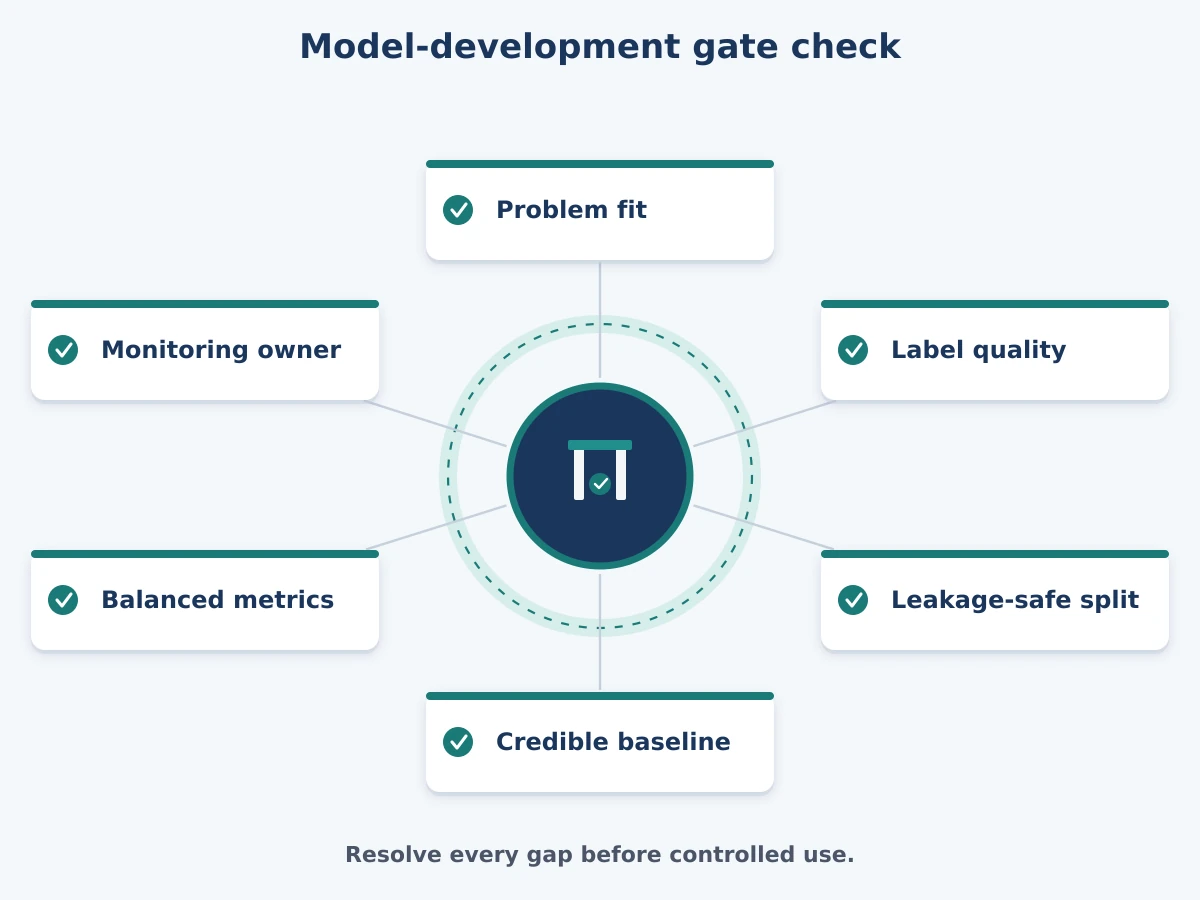
Model-development gate checklist
Before approving controlled use, confirm that the team can answer yes to every item:
- The target, population, prediction time, horizon and user action are explicit.
- Data and labels are permitted, relevant and audited for quality and representation.
- No feature uses information unavailable at prediction time.
- A credible baseline and deployment-representative split have been established.
- Preprocessing and model selection are contained within the training process.
- Candidate models are compared under the same controlled evaluation.
- Metrics, thresholds and segment checks reflect operational error costs.
- The final test data remained independent until the development choices were fixed.
- Limitations, human-review rules and fallback actions are documented.
- A named owner will monitor performance, outcomes, overrides and incidents.
- Review, pause, retraining and retirement triggers are agreed.
Build supervised-learning judgement
A reliable model-development framework does not eliminate judgement; it places judgement where it can be examined. Teams still need to define a meaningful outcome, challenge the data, compare approaches, interpret error trade-offs and decide how evidence should control real use.
EPW's five-day Supervised Learning Algorithms and Techniques course develops these capabilities through regression, classification, ensembles, validation, model selection, interpretation and responsible deployment. You can also review EPW's Artificial Intelligence and Machine Learning Courses and the Artificial Intelligence and Machine Learning Articles hub for related learning.
Ready to apply supervised learning to a real prediction problem? Explore the Supervised Learning Algorithms and Techniques course, review available dates and locations, or request tailored in-house training.
Sources and references
- Google for Developers, Supervised Learning.
- scikit-learn, Supervised learning, version 1.9 documentation.
- scikit-learn, Cross-validation: evaluating estimator performance, version 1.9 documentation.
- Michael A. Lones, “How to avoid machine learning pitfalls: a guide for academic researchers”, Patterns, 2024 revision.
- National Institute of Standards and Technology, AI Risk Management Framework, AI RMF 1.0.