

Computer vision is becoming an increasingly important subfield in the fast moving technology space we live today, ranging from self-driving cars to health care. Here’s the deal: Whether you’re hoping to switch careers into tech and are in need of yet another way to stand out in an overcrowded applicant field, or if you simply want to beef up your professional repertoire by taking a programming crash course specifically tailored for visual recognition analytics, signing up for a computer vision course can be a total game-changer.
This article looks at what such a course will involve, the core skills you’ll develop and how this knowledge can help launch your career in one of the most dynamic sectors going.
What is Computer Vision?
Computer Vision definition Comput The ability of a computer to interpret and understand an image (or collection of images) as well as humans do. The discipline borrows from machine learning, image processing and AI to let computers analyse and make decisions based on visual data. Computer vision is the basis of a lot of breakthrough and transformation technological innovations – from facial recognition to self-driving cars.
Course Overview: What to Expect
The contents of most computer vision courses will provide you with theoretical background as well as hands-on experience in processing and analyzing visual data. Prepare to cover an array of topics, from simple image processing to complex methods like deep learning and neural networks. These courses generally combine theory-based teaching with practical project work, so you don’t just learn how the theory works, but also put it into use in a context of your choice.
Essential Topics to be Covered in a Computer Vision Training Program
Image Processing Fundamentals
Starting off you will get the basics of working with images, including how to change and transform them. Edge detection, color correction and noise reduction for example are part of the base of computer vision.
Machine Learning for Vision
A large part of the course will be about machine learning algorithms that were designed for visual data. You will have a chance to discover supervised learning techniques, object recognition and classification. You will also learn about neural networks such as the CNN (Convolutional Neural Networks) that are commonly used in image recognition.
Object Detection and Recognition
In computer vision, object detection and recognition is one of the most challenging problems. You will learn a few object detection and tracking algorithms (something very much needed in systems like security, self-driving cars, robotic motion systems).
Deep Learning Techniques
You will delve into deep learning, a sub-field of machine learning that enables machines to learn and improve without being explicitly programmed. You will be building models such as CNN s and GANs while learning about deep learning processes and what it is applied to when dealing with visual data.
Real-World Projects
Computer vision is an extremely hands-on field, so expect to participate in practical projects that emulate real-world problems. These can range from an image classifier to a facial recogniser or app for augmented reality (AR) and beyond.
Skills You Will Gain from a Computer Vision Course
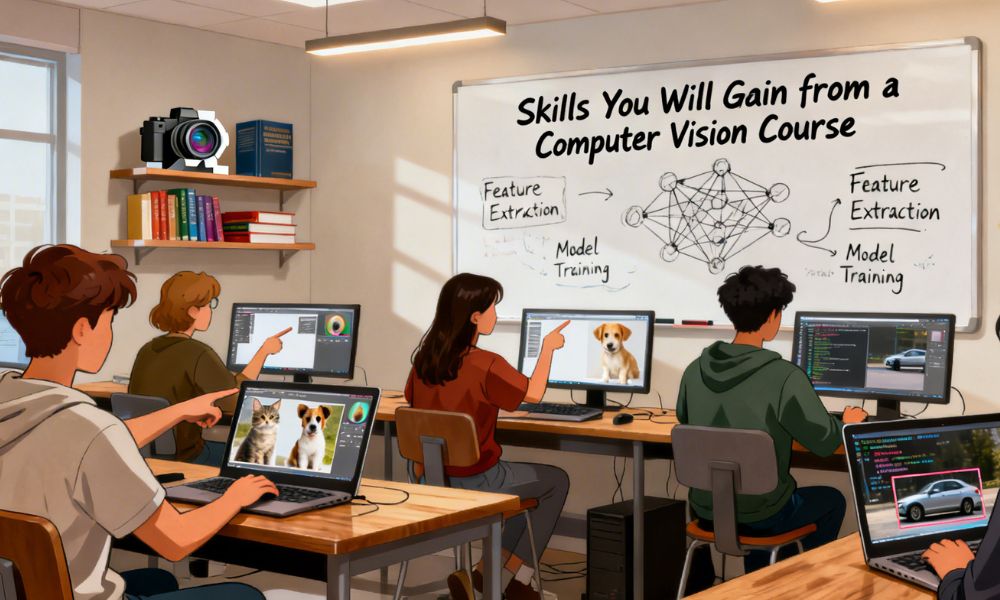
By the end of the course, you will have acquired several valuable skills, including:
- Image Processing: The ability to manipulate and improve visual data using filters, transformations, and feature extraction.
- Machine Learning: Proficiency in applying machine learning techniques to visual data for tasks like classification and pattern recognition.
- Programming: Knowledge of programming languages such as Python and libraries like OpenCV, TensorFlow, and PyTorch.
- Project Management: Experience in planning and executing computer vision projects from start to finish, which will enhance your ability to work in a professional environment.
The Tools You’ll Use
Throughout the course, you’ll become proficient in tools and libraries commonly used in the field of computer vision:
- OpenCV: This open-source library is widely used for image and video processing tasks.
- TensorFlow & Keras: Popular deep learning libraries that allow you to create complex models for object detection and image classification.
- PyTorch: Another deep learning framework that is commonly used in research and production environments.
These tools will be essential in building computer vision models and implementing algorithms learned during the course.
Time Commitment and Course Structure
The time commitment for a computer vision course varies depending on whether it’s part-time or full-time. A typical full-time course may take anywhere from 6 to 12 weeks to complete, while part-time options might extend over a longer period, allowing for more flexibility.
Expect a balanced mix of theory, coding exercises, and project work. Theoretical lessons will cover algorithms, models, and techniques, while practical assignments and projects will reinforce those concepts and allow you to apply them to real-world situations.
The Assessment Process
To evaluate your understanding and skills, computer vision courses generally include:
- Quizzes: To test your theoretical understanding of concepts like algorithms and model architectures.
- Assignments: Hands-on tasks where you will implement techniques such as object detection or image classification.
- Capstone Projects: A final project that requires you to apply everything you’ve learned to create a functional computer vision system.
Career Opportunities Post-Course
Upon completion of a computer vision course, you will be well-equipped to pursue various career opportunities, including:
- Computer Vision Engineer: Design and develop systems that enable machines to interpret visual data.
- Machine Learning Engineer: Focus on developing algorithms that improve the performance of vision-based tasks.
- AI Specialist: Work with AI applications in fields like healthcare, retail, and autonomous vehicles.
- Data Scientist: Analyze large datasets and apply computer vision techniques for data-driven decision-making.
The demand for professionals in computer vision is increasing across industries, and completing a course in this field can open doors to lucrative and exciting career paths.
Overcoming Challenges
Like any technical field, computer vision can be challenging. Beginners often encounter difficulties understanding complex mathematical concepts or debugging code. However, with persistence, practice, and engagement with course materials, these challenges can be overcome.
Tips for Success
- Start Small: Begin by mastering the basics of image processing before diving into more complex algorithms.
- Practice Regularly: Consistent practice with coding exercises and projects is key to reinforcing concepts.
- Collaborate: Join forums, attend webinars, or connect with fellow students to share knowledge and solve problems together.
Conclusion
Enrolling in a computer vision course opens up a world of possibilities, from automating industries to solving complex challenges using AI. By the end of the course, you will have a robust understanding of the field, along with practical skills that will make you a competitive candidate in the job market. Whether you are interested in deep learning, robotics, or AI applications, a computer vision course is an excellent stepping stone towards an exciting career in one of the most innovative fields in tech.