

AI-generated illustration created to represent the article’s subject. It does not depict an actual EPW course, trainer, participant, client, event or venue.
The COBIT framework gives information systems auditors a structured way to assess whether enterprise information and technology are governed and managed in support of business objectives. It helps an audit team translate broad concerns—such as cyber exposure, unreliable systems, uncontrolled change or weak supplier oversight—into defined governance and management objectives, control criteria, evidence requirements and meaningful findings.
COBIT is maintained by ISACA and is designed for the governance and management of enterprise information and technology. It is not a prescriptive audit checklist, a cybersecurity standard or a substitute for professional judgement. Used well, it provides a common language that connects boards, management, technology teams, risk specialists and auditors.
Key takeaways
- COBIT starts with stakeholder needs and enterprise objectives, not with a generic list of technical controls.
- Its core model contains 40 governance and management objectives across five domains.
- Auditors can use COBIT to define criteria, map risks, assess control design and communicate findings in business terms.
- COBIT should be tailored through context and design factors; applying every objective to every audit would be inefficient.
- Cybersecurity and technical testing may require complementary sources such as NIST guidance, architecture standards and system-specific evidence.
Contents
- What COBIT is
- COBIT’s structure and domains
- How auditors use COBIT
- Objectives commonly used in IS audits
- Evidence and testing
- COBIT’s boundaries
- Build practical IS audit capability
What is the COBIT framework?
COBIT is a framework for establishing and improving a governance system for enterprise information and technology. ISACA explains that the COBIT core model contains 40 governance and management objectives, each connected to enterprise and alignment goals. The framework allows organisations to select and tailor practices according to their strategy, risk profile, compliance obligations, sourcing model, technology adoption and other design factors.
The important phrase is enterprise information and technology. COBIT is wider than the IT department. Digital services, automated decisions, information quality, cloud dependencies, privacy, cyber resilience and technology investment affect operations, customers, finance and strategy. An information systems audit should therefore test how technology supports organisational objectives and how associated risks are governed.
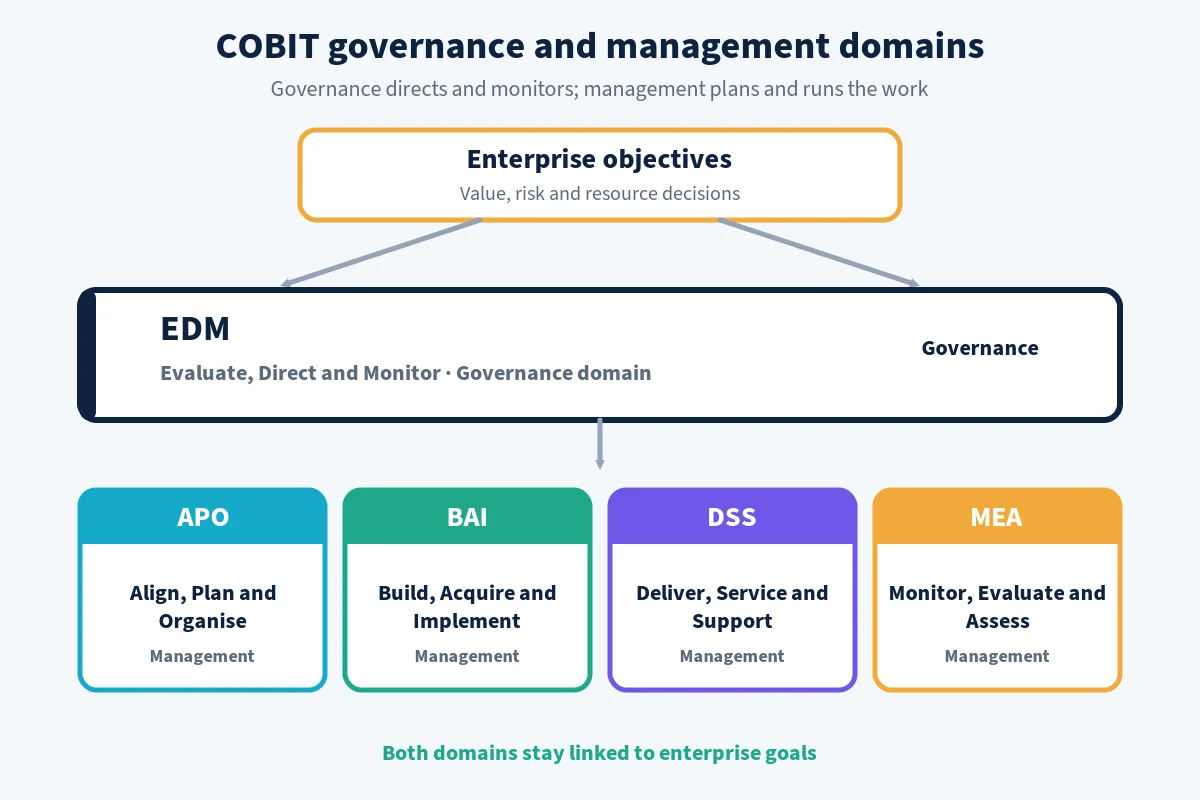
COBIT also distinguishes governance from management:
- Governance evaluates stakeholder needs and conditions, directs priorities and monitors performance and conformance.
- Management plans, builds, runs and monitors activities in line with the direction established by the governing body.
This distinction helps auditors identify the correct accountable party. A board may oversee technology risk and approve direction, while executives and process owners design and operate the management system.
How is COBIT structured?
The five COBIT domains
| Domain | Purpose | Typical audit focus |
|---|---|---|
| EDM: Evaluate, Direct and Monitor | Governance objectives | Board oversight, benefits, risk and resources |
| APO: Align, Plan and Organise | Strategy, architecture, people, risk and security | Accountability, plans, policies and capabilities |
| BAI: Build, Acquire and Implement | Programmes, solutions, change and assets | Projects, requirements, releases and configuration |
| DSS: Deliver, Service and Support | Operations, services, continuity and security | Service delivery, incidents, access and resilience |
| MEA: Monitor, Evaluate and Assess | Performance, internal control and compliance | Monitoring, assurance, control evaluation and obligations |
Governance-system components
A reliable governance system depends on more than processes. COBIT’s components include processes; organisational structures; principles, policies and procedures; information; culture, ethics and behaviour; people, skills and competencies; and services, infrastructure and applications. This breadth is useful in an audit because a formally correct process may still fail when accountability is unclear, information is unreliable or behaviour rewards circumvention.
For example, an audit of privileged access should not stop after reading the access policy. It may need to assess decision authority, administrator competence, account data, approval workflow, monitoring technology, exception culture and management response. The components encourage a more complete causal analysis.
Goals and design factors
COBIT uses a goals cascade to link stakeholder drivers and enterprise goals to technology-related alignment goals and relevant governance or management objectives. It also recognises that governance systems must be tailored. A regulated financial institution, a public body and a fast-growing digital company may require different priorities even when they use similar technology.
For auditors, tailoring improves scope discipline. The audit universe, risk assessment and engagement objectives should reflect material business services, obligations, threat conditions, technology dependencies and change—not an assumption that every COBIT objective deserves equal testing.
How to use COBIT in an information systems audit
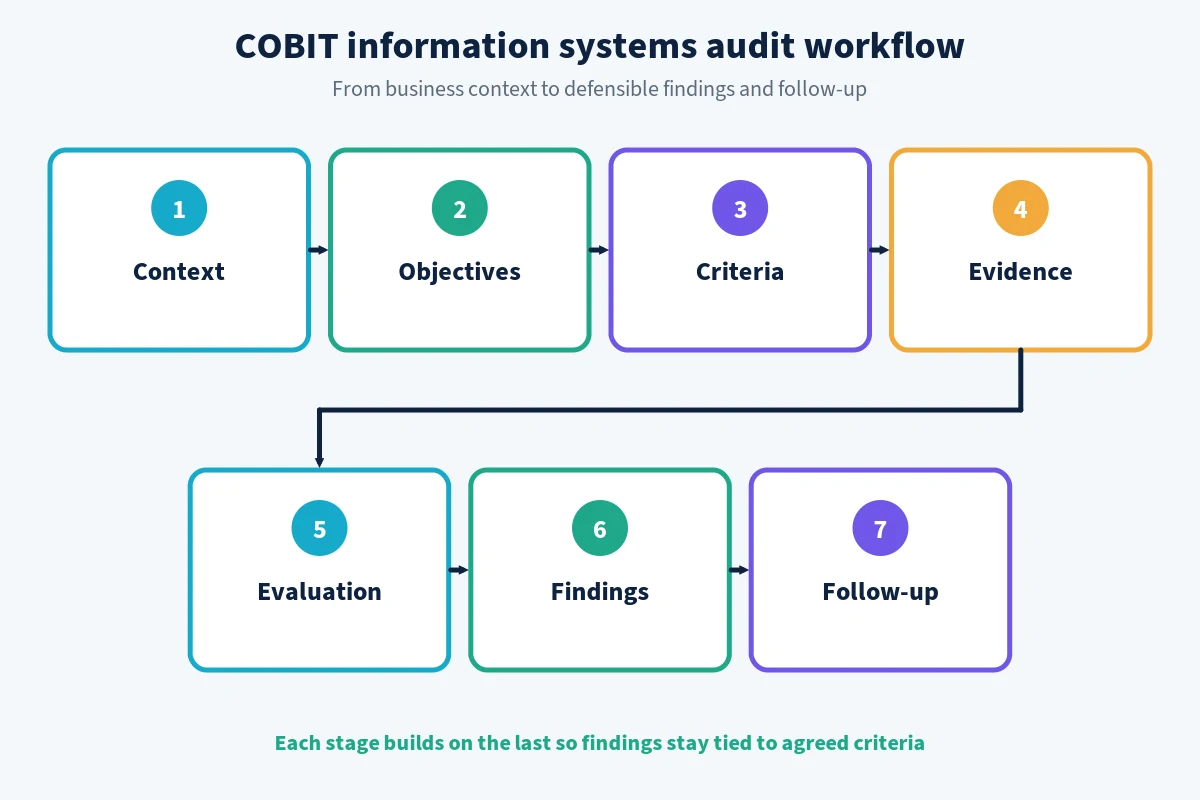
1. Define the business objective and decision context
Begin with the service, process or outcome that technology supports. Identify stakeholders, critical information, tolerance for disruption, legal obligations and dependencies. An audit objective such as “assess change management” becomes stronger when connected to the risk that unauthorised or poorly tested change could interrupt a critical service or corrupt financial information.
2. Identify relevant technology risks
Describe plausible events and their causes, consequences and velocity. Consider unauthorised access, data error, cyberattack, unavailable services, uncontrolled change, supplier failure, weak recovery, obsolete technology and ineffective oversight. Risk scenarios prevent the framework from becoming a compliance exercise.
3. Select relevant COBIT objectives
Map the engagement objective and risks to a focused set of COBIT governance and management objectives. Use the mapping as a reasoned starting point, then confirm it against the actual organisation, architecture and obligations. Record why objectives were included or excluded.
4. Convert practices into audit criteria
Audit criteria state the reasonable condition against which evidence will be evaluated. COBIT can inform criteria, but auditors should combine it with approved policies, contracts, regulation, recognised security standards and system requirements. Criteria need to be relevant, reliable, understandable and agreed early enough to avoid disputes after testing.
5. Assess design before operating effectiveness
Determine whether responsibilities, procedures, technology and information could reasonably achieve the control objective. A control cannot operate effectively if its design omits a material population, permits incompatible access or lacks escalation. Design assessment prevents extensive testing of a fundamentally unsuitable control.
6. Test operation using sufficient, reliable evidence
Use enquiry only as context. Corroborate it with configuration, logs, tickets, approvals, reconciliations, monitoring records, observation, reperformance or data analysis. Consider completeness and accuracy of system-generated information before relying on it. Sample selection should reflect frequency, population, risk and possible management override.
7. Report the condition, cause, consequence and action
Connect findings to the governance or management objective and the affected enterprise outcome. Explain the actual condition, credible root cause, risk exposure and agreed action. Avoid implying that a COBIT practice is mandatory unless law, contract or policy makes it so. Follow up until action is implemented or the responsible authority formally accepts the residual risk.
COBIT objectives commonly relevant to IS audits
| COBIT objective | Example audit questions |
|---|---|
| EDM03 Ensured Risk Optimisation | Does governing-body direction reflect material technology risk and appetite? |
| APO12 Managed Risk | Are technology risks identified, analysed, owned and integrated with enterprise risk? |
| APO13 Managed Security | Is information security governed through an appropriate management system? |
| BAI06 Managed IT Changes | Are changes authorised, tested, segregated, documented and reviewed? |
| DSS04 Managed Continuity | Can critical technology services recover within business requirements? |
| DSS05 Managed Security Services | Are security operations, access, monitoring and response controlled? |
| MEA02 Managed System of Internal Control | Does management monitor control design, performance, deficiencies and remediation? |
| MEA03 Managed Compliance With External Requirements | Are applicable technology obligations identified, assigned and monitored? |
The selection is illustrative, not universal. An application audit may emphasise requirements, data integrity and change; a cloud audit may focus on architecture, suppliers, security services and continuity; and a governance audit may concentrate on EDM and APO objectives.
What evidence should a COBIT-informed audit obtain?
- Governance evidence: approved strategies, committee mandates, decisions, risk appetite, investment criteria and oversight reports.
- Process evidence: procedures, workflows, tickets, approvals, exceptions and performance measures.
- Technical evidence: configuration extracts, identity records, logs, vulnerability results, backup records and recovery tests.
- Information evidence: data definitions, ownership, lineage, quality controls and reconciliation.
- People and culture evidence: role profiles, competence records, interviews, escalation behaviour and consequence management.
- Third-party evidence: contracts, service levels, assurance reports, incident notifications and exit provisions.
The audit team should validate evidence provenance, period and completeness. Screenshots selected by the control owner may illustrate configuration but rarely prove that it operated across the audit period. Where possible, obtain evidence directly from authoritative systems and reconcile populations before sampling.
How COBIT relates to NIST CSF 2.0
COBIT and the NIST Cybersecurity Framework are complementary. COBIT provides an enterprise governance and management system; NIST CSF 2.0 organises cybersecurity outcomes around Govern, Identify, Protect, Detect, Respond and Recover. NIST’s addition of the Govern function strengthens the connection between cybersecurity, enterprise risk, policy and accountability.
An auditor might use COBIT to assess governance, accountability and management processes, then use NIST CSF outcomes and more detailed technical criteria for security testing. Cross-mapping is helpful, but it does not make the frameworks interchangeable. The audit must retain a clear line from objective to risk, criterion, evidence and conclusion.
What COBIT does not do
- It does not automatically define an audit scope or replace risk assessment.
- It does not prove that a control operated; evidence and testing remain essential.
- It is not a detailed penetration-testing, configuration or forensic method.
- It does not make every practice mandatory for every organisation.
- It does not remove the need to consider regulation, contracts, internal policy and other authoritative criteria.
Common mistakes include copying a maturity questionnaire without verifying evidence, applying too many objectives, rating capability without a sound method, and reporting framework gaps without explaining business consequences. The best use of COBIT is selective, transparent and anchored in the organisation’s objectives.
A practical COBIT audit checklist
- State the business service or objective in scope.
- Document material technology and cyber-risk scenarios.
- Identify accountable governance and management roles.
- Select relevant COBIT objectives and components.
- Agree suitable criteria and evidence requirements.
- Assess control design before sampling operation.
- Validate system-generated populations and technical evidence.
- Relate findings to consequences, root causes and residual risk.
- Assign actions, owners and target dates.
- Monitor completion and confirm sustainable improvement.
Readers seeking a broader governance context can also review EPW’s explanation of governance, risk and compliance and the Auditing, Governance, and Risk Compliance training portfolio.
Build practical information systems audit capability
EPW’s five-day Information Systems Auditing and Cyber Risk Awareness Course equips internal auditors, risk professionals and control managers to conduct risk-based technology assurance. It covers COBIT and NIST concepts, IT governance, general IT controls, applications, data, cloud services, cyber-risk scenarios, resilience, audit evidence, analytics and technology-risk reporting. Participants practise scoping, control testing and evidence evaluation in workshops and a capstone IS audit case.
Frequently asked questions
Is COBIT an audit standard?
No. COBIT is a governance and management framework. Auditors can use it as a source of criteria and structure, while following applicable professional audit standards and considering legal, regulatory, contractual and internal requirements.
Does an organisation need to implement all 40 COBIT objectives?
No. COBIT is designed to be tailored. The relevant objectives depend on enterprise goals, risks, obligations, sourcing, technology and other design factors.
Can COBIT be used for cyber-risk audits?
Yes, particularly for governance, accountability and management processes. Detailed cybersecurity testing should also use suitable security frameworks, technical standards and system-specific criteria.
References
- ISACA, COBIT resources and COBIT 2019 framework publications.
- ISACA, How COBIT relates to business and other standards.
- US National Institute of Standards and Technology, Cybersecurity Framework 2.0.
- The Institute of Internal Auditors, Global Internal Audit Standards.
- NIST, Security and Privacy Controls for Information Systems and Organizations, SP 800-53 Rev. 5.