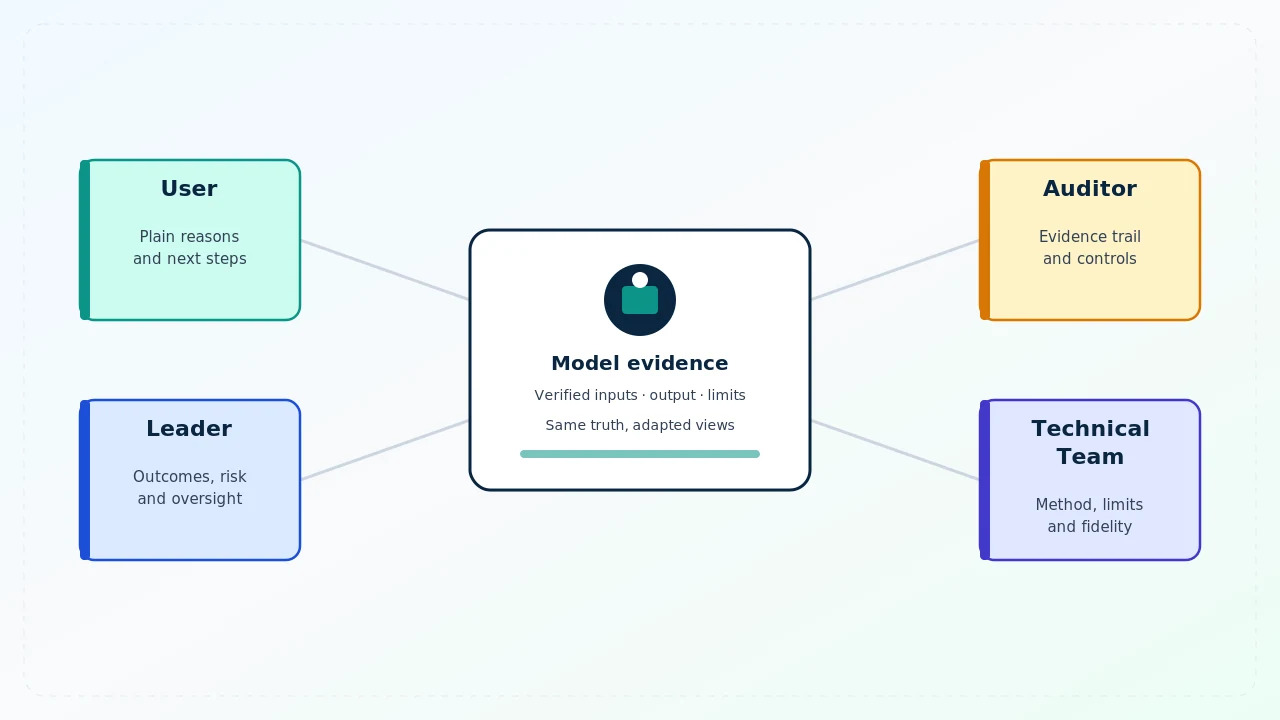

AI-generated illustration created to represent the article’s subject. It does not depict an actual EPW course, trainer, participant, client, event or venue.
A speech recogniser can look excellent on a clean benchmark and still fail in a busy control room, a multilingual contact centre or a hands-free field application. The reason is straightforward: speech varies with speaker, accent, language, microphone, background noise, channel, vocabulary and conversational style.
A useful evaluation therefore asks more than “What is the word error rate?” It tests whether errors affect the intended task, whether the system responds quickly enough, whether performance is robust across realistic conditions and whether privacy and operational controls are adequate. This guide provides a repeatable method for doing that.
What a speech-recognition system does
Automatic speech recognition (ASR) converts an audio signal into a sequence of text tokens. A production pipeline may include audio capture, voice-activity detection, feature or representation learning, an acoustic encoder, token prediction, decoding, punctuation, speaker diarisation and downstream language processing.
Modern systems can learn directly from waveforms or spectral representations. wav2vec 2.0 demonstrated that self-supervised pre-training on unlabelled audio followed by fine-tuning can reduce dependence on large labelled corpora. The Conformer architecture combines convolution for local acoustic patterns with transformer mechanisms for longer-range interactions. Connectionist Temporal Classification, introduced in the original CTC paper, enables sequence models to learn from unsegmented input without a frame-by-frame transcript alignment.
Architecture matters, but evaluation design determines whether reported performance says anything useful about deployment.
Start with a testable operating claim
Define what the system must enable. “Transcribe meetings accurately” is vague. A stronger claim is: “Produce searchable English meeting transcripts within two minutes of session end, identify speakers reliably enough for review, and capture agreed actions and named projects without material omissions.”
This statement identifies the users, language, latency, high-value content and review process. It also reveals that overall transcript accuracy is only one measure. A live voice command may prioritise response time and keyword recall; a regulated record may prioritise exact terminology, auditability and human verification.
Word error rate—and what it misses
Word error rate (WER) counts substitutions, deletions and insertions relative to the number of words in a reference transcript:
WER = (substitutions + deletions + insertions) ÷ reference words
This is the standard foundation. The NIST OpenSAT evaluation plan uses WER for ASR and defines it in these terms. Yet WER gives equal weight to errors with very different consequences. Replacing “fifteen” with “fifty” may be more serious than omitting a filler word. Apple’s research on humanising WER similarly notes that conventional WER can give a misleading impression of transcript readability.
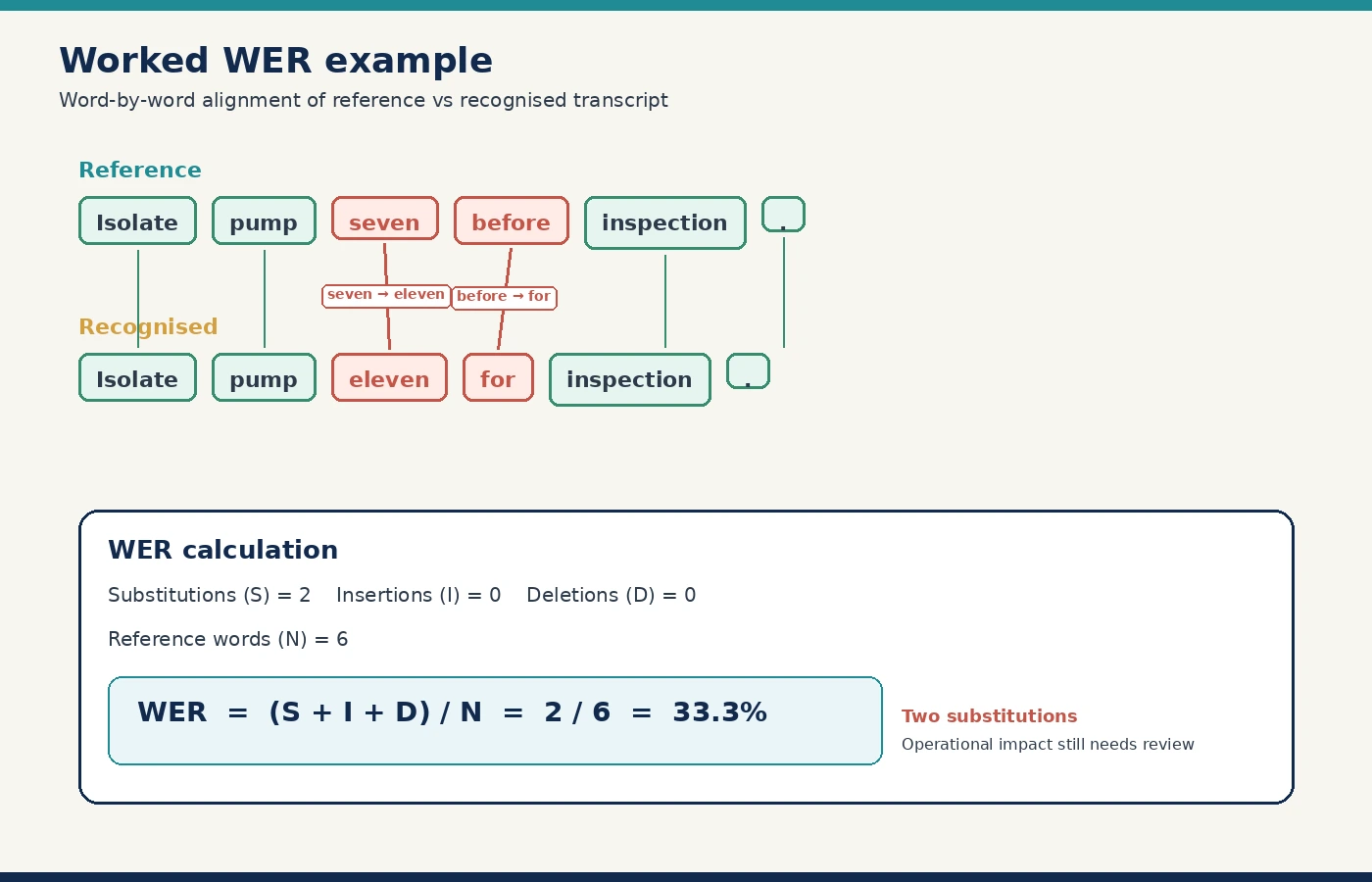
A worked WER example
Reference: “Isolate pump seven before inspection.”
Recognised: “Isolate pump eleven for inspection.”
There are two substitutions: “seven” becomes “eleven” and “before” becomes “for”. With six reference words, WER is 2 ÷ 6, or 33.3%. More importantly, one error changes the asset and the other changes the instruction. A safety-related application should label these as critical semantic errors, not merely two ordinary substitutions.
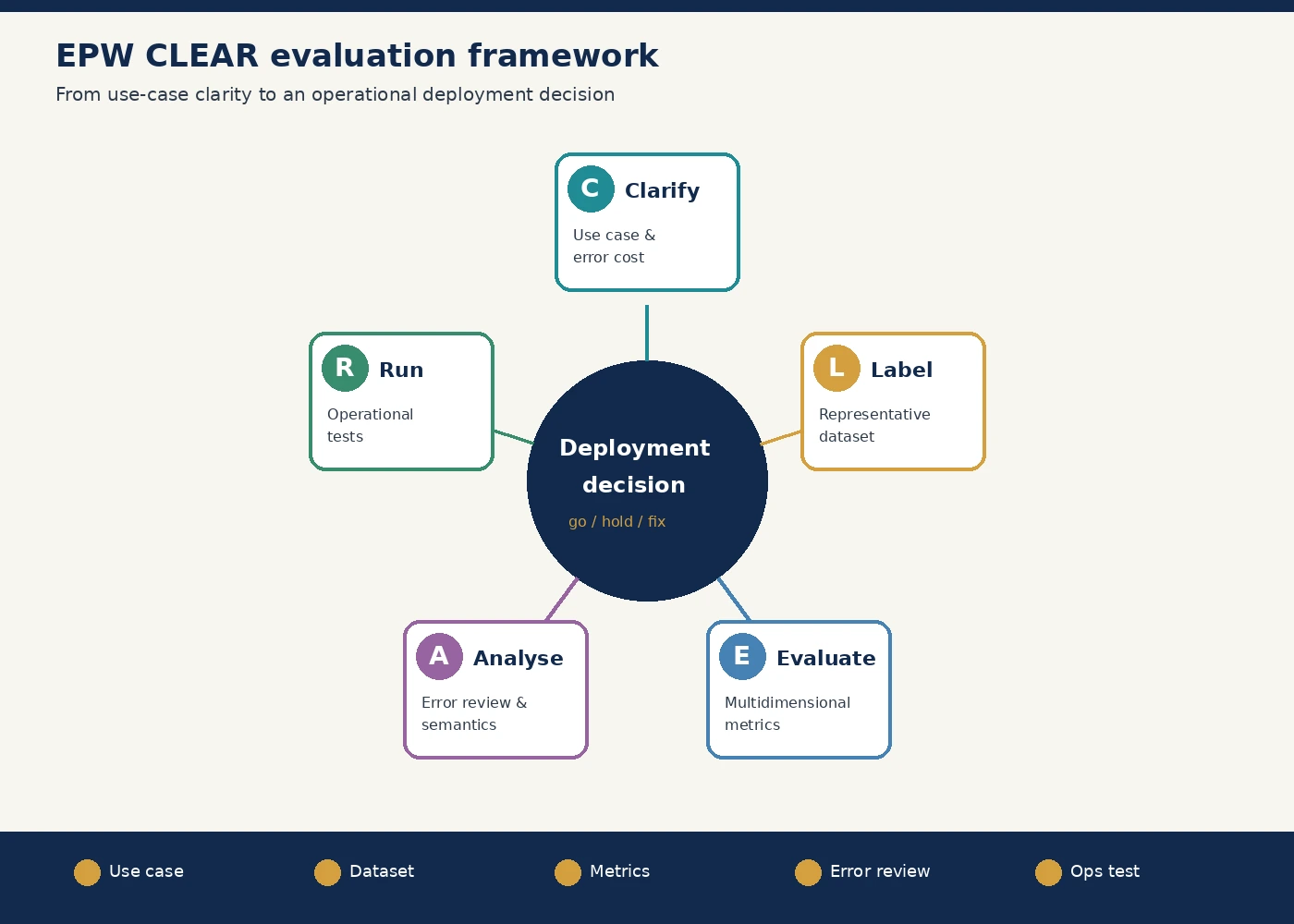
The EPW CLEAR evaluation framework
C — Clarify the use case and error cost
List the actions that follow a transcript or voice command. Define unacceptable errors, such as wrong numbers, negation, named entities or safety terms. Specify whether a human reviews the output and how quickly correction must occur. This converts “accuracy” into risk-aware acceptance criteria.
L — Label a representative test set
Build an evaluation set from the conditions the service will actually encounter: languages, accents, speaking rates, microphones, codecs, room acoustics, background noise, overlap and domain vocabulary. Keep speakers and recordings separate from training data. Create transcription rules for punctuation, hesitations, numbers, abbreviations and partial words, then measure annotator agreement.
Public data can support development, but it does not replace local testing. Mozilla’s Common Voice initiative exists to broaden representation across languages and communities; any external corpus still needs a documented fit assessment for the target population and acoustic environment.
E — Evaluate multiple dimensions
| Dimension | Measures | Why it matters |
|---|---|---|
| Transcript accuracy | WER, character error rate, error type | Shows edit distance and where mistakes arise |
| Critical content | Named-entity recall, number accuracy, negation errors, keyword recall | Weights terms that drive the task or risk |
| Speaker handling | Diarisation error, speaker-attributed WER | Tests who said what in multi-speaker audio |
| Latency | Time to first partial result, time to final result, real-time factor, tail latency | Determines whether interaction feels or remains operationally usable |
| Robustness | Performance by noise, accent, device, language and signal quality | Exposes averages that hide weak conditions |
| Reliability | Failure rate, empty output, retry rate, calibration or confidence quality | Captures behaviour beyond successful requests |
Report confidence intervals where sample size permits and retain the number of speakers and recordings behind every slice. A 5% WER calculated from a handful of clean clips is not comparable with the same value across thousands of varied conversations.
A — Analyse errors, not just scores
Create an error taxonomy: acoustic confusion, vocabulary gap, segmentation, speaker overlap, diarisation, punctuation, hallucinated text, number formatting and downstream post-processing. Review high-impact examples with domain specialists. Separate errors caused by ASR from errors introduced after transcription.
Compare each candidate with a meaningful baseline under identical normalisation rules. If one system improves average WER but doubles latency or performs worse for a key accent group, the trade-off must be explicit.
R — Run realistic operational tests
Test streaming behaviour, concurrency, network interruption, long files, silence, sudden noise and unsupported formats. Measure median and tail latency; users experience the slow cases, not only the average. Validate edge, cloud or hybrid deployment against bandwidth, hardware, cost and privacy constraints.
For sensitive recordings, minimise collection, define retention and access, encrypt data in transit and at rest, and keep an auditable record of model and configuration versions. Speaker identification and voice biometrics require additional risk and legal review.
A practical test matrix
Do not create one undifferentiated test set. Use a matrix that combines the conditions most likely to interact:
- Speaker: accent, language, age range, speaking rate and relevant speech variation.
- Environment: quiet office, vehicle, plant floor, meeting room or outdoor location.
- Channel: headset, mobile handset, conference microphone, telephone codec or embedded device.
- Conversation: read speech, spontaneous speech, command, dialogue, overlap and interruption.
- Content: general vocabulary, product names, locations, personal names, numbers and domain terminology.
Prioritise high-risk and high-volume combinations. For a maintenance assistant, that might mean accented speech through protective equipment beside running machinery, with asset identifiers and measurements. For a meeting service, it might mean overlapping speakers, distant microphones and project names.
Choosing an acceptance threshold
There is no universal acceptable WER. Set thresholds from task performance and risk. Begin with a pilot: measure how transcription errors change human correction time, command completion, search success or downstream extraction. Then define a minimum standard for overall performance and separate guardrails for critical terms and population slices.
A release rule might require: no regression against the current system; critical-number accuracy above an agreed threshold; bounded latency at the 95th percentile; no material performance gap across priority accents; and successful fallback when confidence is low. These are examples, not generic targets—the values must be derived from the application.
Speech-recognition evaluation checklist
- Is the operational task and user group explicit?
- Are training, tuning and test speakers separated?
- Do test recordings reproduce real devices and environments?
- Are transcript-normalisation rules documented and applied equally?
- Are WER, critical-term accuracy, latency and failure rate all reported?
- Are results sliced by relevant language, accent, noise and channel?
- Have high-impact errors been reviewed by domain specialists?
- Are human review and low-confidence fallbacks defined?
- Are consent, retention, access and deletion controls documented?
- Can the deployed model, decoder, vocabulary and configuration be reproduced?
A four-phase pilot runbook
First, freeze a representative test set and scoring policy before comparing systems. Keep a hidden final subset so repeated tuning does not gradually optimise to the evaluation material. Second, run every candidate with the same audio, transcript normalisation, vocabulary support and computing conditions. Save raw outputs as well as post-processed transcripts.
Third, conduct a limited operational pilot with human review. Log low-confidence cases, correction time, abandoned interactions, retries and downstream task outcomes. Ask reviewers to label why an error mattered rather than merely whether a word differed. This turns anecdotal complaints into an actionable error backlog.
Fourth, make a release decision against the acceptance criteria and document residual risks. If the system proceeds, retain a regression suite containing critical examples and new failure modes. Monitor input duration, signal quality, language mix, confidence, latency and correction patterns. A rising share of noisy or unfamiliar audio may require data collection or routing changes before model retraining. A good pilot does not simply choose a model; it creates the measurement process needed to keep the service reliable.
Build reliable speech systems, not benchmark winners
EPW’s Speech Recognition and Audio Processing with Deep Learning course covers audio preparation, spectral features, convolutional and transformer models, CTC, decoding, WER, diarisation, multilingual adaptation and responsible deployment. It complements EPW’s broader explanation of the benefits of AI and machine learning for organisations.
The most reliable evaluation is representative, multidimensional and tied to a decision. Use WER, but do not stop there. Test the words that matter, the people and environments the system will encounter, the latency users experience and the failures that operations must absorb. That is how a promising model becomes a dependable speech service.