

AI-generated illustration created to represent the article’s subject. It does not depict an actual EPW course, trainer, participant, client, event or venue.
An AI predictive maintenance process uses asset condition, operating context and maintenance history to estimate abnormal behaviour, failure risk or remaining useful life—and then connects that evidence to a controlled maintenance action. The model is only one stage. Value appears when the alert reaches the right planner, at the right lead time, with enough evidence to create an appropriate work order.
Many pilots stop at a dashboard. They detect anomalies but do not define failure modes, planning rules, spare-parts constraints or feedback from completed work. The result is alert fatigue rather than reliability. This guide presents an end-to-end process from asset selection to work-order learning.
Predictive maintenance is a decision system
Reactive maintenance acts after failure. Preventive maintenance performs work at scheduled intervals. Condition-based maintenance responds to measured condition. Predictive maintenance uses condition and operational data to estimate what is likely to happen and when, so work can be timed before unacceptable failure while avoiding unnecessary intervention.
The US Department of Energy’s Operations & Maintenance Best Practices Guide describes predictive maintenance as a data- and trend-oriented programme rather than a single technology. Techniques may include vibration analysis, thermography, oil analysis, ultrasound and electrical monitoring. AI can combine or interpret such signals, but it does not replace the engineering understanding behind them.
Modern systems may draw on IoT sensors, work orders, maintenance records, operating data and environmental conditions. Official asset-management guidance from IBM similarly emphasises that predictive maintenance combines these sources to identify developing issues. The key word is combine: a sensor pattern without asset identity, load, maintenance state and failure consequence can be operationally meaningless.
Choose the prediction target before the algorithm
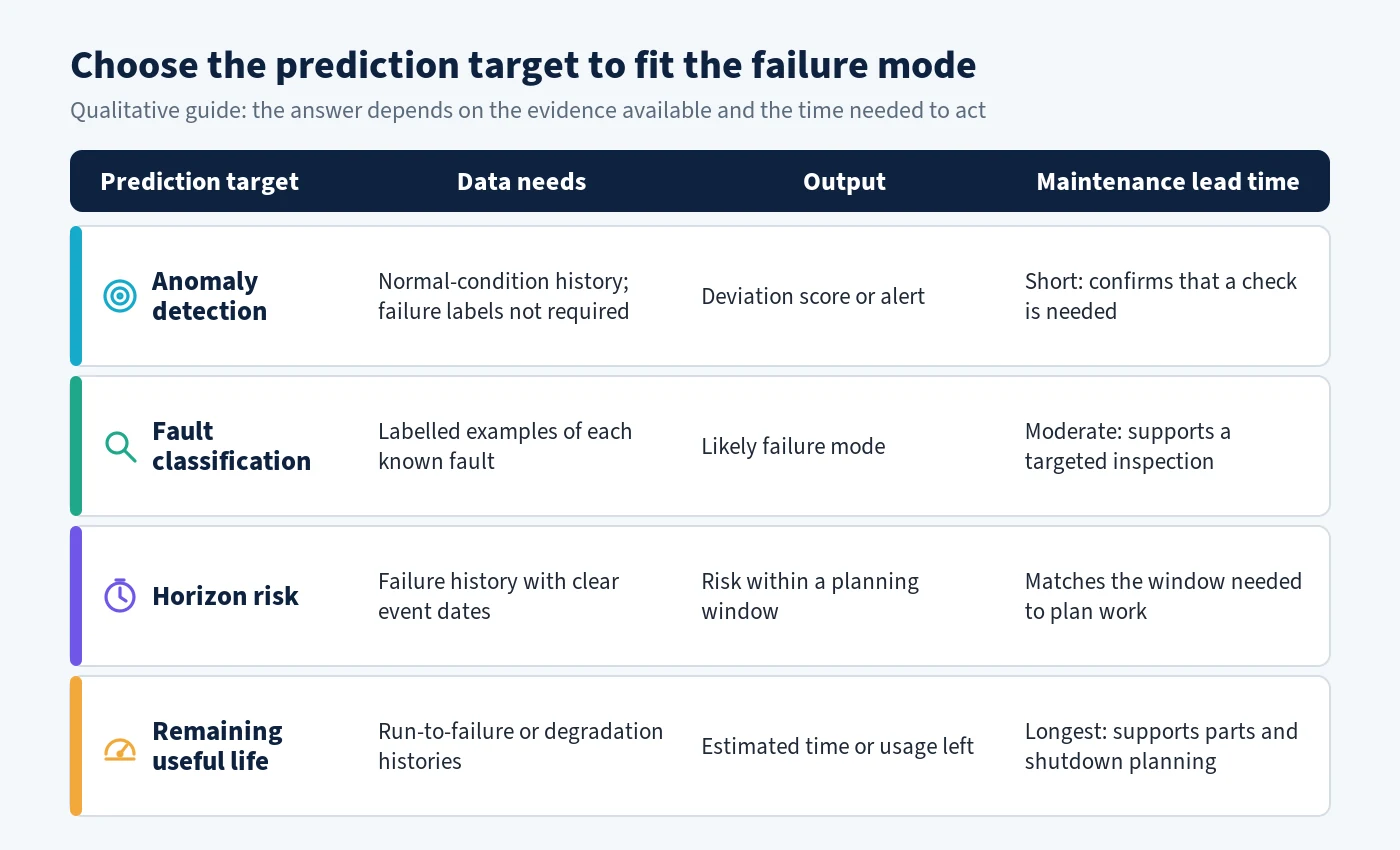
“Predict failure” can describe at least four different tasks:
| Task | Output | Useful when | Main limitation |
|---|---|---|---|
| Anomaly detection | Deviation score or alert | Failure labels are scarce | An abnormal pattern may not identify a fault |
| Fault classification | Probability of a known failure mode | Distinct labelled faults exist | Unknown faults may be missed |
| Risk within a horizon | Probability of failure in 7, 30 or 90 days | Planning needs a defined lead time | Horizon and censoring must be handled correctly |
| Remaining useful life | Time or usage until a threshold | Degradation histories are available | Uncertainty can widen sharply outside known regimes |
The output must match the maintenance decision. A planner who needs three weeks to obtain a bearing cannot use a warning that arrives two hours before failure. Conversely, an early alert with no stable diagnostic evidence may trigger wasteful inspection. Define the actionable window, not merely the most convenient label.
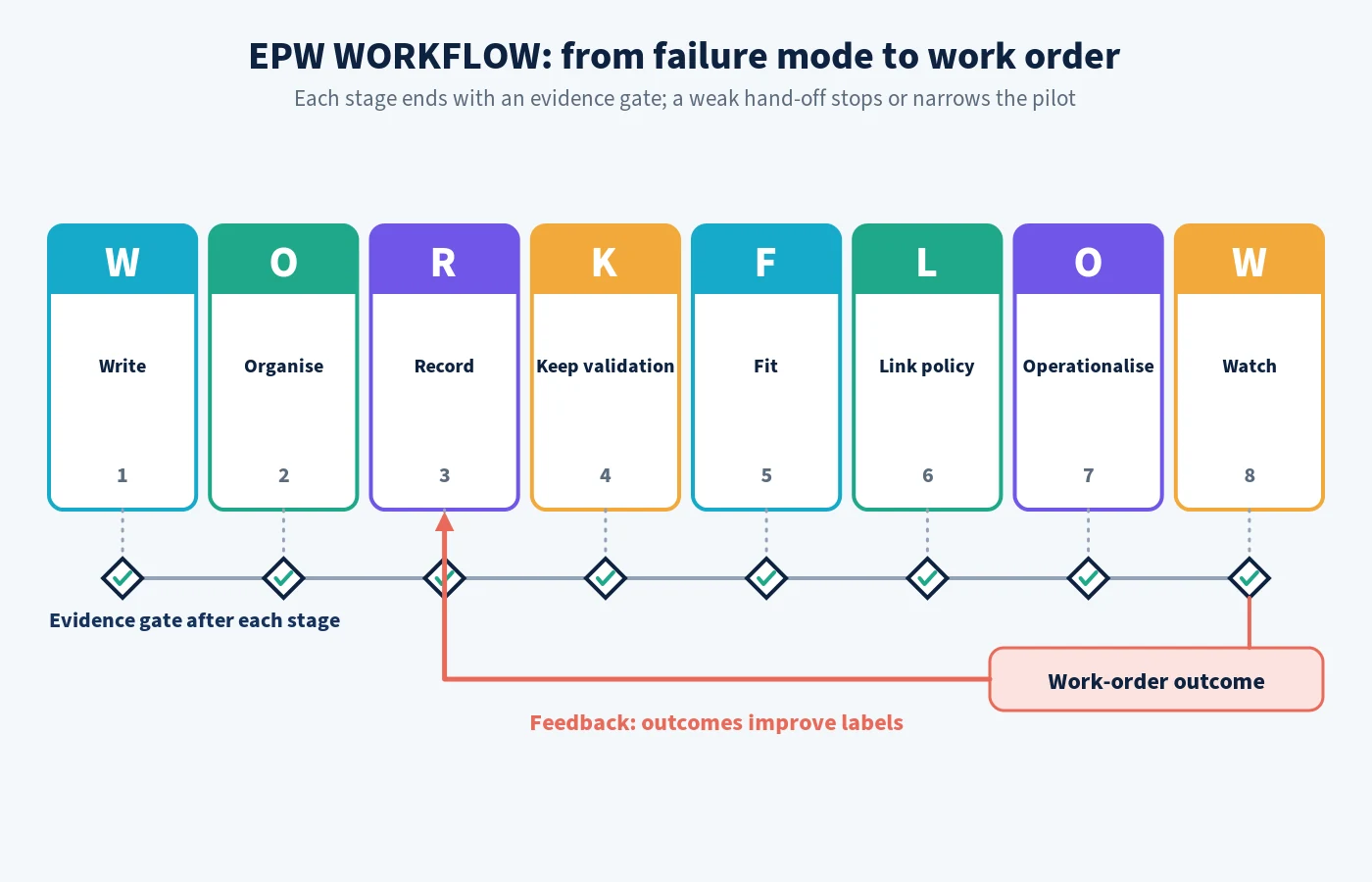
The eight-stage EPW WORKFLOW process
WORKFLOW provides a practical chain from failure mode to work order. Each stage has an evidence gate; a weak hand-off should stop or narrow the pilot.
W — Write the failure mode and action
Select a specific asset–failure pair, not an entire plant. Record the failure mechanism, consequence, current detection method, intervention options and minimum lead time. Use maintenance and operations expertise to distinguish a detectable degradation pattern from a sudden random failure that sensors cannot forecast.
Set a baseline: current unplanned downtime, failure frequency, inspection cost, emergency work, false alarms and production loss. Without a baseline, improvement cannot be demonstrated.
O — Organise asset identity and data
Link sensor streams to a consistent asset hierarchy, component, location and timestamp. Align condition data with operating state, load, speed, product, ambient conditions and maintenance events. Check sampling rate, units, calibration, missing periods and clock drift. A model may otherwise learn a sensor replacement or shift pattern instead of degradation.
Map data ownership and retention. Limit personal or commercially sensitive information, secure connected devices and document who may see raw signals, scores and maintenance outcomes.
R — Record labels and evidence quality
Translate work-order text and technician findings into defined failure labels. “Motor issue” is rarely precise enough. Capture whether a component was inspected, what was found, whether the alert was confirmed and which work was completed. Include censored cases—assets that have not failed by the end of observation—where the chosen method requires them.
Review label leakage. A feature created after a failure, such as an emergency work-order code, cannot be used to predict that failure beforehand.
K — Keep validation faithful to time and assets
Split data in the order it would be encountered in operation. Randomly mixing windows from the same asset across training and test sets can make results look excellent because adjacent signals are nearly identical. Hold out later periods, and where appropriate entire assets or sites, to test generalisation.
Preserve the natural class balance. Report performance by failure mode, asset class and operating regime. A model that recognises one frequent fault may still miss rare, high-consequence events.
F — Fit, calibrate and challenge the model
Begin with rules and simple statistical baselines. Compare them with anomaly detectors, tree-based models, survival models, sequence models or ensembles only when complexity adds reliable value. Evaluate precision and recall at the operating threshold, warning lead time, calibration and alerts per asset-month. Accuracy alone is misleading when failures are rare.
Challenge the model with sensor dropout, regime changes, post-maintenance behaviour and equipment outside the training range. NIST’s AI Risk Management Framework stresses testing before deployment and regular assessment in operation. For maintenance, that means model checks must sit alongside engineering safeguards, change control and human accountability.
L — Link scores to maintenance policy
Convert model output into a tiered response. A low-level deviation may trigger continued observation; a persistent, corroborated pattern may request inspection; a high-risk pattern tied to a known failure mode may enter planning review. Define suppression, repeat-alert and reset rules so one developing event does not create dozens of tickets.
The threshold should reflect consequence, lead time, intervention cost and capacity. Calibrate it on expected operational loss, not the model’s preferred default. For safety-critical equipment, the AI alert should complement rather than silently override established protection and inspection requirements.
O — Operationalise the work-order hand-off
Integrate the alert with the enterprise asset management or computerised maintenance management system. Provide asset ID, probable failure mode, confidence or severity, signal evidence, first detection time, trend, recommended diagnostic check and required-by date. Keep approval with an authorised planner unless a narrowly governed automation rule has been validated.
A work order must also consider production windows, permits, technician competence, parts and tools. Predictive evidence that cannot be scheduled is not yet a maintenance outcome.
W — Watch outcomes and learn
Close the loop after inspection or repair. Record confirmed fault, fault-not-found, component condition, work performed, parts used, downtime and whether the intervention was timely. Monitor missed failures, false alerts, lead time, emergency-work share, availability, maintenance cost and avoided loss using agreed definitions.
Watch data quality, feature distributions, score distributions, calibration and alert volume. Trigger review after sensor changes, component redesign, operating-regime shifts or maintenance-policy changes. Version the data, model, threshold and workflow so decisions remain traceable.
Worked example: pump-bearing degradation
Consider a fleet of process pumps where bearing wear sometimes develops over several weeks. The current programme uses monthly routes and reactive repair. The team chooses one failure mode—inner-race bearing degradation—and defines the decision: request a diagnostic inspection at least ten operating days before functional failure.
Vibration, temperature and motor current are linked to pump ID, bearing type, speed, flow and maintenance history. Engineers inspect sampling quality and discover that vibration varies strongly with speed. Instead of treating high vibration as failure, features are conditioned on the operating regime.
Technician reports are reviewed to distinguish confirmed bearing damage from imbalance, cavitation and alignment faults. Historical data is split by time, with several pumps held out. A simple trend rule is retained as the baseline. Candidate models are compared on confirmed-warning precision, recall, median and lower-quartile lead time, alerts per pump-month and calibration.
The chosen policy requires a persistent score across several windows plus corroborating evidence from at least two signal families. A moderate alert asks a reliability engineer to review the trend. A validated high alert creates a draft inspection request in the maintenance system containing the asset, suspected failure mode, evidence and required-by date. A planner confirms priority, parts and production access before the work order is released.
After inspection, the technician records the actual condition. That result becomes feedback, not an automatic ground truth: a “fault not found” may mean a false alert, an inaccessible component or an inspection that was too early. Monthly review examines missed failures, alert burden, useful lead time, downtime and cost against the original baseline.
Metrics that connect model quality to maintenance value
| Layer | Example measures | Question answered |
|---|---|---|
| Data | Coverage, missingness, timestamp alignment, sensor health | Can the signal be trusted? |
| Model | Precision, recall, calibration, false alerts per asset-month | Does the model distinguish useful risk? |
| Timing | Warning lead-time distribution, late and premature alerts | Is there enough time to act? |
| Workflow | Review time, work-order acceptance, inspection completion | Does evidence reach execution? |
| Reliability | Unplanned failures, availability, repeat faults | Did asset performance improve? |
| Economics | Emergency cost, unnecessary work, avoided loss, programme cost | Is the process worth sustaining? |
Avoid claiming savings from generic industry figures. Build a site-specific business case using attributable outcomes, uncertainty ranges and the full cost of sensors, connectivity, data engineering, model operation, integration and changed maintenance work.
Common failure modes of predictive-maintenance programmes
- Selecting assets by data availability alone. A well-instrumented, low-consequence asset may offer little value.
- Using weak work-order text as unquestioned truth. Ambiguous labels train ambiguous models.
- Leaking future information into validation. Random windows and post-event codes exaggerate performance.
- Optimising accuracy for rare failures. A model can be highly accurate by predicting no failures.
- Creating alerts without response ownership. Unowned alerts become dashboard noise.
- Automating work orders before the policy is stable. False positives can consume scarce labour and parts.
- Ignoring post-maintenance resets. Model baselines may become invalid after component replacement.
- Measuring avoided failure as certainty. Counterfactual savings require cautious attribution.
Predictive-maintenance readiness checklist
- Select a detectable failure mode with material consequence and an actionable lead time.
- Document the current maintenance baseline and decision pathway.
- Connect sensor, operating, asset and work-order data through stable identifiers.
- Audit sampling, calibration, missing data, timestamps and maintenance-state changes.
- Define labels with engineering and technician input.
- Use time- and asset-faithful validation with a simple baseline.
- Measure alert burden, calibration and lead time—not accuracy alone.
- Set tiered action, suppression, escalation and safe-fallback rules.
- Design the planner’s evidence package and maintenance-system hand-off.
- Capture inspection outcomes and review drift, reliability and economics.
Building AI predictive-maintenance capability
Successful programmes need reliability engineering, data engineering, machine learning, maintenance planning and change management. EPW’s AI Driven Predictive Maintenance and Asset Management course covers maintenance strategies, sensors and condition data, machine-learning methods, performance measures, integration, business cases and implementation planning.
For the wider decision context, EPW’s article on the benefits of AI and machine learning for organisations explains why model metrics must be linked to operational outcomes and accountable human decisions.
Conclusion
An AI predictive maintenance process succeeds when it changes maintenance at the right time. Define the failure mode and action, organise trustworthy asset data, create defensible labels, validate across time and assets, calibrate the model, set an explicit response policy, integrate the work-order hand-off and learn from completed work.
The WORKFLOW process keeps those stages connected. It turns an anomaly score into decision evidence while preserving engineering judgement and maintenance control. That is the difference between a promising model and a sustainable reliability capability.